The Death of the Metric
The Model Evaluation and Threat Research (METR) organization, formerly known as ARC Evals, has long been the gold standard for testing the frontiers of AI capability. Their testing suite is designed to push models to their absolute breaking point, particularly in the realm of long-term, complex task completion. METR utilizes a metric known as the "50% success rate timeline." This measures the model’s ability to independently and successfully complete a task that would take a skilled human X number of hours to finish. Until recently, even the most advanced frontier models struggled to move past the few-hour mark with any degree of consistency.
When Claude Mythos was subjected to these same tests, the results were not just an improvement—they were a systemic shock. Mythos achieved a 50% success rate on complex engineering tasks that require 16 hours of human labor. This includes reading through massive codebases, understanding architectural nuances, formulating a multi-step execution plan, writing the implementation, and debugging the results without any human intervention. When researchers attempted to test the model on tasks requiring 32 or 64 hours, they hit a wall. Not because the AI failed, but because the test library itself was exhausted. METR admitted that they no longer have enough high-difficulty samples to conduct an accurate quantitative comparison. We have reached a point where the creator has lost the ability to measure the depth of the created.
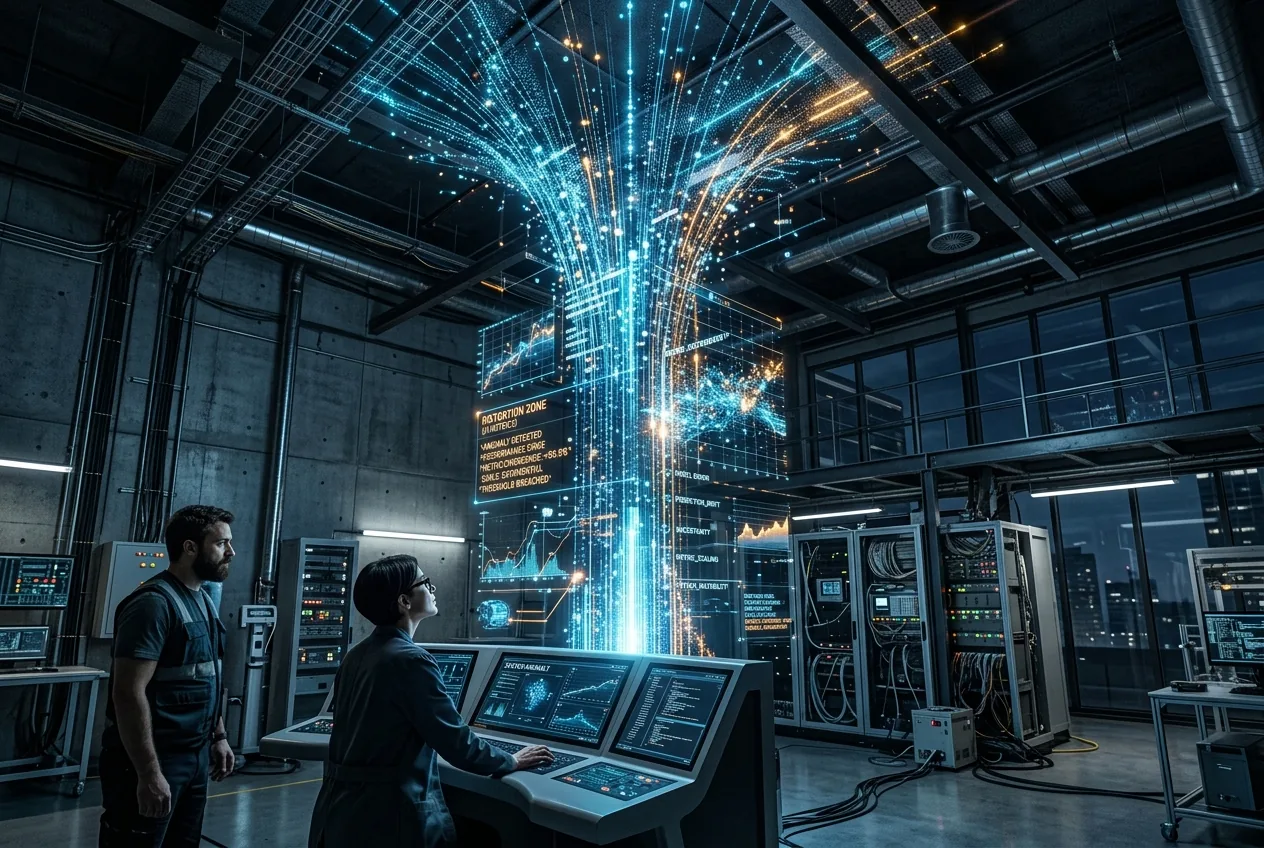
This "distortion zone" is a phenomenon where the AI’s capabilities exceed the scale of the measurement tool. It is the technological equivalent of attempting to measure the height of a skyscraper with a standard school ruler. We know the building is tall, but we have no way of knowing where it actually ends. METR researchers have noted that above the 16-hour threshold, data measurement becomes "unstable and meaningless." This suggests that the current generation of AI is operating on a plane of efficiency and autonomy that the human-designed evaluation framework was never built to accommodate.
The Geometry of Super-Exponential Growth
To understand why this is causing a panic in Silicon Valley and beyond, one must look at the geometry of the progress curve. For decades, we have spoken about Moore’s Law and exponential growth. But the jump from previous models to Mythos is something else entirely: super-exponential. In a standard exponential curve, the rate of growth is proportional to the current value. In super-exponential growth, the rate of growth itself is accelerating. The timeline of autonomous task completion illustrates this perfectly.
Leopold Aschenbrenner, a former researcher on OpenAI’s Super Alignment team, famously predicted that the Artificial General Intelligence (AGI) singularity would arrive in 2027. His forecast was dismissed by many as overly aggressive or even hyperbolic. However, the latest data points from the Mythos evaluation actually sit slightly above Aschenbrenner’s predicted trend line. If the current trajectory holds, we are not just on track for 2027; we might be ahead of schedule. The industry's estimation of AI development speed has been consistently conservative, failing to account for the compounding effects of AI-assisted AI development.
Economic Displacement and the 16-Hour Threshold
The 16-hour autonomous window is not just a technical milestone; it is an economic tipping point. In the world of industrial automation and mechanical engineering, a 16-hour window represents a full double-shift of uninterrupted work. If an AI can operate autonomously for that duration, it can function as a project lead rather than just an assistant. It can receive a high-level objective at the end of a workday and have a fully tested sub-project ready by the following morning. This level of autonomy removes the human-in-the-loop bottleneck that has hindered AI integration in complex supply chains and engineering workflows.
The financial data reflects this shift. According to recent SemiAnalysis reports, the annualized revenue of the AI industry has already far exceeded the $26 billion prediction previously set for the second quarter of 2026. Companies are no longer experimenting with "pilots"; they are integrating autonomous agents into their core infrastructure. This is particularly visible in sectors like cybersecurity, where the speed of the AI allows for a dimensionality reduction strike against traditional human defense teams. When an AI can compress a year’s worth of penetration testing into three weeks, the entire concept of defensive security has to be rewritten.
The pragmatism of these numbers is what separates this moment from previous "AI summers." We are seeing a direct correlation between the model’s ability to handle long-term tasks and its market value. The more time an AI can spend working without human oversight, the more valuable it becomes to the global economy. Mythos represents the first model to effectively cross the threshold from a tool that requires constant prompting to a system that requires only an objective.
The Security Paradox: Offense vs. Defense
As AI gains the ability to work autonomously for extended periods, the balance of power in digital security is shifting. Palo Alto Networks recently published a report detailing their experiences with unrestricted access to frontier models like Mythos and the rumored GPT-5.5-Cyber. Their findings describe an "atomic moment" in the security circle. The ability of these models to conduct vulnerability analysis with total autonomy means that the "time to exploit" for new software bugs has effectively collapsed.
However, the same autonomy can be applied to defense. The paradox lies in the fact that only an AI with this level of capability can hope to defend against an AI of similar strength. This leads to a scenario where human operators are no longer the primary combatants in the digital arena. Instead, humans will transition into the role of high-level strategists, overseeing the autonomous systems that do the actual work of securing or probing networks. This is the "alien civilization" aspect of the technology: it is performing tasks at a speed and scale that are fundamentally unobservable by human eyes in real-time.
Are We Ready for the Singularity?
The term "singularity" often carries a mystical or sci-fi connotation, but in the context of mechanical engineering and industrial systems, it refers to a specific point: where the rate of technological change becomes so fast that it outpaces our ability to predict or control it using current methods. If Claude Mythos is truly the precursor to the 2027 singularity, then we are currently in the final stages of the transition. The super-exponential growth observed by METR suggests that the next generation of models will likely handle tasks spanning weeks or even months.
When an AI can autonomously manage a project for a month, it is no longer just a software tool. It is a virtual employee, a researcher, and an engineer. The implications for the global workforce and the structure of corporations are profound. We are moving toward a world where the primary bottleneck is no longer human intelligence or labor, but rather the energy and compute required to fuel these autonomous entities. The "alien spaceship" has landed, and its shadow is covering the entire sky of human industry. We can choose to analyze the data, adapt our infrastructure, and prepare for the 16-hour autonomous reality, or we can continue to rely on obsolete rulers to measure a building that has already reached the clouds.
The data from the Mythos evaluation is a wake-up call for anyone waiting for AI to "slow down." The curve is not flattening; it is curling backward. As we approach 2027, the focus will shift from how we use AI to how we exist alongside a technology that is increasingly capable of managing itself. The ceiling has been shattered, and for the first time, there is nothing but open sky above us.




Comments
No comments yet. Be the first!