The landscape of the private aerospace industry is about to undergo its most significant transformation since the dawn of the Space Age. SpaceX, the cornerstone of modern orbital logistics and satellite telecommunications, has reportedly accelerated its timeline for an initial public offering (IPO), targeting a debut on the Nasdaq exchange for June 12. This move, which comes amid a flurry of regulatory filings and internal shareholder votes, positions the company at a staggering valuation that could exceed $2 trillion, a figure that would instantly place it among the most valuable corporate entities on the planet.
For observers of industrial automation and mechanical engineering, this IPO is not merely a financial event; it is a validation of a decade-long gamble on reusable rocket architecture and vertical integration. The acceleration of the listing, moving up from previous estimates of a late-summer debut, suggests a high level of confidence in the company’s current revenue streams—most notably the Starlink satellite constellation—and the developmental trajectory of the Starship launch system. By selecting the ticker symbol "SPCX" and setting a roadshow commencement for June 4, SpaceX is signaling that it is ready to move from a venture-backed disruptor to a public-market infrastructure titan.
The Mechanics of the Five-for-One Stock Split
Central to the IPO strategy is a newly approved 5-for-1 stock split, a tactical move designed to lower the barrier to entry for a broader base of investors. Prior to this split, SpaceX shares were trading in private markets at prices that made individual acquisition difficult for retail participants. Following the split, the per-share price is expected to hover around $105.32. From a mechanical engineering standpoint, this split reflects the company’s desire for liquidity without diluting the core vision of its leadership. It allows for a more granular distribution of equity, which is essential for a company that relies heavily on stock-based compensation to attract top-tier engineering talent.
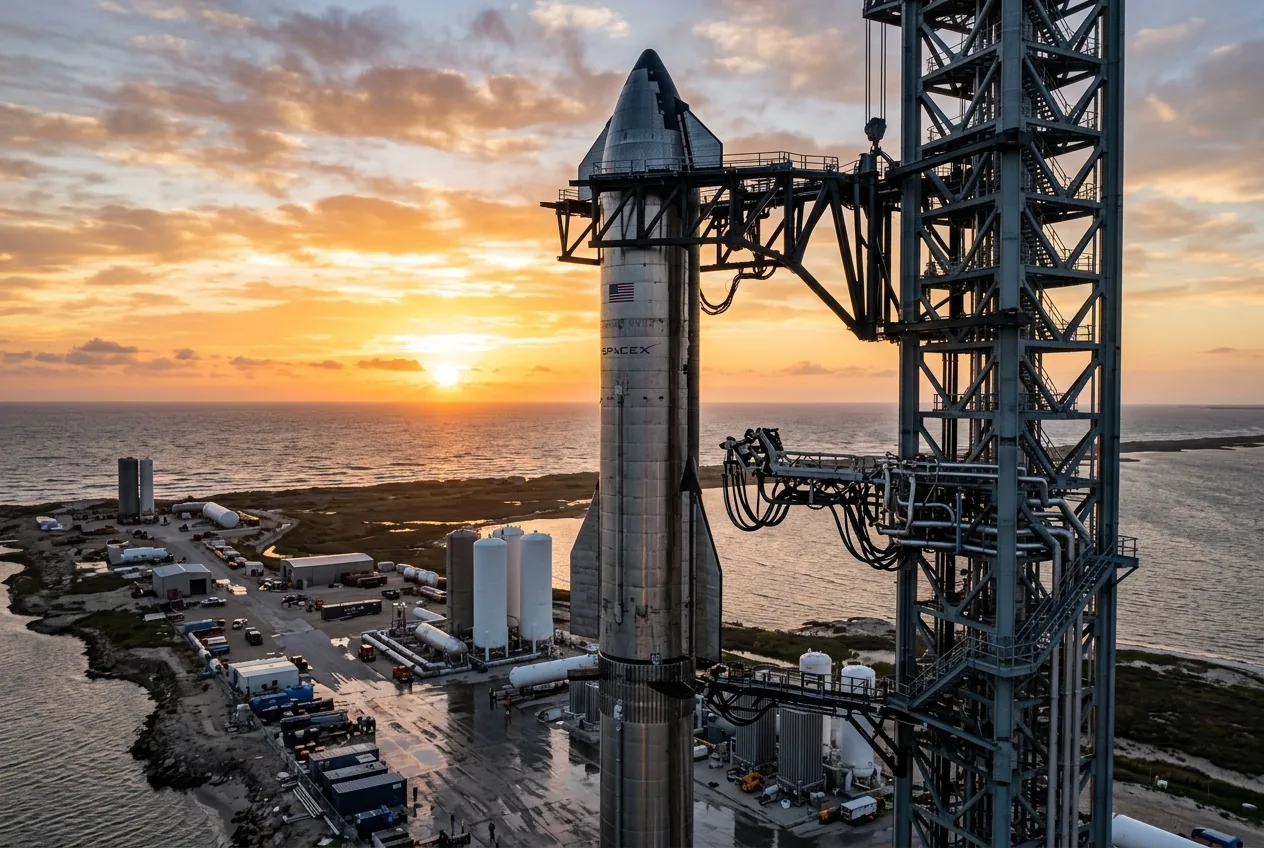
The pricing of the IPO is tentatively set for June 11, just 24 hours before the opening bell on the Nasdaq. Reports indicate that the company is seeking to raise as much as $75 billion in new capital, which would represent the largest IPO in financial history. This capital injection is likely earmarked for the aggressive scaling of the Starship manufacturing facility in Boca Chica, Texas, known as Starbase. The facility functions more like a high-speed automotive assembly line than a traditional aerospace hangar, utilizing advanced robotics and automated welding stations to produce stainless steel spacecraft at a cadence previously thought impossible in the industry.
How Starlink Stability Drives Investor Confidence
The primary driver behind the $2 trillion valuation is not the speculative promise of Martian colonization, but the cold, hard data of the Starlink network. As of mid-2024, Starlink has deployed over 6,000 satellites into low-Earth orbit (LEO), providing high-speed internet to millions of customers globally. From a supply chain perspective, Starlink has effectively bypassed traditional terrestrial infrastructure, creating a proprietary global utility. The recurring revenue from these subscriptions provides the fiscal floor necessary to support the high-risk, high-reward development of the Starship program.
Investors are increasingly viewing SpaceX as a logistics and telecommunications hybrid rather than a pure-play aerospace firm. The company’s ability to launch its own satellites at internal cost—utilizing the Falcon 9’s flight-proven boosters—gives it a margin advantage that no competitor, including Amazon’s Project Kuiper or legacy providers like Eutelsat, can currently match. The technical reliability of the Falcon 9, which recently achieved a milestone of over 300 successful launches and landings, has turned orbital delivery into a routine industrial process, removing the "risk premium" that traditionally suppressed aerospace valuations.
The Synergy Between Grok and SpaceX Access
In a move that blends financial engineering with ecosystem loyalty, reports have emerged that Elon Musk plans to tie SpaceX IPO access to Grok subscriptions. Grok, the artificial intelligence model developed by xAI, is currently integrated into the X (formerly Twitter) platform. By potentially offering IPO allocation preferences to those who subscribe to the AI service, Musk is attempting to build a cross-platform moat. While this strategy has raised questions among traditional market analysts, it aligns with a broader trend of leveraging digital communities to drive capital into heavy industry.
Does the No-Sale Pledge Ensure Long-Term Stability?
One of the most significant pieces of news accompanying the IPO announcement is Elon Musk’s public vow that he will not sell any of his SpaceX shares post-listing. In the world of high-stakes finance, the "lock-up period" usually dictates when insiders can liquidate their holdings. By voluntarily committing to a no-sale position, Musk is attempting to mitigate fears of a liquidity vacuum or a sudden drop in share price once the company goes public. This pledge is designed to reassure institutional investors that the leadership remains fully committed to the long-term roadmap, rather than seeking a quick exit at the top of the market.
This commitment is particularly important given the capital-intensive nature of the company’s next phase. The transition from Falcon 9 to Starship involves moving from a 22.5-ton payload capacity to over 100 tons in a fully reusable configuration. The engineering challenges of the Raptor engine—a complex liquid oxygen and methane-fueled power plant—require sustained investment. Musk’s refusal to sell suggests that he views the current $2 trillion valuation as a baseline rather than a ceiling, projecting a future where SpaceX dominates the lunar economy and beyond.
Global Implications for the Aerospace Supply Chain
The public listing of SpaceX will have immediate ripple effects across the global aerospace and defense supply chain. Companies like Boeing and Lockheed Martin, which have historically operated on cost-plus contracts and slower development cycles, will now be measured against a publicly traded SpaceX that operates on a philosophy of rapid iteration and failure-tolerant testing. The influx of $75 billion in capital will allow SpaceX to further vertically integrate, likely acquiring smaller suppliers in the propulsion, avionics, and materials science sectors.
From an engineering standpoint, this could lead to a standardization of aerospace components. Just as the automotive industry standardized parts to reduce costs, a publicly traded SpaceX has the market power to dictate the specifications for everything from thermal protection tiles to high-pressure valves. This "SpaceX standard" could lower the cost of entry for other startups, while simultaneously making it harder for legacy firms to compete on price. The IPO marks the moment where space ceases to be a government-led frontier and becomes a fully realized industrial sector, driven by quarterly earnings, capital expenditures, and market-driven innovation.
As June 12 approaches, the eyes of the technological world are fixed on the Nasdaq. The transition of SpaceX to a public entity is the culmination of twenty years of mechanical refinement and a radical rethink of orbital mechanics. For Noah Brooks and those who track the interface of robotics and heavy industry, the question is no longer whether SpaceX can reach the stars, but how much of the orbital economy it will own once it gets there.




Comments
No comments yet. Be the first!