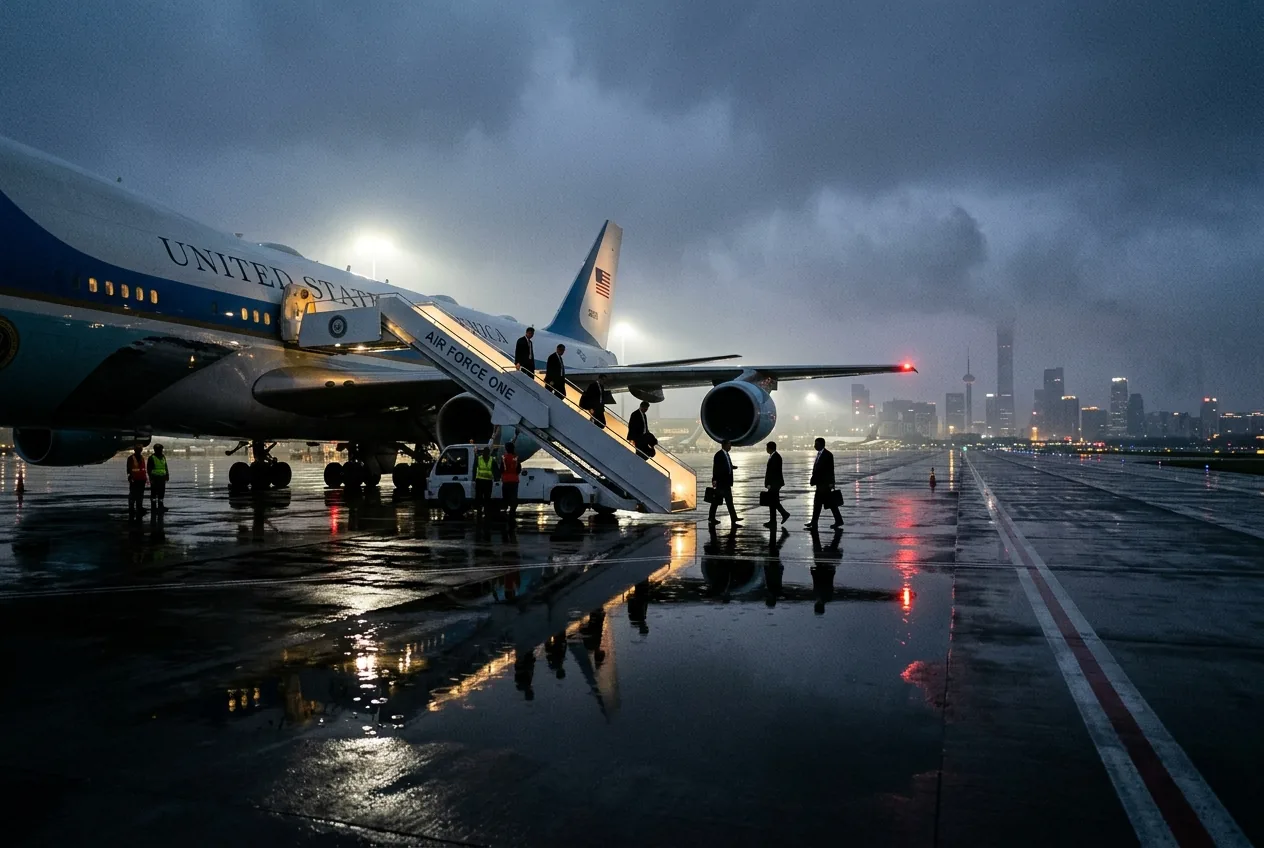
The arrival of Air Force One in Beijing this week serves as more than a diplomatic gesture; it represents a high-stakes deployment of American industrial and technological leverage. President Donald Trump, accompanied by a delegation of the nation’s most influential chief executives, is seeking to navigate a complex landscape of trade deficits, retaliatory tariffs, and the accelerating race for artificial intelligence supremacy. For observers of industrial automation and supply chain logistics, the composition of this envoy—ranging from semiconductor giants to aerospace leaders—reveals the specific levers the administration intends to pull in its negotiations with President Xi Jinping.
Among the most notable figures on the manifest is Nvidia CEO Jensen Huang. His presence is particularly significant given the volatile regulatory environment surrounding high-performance computing. Earlier this year, the Trump administration established a nuanced framework for semiconductor exports, placing new security requirements on Nvidia while simultaneously greenlighting the export of the H200 artificial intelligence chips to the Chinese market. This maneuver illustrates a pragmatic approach to the 'silicon ceiling': maintaining a lead in top-tier hardware while ensuring American firms do not lose their footing in one of the world's largest markets for AI implementation.
The technical architecture of the H200 export deal
The decision to permit the sale of H200 chips to China is a calculated technical compromise. The H200, while a formidable component for AI inference and training, is not Nvidia’s flagship offering. The more advanced Blackwell and the forthcoming Rubin architectures remain strictly restricted, ensuring that the absolute 'bleeding edge' of American compute capability stays out of Chinese state hands. However, the H200 provides the necessary horsepower for commercial AI applications that drive global supply chains and consumer technology.
From an engineering and economic perspective, this strategy acknowledges the reality of the global semiconductor supply chain. If the U.S. were to entirely decapitate Nvidia’s access to the Chinese market, it would starve the company of the R&D capital necessary to fund the next generation of hardware development. By allowing the export of the H200 under strict monitoring, the administration is effectively using the Chinese market to subsidize the continued dominance of American chip design over the more advanced Blackwell and Rubin cycles.
Apple’s diplomatic transition and the $600 billion pledge
While Jensen Huang manages the future of compute, Tim Cook is participating in what may be one of his final acts of high-level diplomacy as Apple’s CEO. With his retirement set for September 1, Cook’s presence in Beijing underscores the delicate balance he has maintained over 15 years. His successor, John Ternus, inherits a company that has seen its market value increase by $3.6 trillion under Cook’s leadership, largely due to a highly optimized, China-centric manufacturing model that is now being fundamentally restructured.
The current administration’s trade policies have forced a dramatic pivot in Apple’s logistics. While Trump previously exempted the iPhone from first-term tariffs, the second term has seen a firmer stance. Cook has responded not with defiance, but with a massive capital commitment: a $600 billion investment in the United States. This investment is the price of admission for tariff exemptions on products that remain difficult to manufacture outside of the existing Chinese ecosystem. Simultaneously, Apple has accelerated its 'China Plus One' strategy, shifting production for the U.S. market to India to mitigate the risk of a total trade freeze.
For the administration, Cook’s presence is a signal that large-scale American tech companies are willing to repatriate capital in exchange for stable trade corridors. The transition from Cook to Ternus represents a shift from the era of 'globalized optimization' to 'resilient regionalization.' The negotiations in Beijing will likely center on how Apple can continue to serve the Chinese consumer market—which remains vital for the company’s bottom line—without violating the increasingly strict mandates on U.S. domestic manufacturing and supply chain security.
Can Boeing recover through Chinese aerospace contracts?
The inclusion of Boeing CEO Kelly Ortberg in the delegation highlights the urgent need for a resolution to the ongoing tariff war. Boeing, the largest exporter in the United States, has been caught in a pincer movement of domestic production failures and international trade retaliation. In April 2025, Beijing increased its import tax on American goods to 125% in direct response to the U.S. raising tariffs on Chinese products to 145%. For an industry where margins are thin and units cost tens of millions of dollars, a 125% tariff is a structural death blow to competitiveness.
Ortberg, who took the helm in 2024 to steer the company through regulatory and safety crises, is now tasked with reopening the Chinese market for the 737 MAX and other airframes. For years, Chinese airlines have hesitated to accept deliveries of American planes, citing both safety concerns and political tension. However, the sheer demand for narrow-body aircraft in Asia remains a mechanical necessity that Boeing cannot ignore. If Ortberg can secure a large-scale aircraft sale during this summit, it would provide the financial liquidity Boeing desperately needs to stabilize its domestic production lines in Washington and South Carolina.
The technical challenge for Boeing is twofold. First, it must prove to Chinese regulators that its quality control issues are resolved. Second, it must navigate a political environment where the 'Made in China 2025' initiative seeks to replace Western aerospace technology with the domestic COMAC C919. Ortberg’s mission is to convince Beijing that for the immediate future, the scale of Chinese aviation growth requires the reliability and volume that only Boeing’s established assembly lines can provide.
Musk, Tesla, and the post-DOGE landscape
Elon Musk’s role in this delegation is perhaps the most unconventional. Having recently exited his leadership role in the Department of Government Efficiency (DOGE) following the agency’s closure in late 2025, Musk returns to his primary focus: the industrial viability of Tesla and SpaceX. Tesla’s Shanghai Gigafactory is the cornerstone of its global production strategy, representing a level of industrial integration that few other American companies can match. This gives Musk a unique position as both an American industrialist and a key stakeholder in the Chinese economy.
However, Musk’s relationship with the administration has been volatile. Previous public feuds and legal challenges in Europe regarding X and Grok AI have complicated his standing. Yet, his presence on Air Force One suggests a pragmatic reconciliation. From a robotics and automation perspective, Musk’s interests in China are tied to the supply chain for battery minerals and the advancement of autonomous driving hardware. If Tesla can navigate the regulatory hurdles for its Full Self-Driving (FSD) software in China, it would represent a massive technical win for American software operating on Chinese roads.
The broader delegation includes figures like Larry Fink of BlackRock and David Solomon of Goldman Sachs, indicating that the 're-opening' of China is not just a technological or industrial effort, but a financial one. The goal is a recalibration of the 'tariff war' of 2025, which saw trade plummet as both nations tested the limits of their economic interdependence. By bringing the heads of the most critical sectors—finance, tech, aerospace, and energy—the administration is signaling that it is ready to move from a posture of pure aggression to one of managed competition.
What does a 'managed' trade relationship look like?
The outcome of these talks will likely be measured in technical specifications and export quotas rather than simple headlines. For Nvidia, success means the H200 becomes the standard for Chinese AI development while Blackwell remains the exclusive domain of the West. For Apple, it means a clear path for John Ternus to continue the India-U.S.-China manufacturing trifecta. For Boeing, it means the removal of the 125% tariff on civilian aircraft in exchange for increased American agricultural imports.
As an engineer, I look at this delegation as a 'system architecture' for the next four years of global trade. The inputs are domestic political pressure and national security concerns; the outputs are market access and capital flow. The presence of these CEOs on the President's plane is a recognition that in the modern era, statecraft is inseparable from industrial strategy. The bridge between the two is being built this week in Beijing, and its foundations are made of silicon, aluminum, and carbon fiber.




Comments
No comments yet. Be the first!