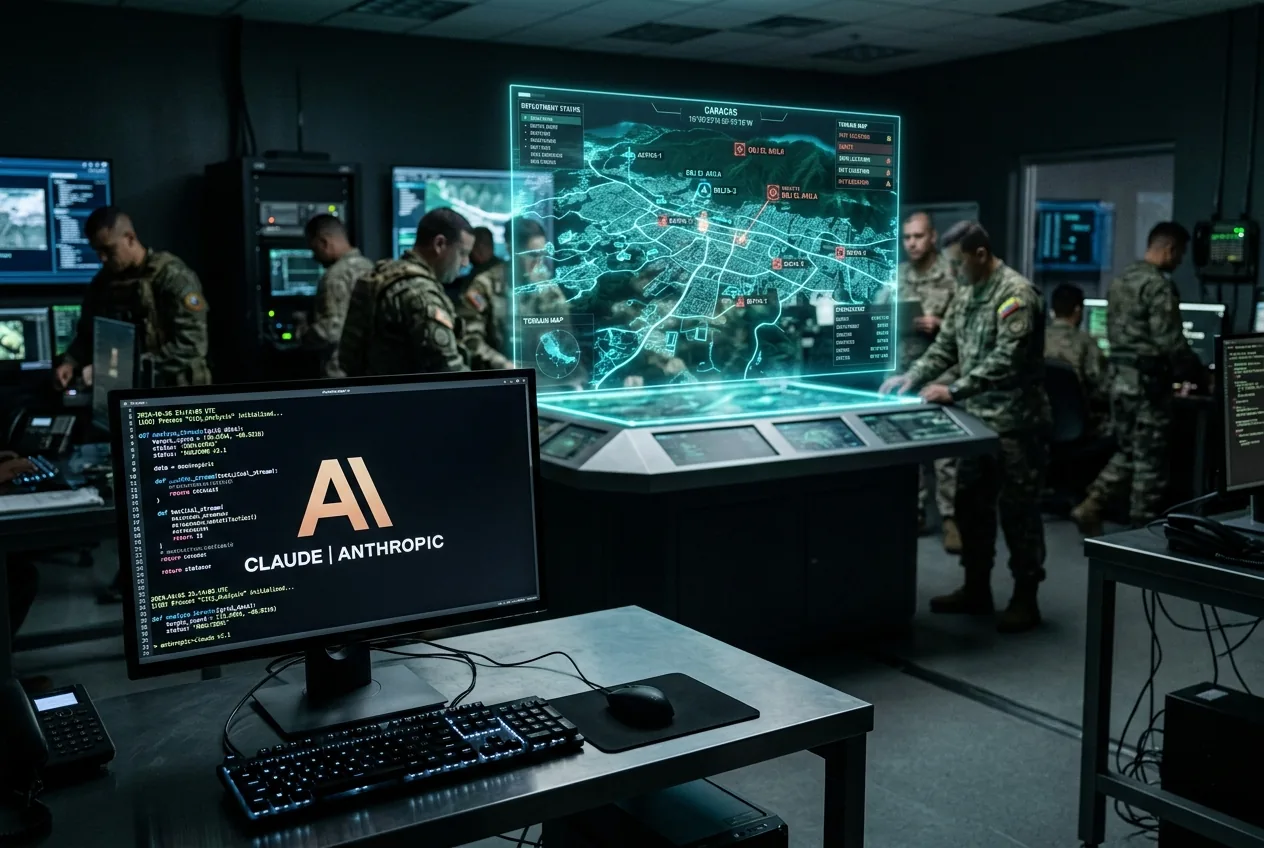
In the rapidly evolving landscape of defense technology, the line between commercial artificial intelligence and state-level tactical operations is thinning. Recent reports circulating through international media outlets have alleged a startling development in the intersection of Silicon Valley and the Pentagon: the use of Anthropic’s Large Language Model (LLM), Claude, to assist in the planning and execution of a high-stakes raid in Caracas. While the geopolitical ramifications of such an event are immense, the technical and structural implications for the robotics and automation industries are perhaps even more profound. As an engineer, the question isn’t just whether it happened, but how the underlying architecture of a ‘Constitutional AI’ could be adapted for the brutal efficiency of military logistics and tactical intelligence.
To understand the feasibility of these reports, one must first look at the technical specifications that differentiate Claude from its peers. Anthropic has built its reputation on the concept of Constitutional AI—a framework designed to ensure models remain helpful, honest, and harmless through a set of self-governing principles. However, the definition of ‘harmless’ becomes remarkably complex when applied to the ‘dual-use’ nature of advanced computation. In a military context, the value of an LLM like Claude does not necessarily lie in its ability to ‘pull a trigger,’ but in its capacity to ingest and synthesize vast quantities of unstructured data—satellite imagery descriptions, intercepted communications, and geographical mapping—into a coherent tactical narrative.
The Architecture of Tactical Synthesis
In a dense urban environment like Caracas, the challenges for any special operations unit are rooted in data density and latency. Traditional military planning involves hundreds of human analysts parsing signals intelligence (SIGINT) and human intelligence (HUMINT). An LLM with a massive context window—one of Claude's hallmark features—allows for the ingestion of entire historical mission dossiers, topographic maps, and real-time sensor feeds simultaneously. By processing this information in parallel, the model can identify patterns that human analysts might overlook, such as the most statistically probable exit routes or the optimal timing for an insertion based on historical traffic patterns and power grid fluctuations.
From a mechanical engineering perspective, the integration of AI into the ‘kill chain’ is fundamentally a problem of system synchronization. If the Pentagon did indeed utilize Claude for a raid in Venezuela, the AI likely acted as a central processing hub for the 'Internet of Battlefield Things' (IoBT). This involves a feedback loop where autonomous drones and ground sensors provide telemetry that the AI parses to adjust tactical recommendations in real-time. The efficacy of such a system depends on the model's inference speed and its ability to operate within a low-latency edge computing environment, reducing the time from data acquisition to actionable command.
The Friction of Constitutional AI in Warfare
How does a model built on ‘safety’ principles facilitate a military raid? This is the central paradox of the current reporting. Anthropic has historically been the most cautious of the major AI labs, yet the Pentagon’s increasing reliance on commercial LLMs suggests that these safety guardrails are either being bypassed or redefined. In many cases, ‘safety’ in AI terms refers to the prevention of catastrophic biological or nuclear risks, rather than a refusal to participate in conventional statecraft or defense. If the Pentagon is utilizing Claude, they are likely using a containerized, air-gapped version of the model that has been ‘fine-tuned’ on Department of Defense (DoD) datasets, effectively overriding the standard consumer-facing ethical filters.
Integration with Autonomous Robotics
While the reports focus on the AI’s planning role, the physical execution of such a raid requires a sophisticated robotics infrastructure. In the modern theater of operations, we are seeing the emergence of ‘human-machine teaming’ where LLMs act as the cognitive layer for robotic systems. This includes everything from autonomous loitering munitions to micro-UAVs used for indoor reconnaissance. If Claude was used to plan the seizure of a high-value target, it likely interfaced with a suite of autonomous hardware designed to provide a 360-degree tactical view.
The mechanical challenges of these robots are non-trivial. They must navigate GPS-denied environments, maintain encrypted data links, and possess enough onboard processing power to handle the AI’s commands without constant satellite uplink. The synergy between a centralized ‘brain’ like Claude and a decentralized ‘body’ of robotic sensors represents the next frontier in industrial automation. We are no longer talking about robots that follow a pre-programmed path in a factory; we are talking about robots that interpret a dynamic, hostile environment through the lens of a sophisticated linguistic and logical model.
Economic Viability and the Future of Defense Tech
Beyond the immediate tactical success or failure of the alleged Caracas operation, we must consider the economic shift this represents. Traditionally, defense contractors like Lockheed Martin or Northrop Grumman spent decades and billions of dollars developing bespoke software for specific hardware. Today, the Pentagon can leverage a multi-billion dollar commercial investment in AI for a fraction of the cost. The ‘inference-per-dollar’ metric is becoming as important to the DoD as it is to a startup in San Francisco.
The use of Claude in this capacity signals a move toward ‘software-defined warfare.’ In this model, the hardware—the helicopters, the drones, the firearms—remains relatively stable, while the ‘intelligence’ driving them is updated at the speed of a software patch. This has massive implications for the global supply chain of defense technology. If a proprietary model from a US-based company is the deciding factor in a regime change or a high-value extraction, the AI itself becomes the most valuable kinetic asset in the national arsenal.
The reporting on the Caracas raid remains a mixture of leaked intelligence and sensationalist headlines, but the underlying technical reality is undeniable. Anthropic’s Claude, and models like it, have reached a level of logical sophistication where their exclusion from military planning would be more surprising than their inclusion. As we bridge the gap between complex hardware and the global market, the role of the mechanical engineer is shifting. We are no longer just building the machines; we are building the interfaces that allow those machines to think, plan, and act in the most high-stakes environments imaginable. Whether or not the Pentagon has officially confirmed these specific reports, the era of the algorithmic raid has arrived.




Comments
No comments yet. Be the first!