Amazon has quietly disbursed the final tranches of its landmark $50 billion commitment to OpenAI, according to regulatory disclosures filed with the U.S. Securities and Exchange Commission. The move formalizes one of the largest corporate capital injections in tech history, securing Amazon an estimated 5 percent equity stake in the San Francisco-based artificial intelligence developer. Beyond the sheer headline figure, the conclusion of the capital transfer cements a multi-year industrial pact that fundamentally alters the physical and economic infrastructure underpinning frontier model development.
The capital deployment unfolded at a remarkably accelerated tempo across the first seven months of the year. Following the strategic agreement's initial announcement in February, Amazon executed a phased liquidity schedule: an initial $15 billion injection during the first quarter, followed by $13.7 billion in the second quarter, and the remaining $21.3 billion finalized shortly after June 30. By closing out the full $50 billion commitment ahead of schedule, Amazon has bypassed the extended milestone timelines that market observers initially anticipated.
For Amazon Web Services, the transaction represents much more than a venture portfolio play. The true operational engine of the agreement is an expanded eight-year infrastructure pact that could total up to $100 billion in cloud compute commitments. Under the terms of the arrangement, AWS stands as the exclusive third-party cloud infrastructure provider for OpenAI’s Frontier initiative, securing the hyperscaler a guaranteed, high-density tenant for the immense data center capacity it is currently commissioning across North America.
The Vanishing Milestones and Hyperscaler Urgency
When the deal was first unveiled, Amazon disclosed that following the initial $15 billion disbursement, the remaining $35 billion would be released in successive increments only “when certain conditions are met.” Industry reporting pointed toward stringent operational and corporate milestones, including provisions linked to an eventual initial public offering or verifiable internal benchmarks indicating parity with human-level cognitive workloads, often categorized under artificial general intelligence. Yet regulatory filings show the entire $35 billion balance flowed into OpenAI’s treasury without an IPO registration or public certification of an autonomous general agent.
Amazon has not publicly detailed the specific metric adjustments that triggered the final payments, but the industrial logic behind the acceleration is straightforward. Hyperscale infrastructure cannot wait on speculative legal definitions. The timeline required to secure substation interconnections, liquid-cooling distribution manifolds, high-voltage switchgear, and dedicated fiber trunks spans three to five years. In an environment where every tier-one lab is fighting for multi-gigawatt power allocations, locking down an exclusive tenancy over OpenAI's bleeding-edge workloads is an operational necessity that superseded conditional financial gates.
Had Amazon delayed the capital tranches while waiting for market liquidity events, it risked ceding OpenAI’s forward-looking compute pipeline to competing architectures. With competing sovereign funds and entities like SoftBank aggressively consolidating their positions—SoftBank having recently closed out a $30 billion follow-on to bring its own OpenAI balance sheet commitment to $64.6 billion—Amazon recognized that liquidity was the primary leverage point required to secure long-term capacity utilization for AWS hardware.
Engineering the Performance-per-Dollar Curve
The scale of the investment directly aligns with the crushing economics of continuous inference and sustained parameter scaling. OpenAI's flagship interface, ChatGPT, is now approaching one billion weekly active users, operating at a global query volume that strains conventional thermal and networking limits. Running inference at this scale requires a radical departure from standard cloud virtualization models, demanding bare-metal clusters linked by ultra-low-latency interconnect fabrics.
Simultaneously, OpenAI has rolled out aggressive price cuts across its high-volume enterprise models while boosting token processing speeds on intermediate systems. Sustaining these margin-compressing unit economics is impossible without low-level architectural optimizations that match specific mathematical operations to dedicated hardware. In recent operational disclosures, OpenAI emphasized that it is structuring a diversified infrastructure portfolio designed to optimize system performance per dollar across diverse enterprise workloads rather than relying solely on monolithic, high-cost accelerators.
This operational pivot plays directly into Amazon's vertical silicon roadmap. While high-parameter pre-training remains heavily tied to leading-edge commercial GPUs, enterprise serving and high-throughput agentic workflows are moving toward custom application-specific integrated circuits. Amazon's internal development of specialized compute nodes, including its Trainium and Inferentia silicon families, offers OpenAI a path toward significantly lowering the cost per generated token. Deploying custom silicon at scale allows AWS to slash the power footprint per inference cycle, driving down the aggregate cooling and electricity overhead that currently caps large-scale industrial deployment.
The Physical Reality of Multi-Gigawatt Scaling
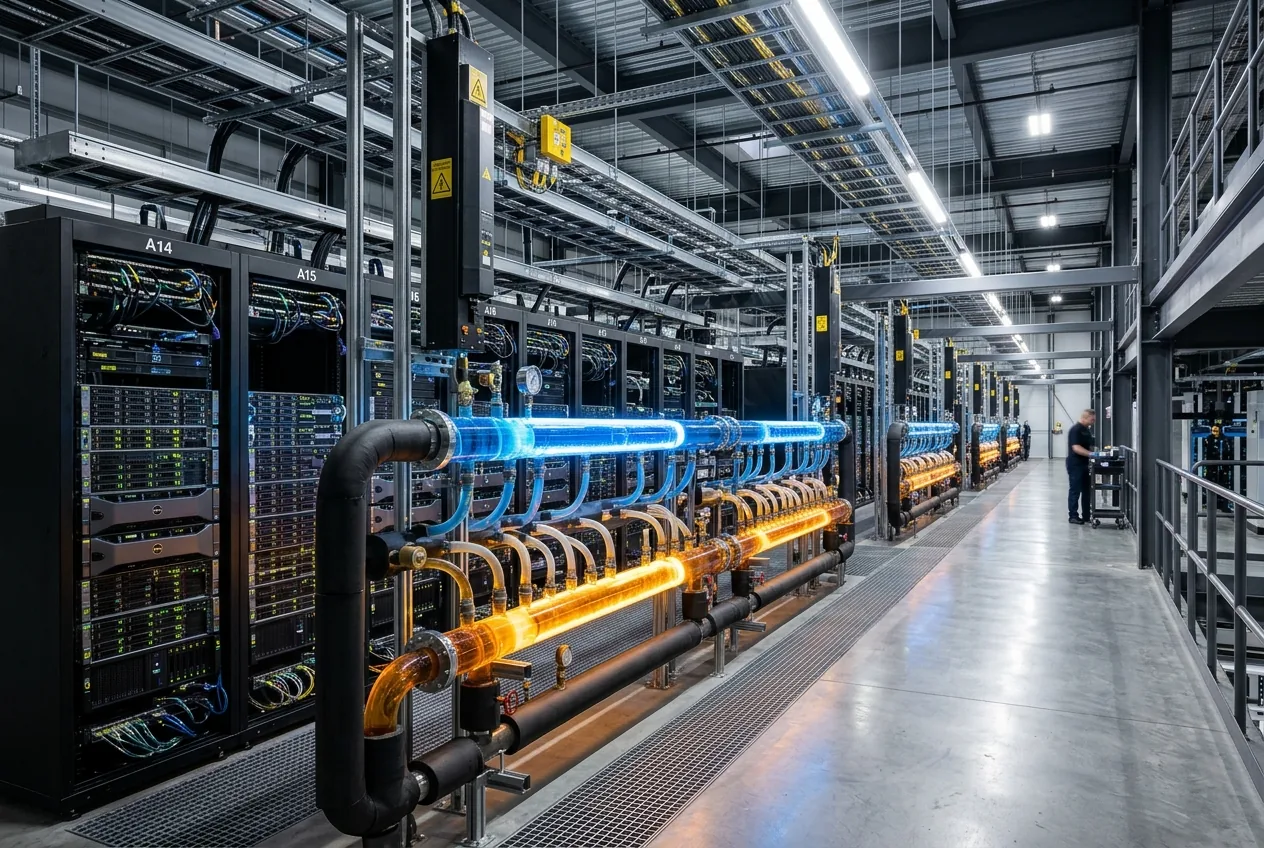
Behind the corporate ledgers and valuation multiples lies the brute physical constraint of modern high-performance computing: power availability. Generating tens of trillions of parameters each week requires an energy distribution framework comparable to regional heavy manufacturing plants. The expanded $100 billion compute roadmap agreed upon by OpenAI and AWS represents a physical buildout encompassing hundreds of thousands of networked nodes, multi-stage liquid cooling distribution units, and specialized transformer yards capable of handling unprecedented thermal loads.
Securing this capacity requires capital to be deployed years in advance of silicon installation. High-voltage power transformers and medium-voltage switchgear currently face manufacturing lead times extending past 100 weeks. By transferring $50 billion directly onto OpenAI's balance sheet while locking in long-term cloud service agreements, Amazon guarantees the cash flow needed to pre-purchase utility interconnections, sign long-term power purchase agreements, and secure primary physical footprints adjacent to nuclear and hydroelectric baseload generation facilities.
For Amazon, the massive capital outlay serves as a financial shock absorber that bridges raw capital expenditure into durable, recurring cloud revenue. As OpenAI draws on this capital to train next-generation multimodal architectures, the majority of those dollars circulate directly back into AWS infrastructure billing. It is an industrial closed loop: Amazon supplies the upfront capital, OpenAI burns that liquidity on compute cycles, and AWS uses the revenue to finance the mechanical, civil, and electrical engineering required to construct the next tier of data center campuses.
A Redrawn Competitive Landscape
The formal completion of this equity and compute arrangement decisively redraws the alliances governing enterprise automation. For years, OpenAI's corporate fortunes and compute footprints were tied almost exclusively to Microsoft Azure. By securing a minority equity interest and the exclusive third-party cloud provider status for the Frontier program, Amazon has successfully fragmented that exclusivity, anchoring its own cloud ecosystem at the core of the generative era.
The move also insulates Amazon from over-reliance on third-party foundation models. While the company continues to invest heavily in its internal frontier model development and maintains large equity positions in rival labs like Anthropic, bringing OpenAI into the AWS stable ensures that enterprise customers building on Amazon's cloud have native, low-latency access to the market's highest-demand model family. This dual-track strategy hedges Amazon against architectural obsolescence; regardless of which research laboratory makes the next breakthrough in reasoning density or synthetic training loops, the underlying matrix multiplications are guaranteed to execute on AWS power and metal.
As enterprise software transitions from experimental text interfaces into fully autonomous, robotic, and industrial agent networks, the constraint shifts entirely from software engineering to raw physical throughput. Amazon’s concluded $50 billion deployment is not merely a bet on OpenAI’s corporate valuation; it is a long-term engineering hedge that establishes the physical, thermal, and silicon infrastructure through which the next decade of autonomous computing must inevitably pass.



Comments
No comments yet. Be the first!