The Acceleration of the AI Valuation Hierarchy
The generative artificial intelligence sector is witnessing an unprecedented recalibration of value as Anthropic, the developer of the Claude LLM (Large Language Model) family, enters discussions for a fresh funding round. According to recent reports, the startup is eyeing a valuation exceeding $900 billion. If finalized, this figure would not merely double its $380 billion valuation from February but would also catapult Anthropic past OpenAI, which was last valued at approximately $852 billion. This shift signals a maturing market where investors are increasingly betting on the infrastructure and safety-first methodology that Anthropic has championed since its inception by former OpenAI executives.
The scale of the proposed funding is equally staggering. Preemptive offers are reportedly hovering between $40 billion and $50 billion, highlighting the aggressive stance of venture capital and strategic corporate partners in securing a stake in the next generation of compute. This surge in interest is not purely speculative; it is grounded in a dramatic rise in Anthropic’s annual revenue run rate. Current estimates suggest the company is generating between $30 billion and $40 billion on an annualized basis, a metric largely fueled by the rapid enterprise adoption of Claude’s AI coding assistants and collaborative work platforms. For an industrial analyst, this revenue-to-valuation ratio indicates that the market is pricing in not just software sales, but the long-term utility of Anthropic as an essential layer of the global digital infrastructure.
As the board prepares for a pivotal May meeting to discuss these offers, the broader tech industry is watching closely. This funding round is widely viewed as a potential precursor to an initial public offering (IPO), which could arrive as early as October. For Anthropic, the move is less about survival and more about the raw capital requirements of the scaling laws that govern modern AI development. In a field where the cost of training a single frontier model can reach into the billions, securing nearly $1 trillion in valuation provides the financial leverage necessary to compete for the world’s most scarce resource: advanced compute capacity.
Strategic Infrastructure and the Google Partnership
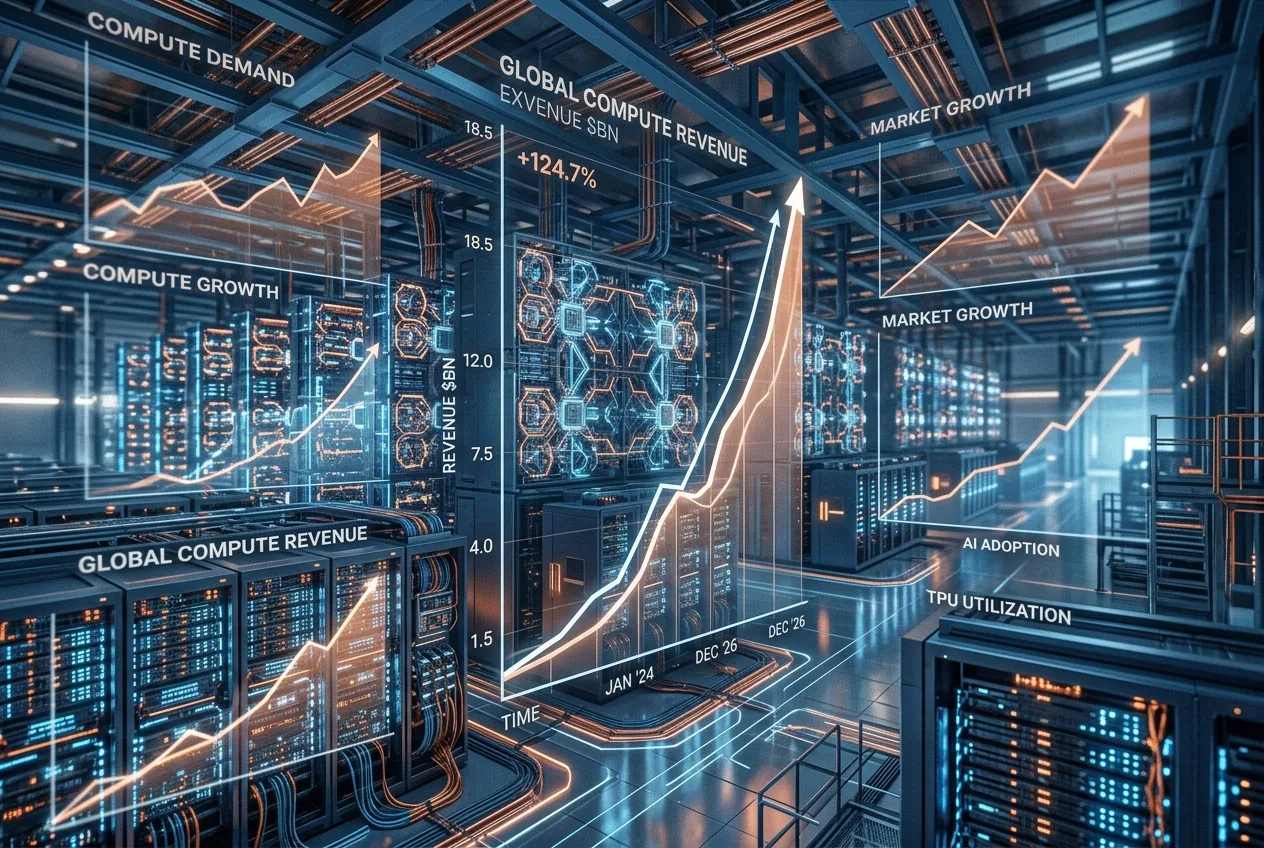
Central to Anthropic’s recent valuation spike is its deeply integrated relationship with Alphabet. Google recently committed up to $40 billion in a multi-stage strategic investment, which includes $10 billion upfront. From a mechanical and logistical perspective, the most critical component of this deal is not the cash, but the guaranteed access to infrastructure. The agreement secures five gigawatts of Tensor Processing Unit (TPU) capacity starting in 2027. To put five gigawatts into perspective, it is roughly equivalent to the power output of five large nuclear reactors, or enough to power millions of homes. In the context of AI, this represents a massive commitment to future training and inference capabilities.
Furthermore, the multi-cloud availability of Claude provides Anthropic with a competitive edge in the enterprise market. While OpenAI is tied closely to Microsoft Azure, Anthropic has successfully maintained significant partnerships with both Google Cloud and Amazon Web Services (AWS). This strategy allows enterprise clients to integrate Claude into their existing cloud workflows regardless of their primary provider. For industrial sectors like manufacturing, logistics, and finance—where data sovereignty and redundancy are paramount—this flexibility is a major selling point that drives the high-value contracts currently boosting Anthropic’s revenue run rate.
The Enterprise Pivot and the Claude Advantage
The primary engine behind Anthropic’s revenue growth is its focus on specialized enterprise use cases, particularly in the realm of software engineering. Claude has carved out a distinct niche as the preferred tool for high-complexity coding tasks. Unlike consumer-oriented models that prioritize conversational flair, Anthropic has engineered its models for precision, long-context window management, and constitutional safety. This "Constitutional AI" framework, which uses a set of rules to guide the model's behavior during training, appeals to risk-averse corporate entities that require predictable and safe outputs.
In industrial automation and technical workflows, the ability to ingest and analyze massive codebases or technical manuals is a transformative capability. Claude’s 200,000-token context window (and experiments with even larger windows) allows mechanical engineers and developers to provide the model with entire project environments. This leads to a higher degree of accuracy in code generation and debugging compared to models that must truncate their input. The economic viability of Anthropic’s business model hinges on this utility; companies are willing to pay a premium for a tool that serves as a force multiplier for their most expensive technical talent.
This focus on enterprise productivity is reflected in the development of Anthropic’s "cowork" platforms. These are not merely chat interfaces but collaborative environments designed to integrate with version control systems, project management tools, and industrial databases. By moving away from a "chatbot" identity and toward an "AI collaborator" identity, Anthropic has successfully positioned itself as an essential component of the modern industrial stack. This differentiation is a key reason why investors are willing to grant Anthropic a valuation that rivals some of the largest legacy tech giants in the world.
Can a Startup Sustain a Near-Trillion Dollar Valuation?
While the $900 billion figure is a testament to the current enthusiasm for AI, it also raises significant questions regarding the sustainability of such valuations for a private startup. From a traditional mechanical engineering perspective, where value is often tied to tangible assets and production capacity, a valuation nearly reaching $1 trillion for a company with a few thousand employees is a radical departure. The market is effectively treating Anthropic as a utility company of the future—one that provides the essential "intelligence" required for all other industries to function.
The primary risk lies in the capital intensity of the field. To maintain its position, Anthropic must continuously reinvest its revenue into research and development and hardware acquisition. The 5GW TPU deal with Google represents a massive future liability if the demand for Claude models does not continue to scale. If the industry reaches a point of diminishing returns in LLM scaling laws, or if open-source models begin to offer comparable performance at a fraction of the cost, the premium currently commanded by Anthropic could erode. However, the current trend suggests the opposite; as models become more capable, the barrier to entry for training them becomes higher, potentially creating a natural monopoly or duopoly between Anthropic and OpenAI.
Another factor to consider is the looming IPO. A $900 billion private valuation sets an incredibly high bar for a public debut. Public markets typically demand a higher level of transparency and consistent quarterly growth than private venture capital. For Anthropic, the transition to a public company will require moving beyond the hype of "AI potential" and demonstrating a clear path to long-term profitability while managing the immense costs of infrastructure. The October IPO timeline suggests that the leadership team believes their current revenue growth and technological lead are robust enough to withstand public scrutiny.
The Competitive Landscape: OpenAI vs. Anthropic
The rivalry between OpenAI and Anthropic is more than just a battle of valuations; it is a clash of philosophies regarding how artificial intelligence should be built and deployed. OpenAI, with its close ties to Microsoft, has pursued a strategy of rapid scaling and consumer-facing ubiquity through ChatGPT. Anthropic, founded by individuals who left OpenAI over concerns about its commercial direction and safety protocols, has emphasized a more cautious, research-heavy approach. Paradoxically, this safety-first reputation has become one of Anthropic's strongest commercial assets in the enterprise sector.
Technically, the models are neck-and-neck. Claude 3 Opus and OpenAI’s GPT-4o often trade places at the top of industry benchmarks. However, the divergence is seen in the API performance and integration. Anthropic has focused on reducing latency and improving the reliability of its outputs for automated systems. In an industrial setting, a 1% improvement in reliability can be the difference between a successful automated deployment and a catastrophic system failure. By targeting these high-stakes applications, Anthropic is building a moat that is difficult for consumer-focused competitors to cross.
The $900 billion valuation also serves as a strategic weapon in the war for talent. In the high-demand field of AI research, the ability to offer equity in a company that is nearing a trillion-dollar valuation is a powerful recruiting tool. As Anthropic expands its operations into finance, healthcare, and industrial design, its ability to attract the world’s best researchers will be the ultimate determinant of whether it can justify its price tag. The upcoming funding round is a clear signal that Anthropic intends to not just participate in the AI revolution, but to own the core infrastructure upon which it is built.




Comments
No comments yet. Be the first!