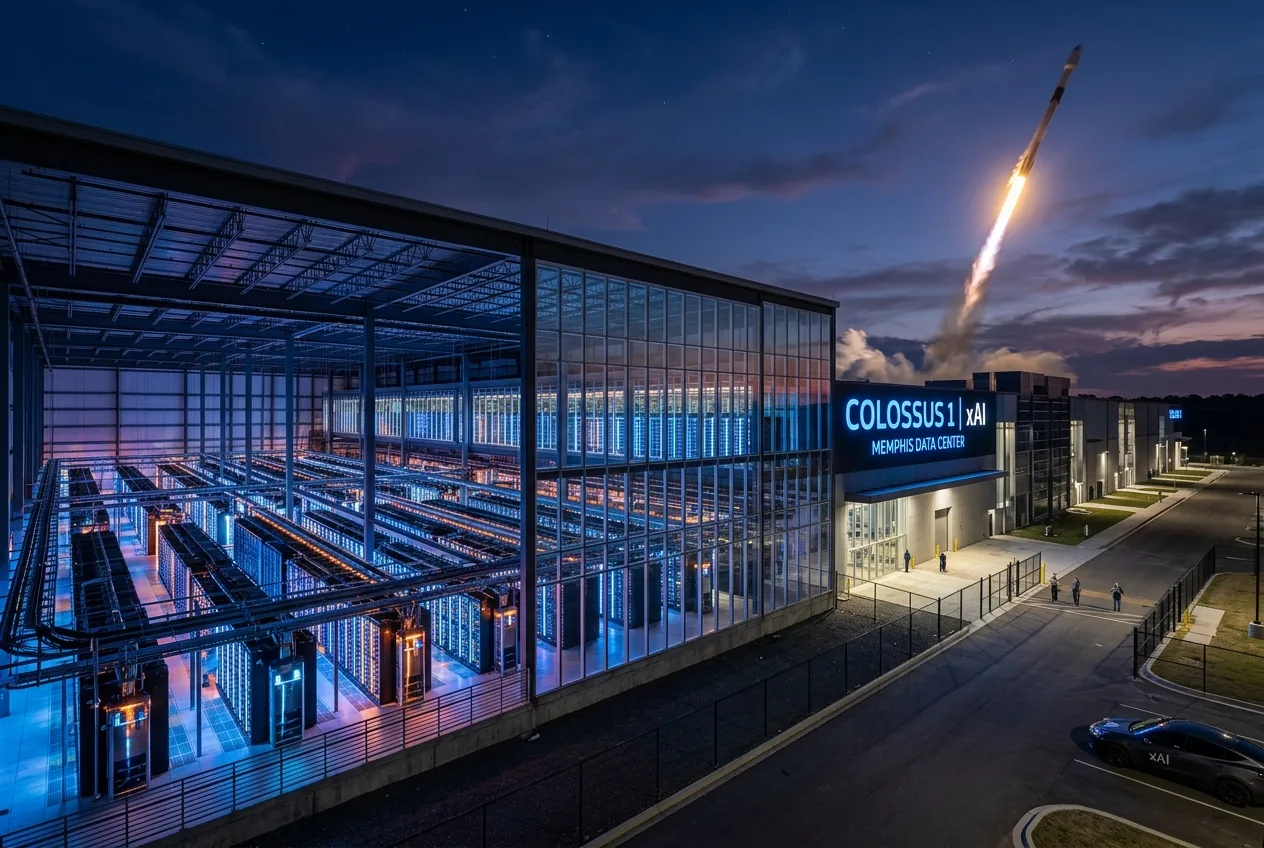
The industrial landscape of artificial intelligence underwent a tectonic shift this week as SpaceX, the private aerospace giant, finalized a deal to lease its massive Colossus 1 data center to Anthropic. This agreement effectively bridges the gap between the world’s most advanced rocket manufacturer and one of the most prominent builders of large language models (LLMs). For SpaceX, the move represents a pivot toward becoming an infrastructure provider for the AI age, while for Anthropic, it provides the raw hardware necessary to sustain the growth of its Claude AI platform.
The deal centers on the Colossus 1 facility located in Memphis, Tennessee. According to technical specifications, the site houses more than 220,000 Nvidia processors, making it one of the most concentrated hubs of GPU power on the planet. Under the terms of the lease, Anthropic will gain access to 300 megawatts of capacity within a month. This is not merely a cloud computing rental; it is a high-stakes infrastructure handoff that allows Anthropic to scale its computational intensive tasks, such as the training and deployment of its coding-focused models, while SpaceX secures a high-tier tenant to validate the economic utility of its massive capital expenditure in Tennessee.
The Engineering Behind Colossus and Anthropic’s Scaling Needs
To understand the magnitude of this deal, one must look at the physical requirements of modern AI training. The Colossus 1 data center was designed with a focus on high-density power delivery and advanced thermal management to support hundreds of thousands of H100 and H200-class GPUs. For an AI developer like Anthropic, hardware at this scale is the primary bottleneck for innovation. The company’s recent focus on "Claude Code" and its suite of AI agents requires consistent, low-latency access to massive compute clusters to handle the millions of tokens being processed simultaneously.
Anthropic recently introduced a feature known as "dreaming," a background processing function that allows AI systems to review work, identify patterns, and update context files between active sessions. This type of persistent processing is computationally expensive. By securing the full power of Colossus 1, Anthropic is effectively building a dedicated industrial-scale lab. The 300-megawatt capacity is equivalent to the power consumption of roughly 250,000 homes, underscoring the shift of AI development from a software exercise into a heavy industrial endeavor.
Strategic Alliances and the 2026 IPO Horizon
The timing of this partnership is inseparable from the broader financial maneuvers occurring within the Musk-led ecosystem. Earlier in 2026, SpaceX successfully integrated xAI, Musk’s dedicated artificial intelligence startup, in a deal that valued the combined entity at a staggering $1.25 trillion. This merger was designed to unify SpaceX’s hardware capabilities—Starlink satellites and Starship rockets—with xAI’s software stack, specifically the Grok chatbot. However, the lease to Anthropic demonstrates that SpaceX is willing to function as a neutral infrastructure provider, much like how it launches satellites for rival telecommunications companies.
Why did Elon Musk reverse his stance on Anthropic?
The deal represents a notable about-face for Musk, who previously criticized Anthropic for what he termed a biased or "misanthropic" approach to AI development. However, following a series of meetings with Anthropic leadership, Musk publicly stated that their commitment to ensuring Claude is "good for humanity" satisfied his concerns. From a pragmatic standpoint, the shift is likely driven by the industrial reality that idle compute is wasted capital.
Orbital Data Centers and the Future of Compute Infrastructure
Perhaps the most technically ambitious aspect of this partnership is the discussion surrounding space-based data centers. Anthropic has expressed interest in working with SpaceX to develop gigawatt-scale orbital compute clusters. While this sounds like science fiction, the mechanical engineering logic is sound, albeit challenging. In space, the primary advantage for data centers is the lack of a need for massive cooling fans; instead, heat can be radiated away in the vacuum, provided the thermal architecture is sufficient.
Orbital data centers would utilize SpaceX’s Starlink network to provide global, low-latency access to AI models, bypassing terrestrial fiber bottlenecks and potentially circumventing local energy grid constraints. For Anthropic, being the first AI company to have a dedicated "brain" in orbit would provide a massive competitive advantage in terms of global reach and operational security. For SpaceX, building these facilities provides a recurring and essential mission for Starship, which would be the only vehicle capable of launching the massive payloads required for gigawatt-scale orbital infrastructure.
The Rise of AI Agents and Enterprise Dominance
Is the 2026 IPO Market Ready for Hectocorns?
The collaboration between these two giants occurs against the backdrop of what experts are calling the "Year of the Hectocorn." With companies like OpenAI, SpaceX, and Anthropic all eyeing 2026 for their public debuts, the market is bracing for a flood of high-valuation listings. The SpaceX-Anthropic deal serves as a stabilizing force in this volatile environment. It proves that despite the intense competition between AI labs, there is a pragmatic layer of cooperation based on infrastructure and engineering needs.
For investors, this deal provides a glimpse into the future of the technology sector: a world where the lines between aerospace, energy, and artificial intelligence are permanently blurred. The successful deployment of Anthropic’s models on SpaceX’s hardware will be a key performance indicator for both companies as they prepare for the scrutiny of public markets. If they can demonstrate that the Colossus infrastructure produces superior AI performance at scale, it will justify the multi-billion dollar valuations currently being assigned to these players.
As the AI race transitions from the laboratory to the industrial plant, the partnership between SpaceX and Anthropic stands as a testament to the fact that the next phase of intelligence will be built on high-power hardware and logistical mastery. The rockets and the code are no longer separate industries; they are two halves of a single, rapidly evolving machine.




Comments
No comments yet. Be the first!