The mechanics of a trillion-dollar trajectory
The reported $965 billion figure coincides with Anthropic’s confidential filing for an Initial Public Offering (IPO). This move toward the public markets suggests that the private venture capital ecosystem, as deep as it is, may no longer be sufficient to fund the astronomical operational expenditures associated with training the next generation of models. Training a frontier model now requires an investment in power and silicon that rivals the infrastructure projects of entire nation-states. By preparing for an IPO, Anthropic is positioning itself to tap into the much deeper pools of liquidity available in public equities, providing the capital necessary to maintain its pace against rivals like OpenAI and Google’s DeepMind.
Why the market is betting on scaling laws
The primary driver behind this valuation is the continued validity of AI "scaling laws." These empirical observations suggest that as compute power, data volume, and parameter counts increase, the capabilities of language models continue to improve in a predictable, linear fashion on a log-log scale. For investors, Anthropic’s $965 billion price tag is a bet that these scaling laws have not yet hit a ceiling. If doubling the compute budget continues to yield a proportional increase in reasoning capabilities, then the first company to reach "Artificial General Intelligence" (AGI) stands to capture a market share that makes a trillion-dollar valuation look conservative.
Anthropic has distinguished itself through its "Constitutional AI" framework, a method of training models to follow a specific set of rules or a "constitution" without human intervention during the reinforcement learning phase. This technical approach has allowed the company to scale its safety protocols alongside its raw processing power. In an era where regulatory scrutiny of AI is tightening, the ability to produce a highly capable but verifiably safe model has become a massive competitive advantage. Investors aren't just buying into a chatbot; they are buying into a robust, scalable architecture that can be deployed within enterprise environments where reliability and safety are non-negotiable.
Hardware constraints and the supply chain of intelligence
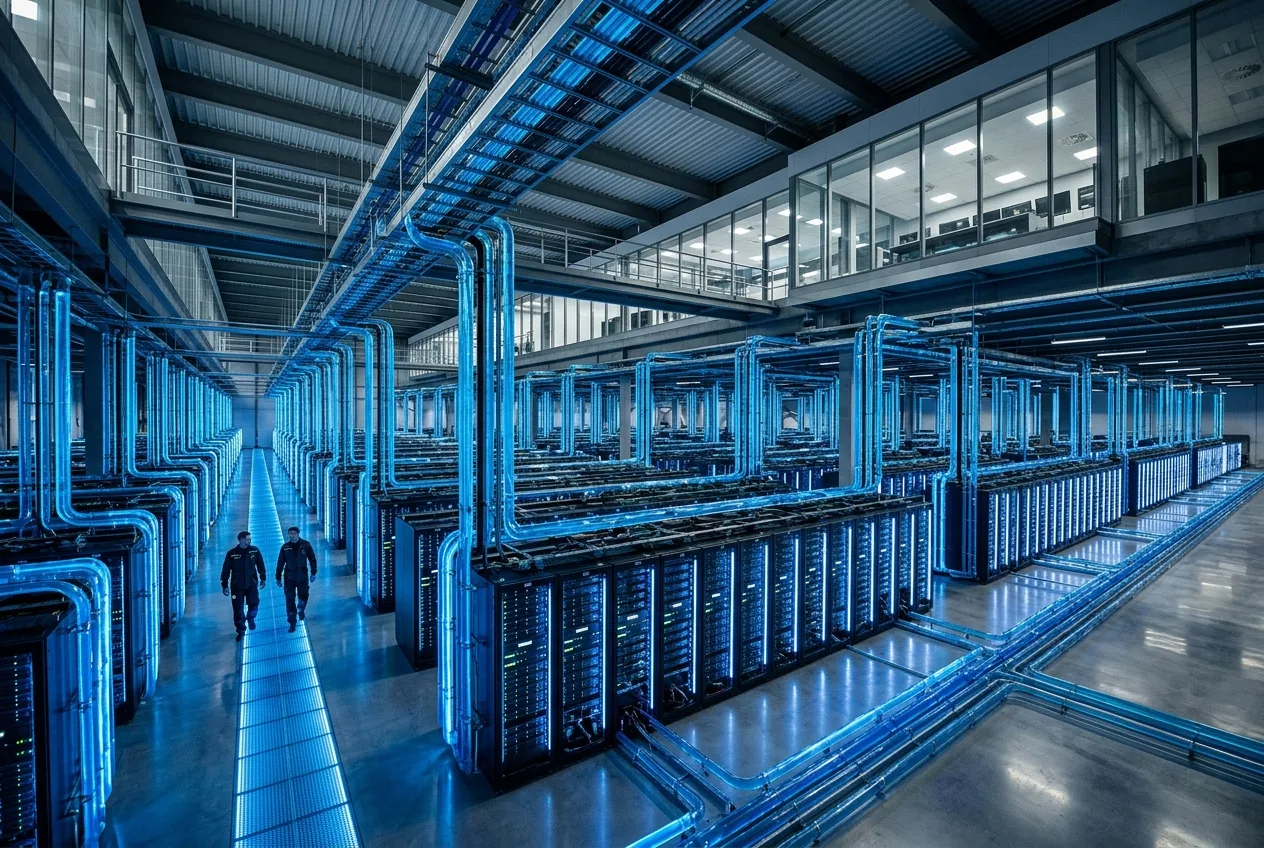
The sheer thermal density of modern AI clusters has forced a redesign of the data center. We are seeing a shift away from traditional air-cooled racks toward direct-to-chip liquid cooling. Anthropic’s ability to navigate these engineering hurdles while simultaneously pushing the boundaries of software optimization is a key reason why firms like Sequoia are willing to lead such massive rounds. The capital is being used to build what are essentially the largest and most complex machines ever constructed by humanity, designed for the sole purpose of processing information at a scale that was previously unthinkable.
Does the prediction market reflect reality?
However, the reliance on social media reports and prediction markets for such a monumental valuation also highlights the opacity of the current AI bubble. Until the IPO filings become public and the S-1 document is available for scrutiny, analysts must rely on these proxies to gauge the health of the sector. The moderate confidence levels seen in some trading brackets suggest that while the growth is undeniable, there is a healthy skepticism regarding the sustainability of these numbers. Can any company, no matter how advanced its technology, grow its value by $960 billion in three years without experiencing significant internal friction or market correction?
The economic viability of frontier AI
Beyond the excitement of the IPO, the core question for Anthropic remains its path to profitability. A $965 billion valuation implies a future revenue stream that must eventually dwarf the company’s current burn rate. Currently, the industry is in a "land grab" phase, prioritizing market share and technical dominance over immediate margins. For Anthropic to maintain its standing, it must transition from a research-heavy lab into a streamlined industrial powerhouse that can monetize Claude across diverse sectors, from automated code generation to complex supply chain optimization.
The role of strategic partners like Amazon and Google cannot be overstated. These tech giants have already poured billions into Anthropic, not just as financial investors but as infrastructure providers. Anthropic’s models run on their clouds, and in return, their cloud customers get access to Claude’s reasoning capabilities. This symbiotic relationship provides Anthropic with a built-in distribution network, which is essential for justifying its massive valuation. The upcoming IPO will test whether the rest of the market believes this ecosystem is durable enough to support a trillion-dollar entity in the long term.
What the 2027 horizon holds
Looking toward the 2027 horizon, the focus will shift from valuation to execution. If Anthropic successfully goes public, the pressure to deliver quarterly growth will replace the relative freedom of private research. The company will need to prove that its "Constitutional AI" can solve real-world problems more efficiently than cheaper, smaller models that are becoming increasingly prevalent in the open-source community. The hardware requirements will also continue to escalate; we are already seeing discussions around "Gigawatt-scale" data centers that could cost upwards of $100 billion each.
If the current trends hold, Anthropic’s ascent is not just a success story for its founders; it is a signal that the global economy is reorienting itself around the production of artificial intelligence as a primary commodity. The transition from $4.1 billion to $965 billion is a symptom of a world where compute is the new currency. Whether Anthropic can sustain this peak or if we are witnessing the apex of a speculative cycle will be determined in the halls of the New York Stock Exchange and the server rooms of the world's most advanced data centers.




Comments
No comments yet. Be the first!