The frontier artificial intelligence sector has officially decoupled from traditional software venture metrics, crossing firmly into the domain of heavy civil engineering and geopolitical industrial policy. Reports detailing Anthropic’s unprecedented push toward a near-trillion-dollar valuation, anchored by an eye-watering $65 billion capital framework, represent more than just a boardroom triumph over rival OpenAI. They signal a fundamental mutation in how foundation models must be financed, constructed, and physically powered.
For the past three years, the narrative surrounding large language models centered on algorithmic breakthroughs, synthetic training data innovations, and the race to capture enterprise chat interfaces. Yet beneath the consumer-facing software layer, the underlying mechanics have always obeyed the brutal laws of thermodynamics and semiconductor supply chains. Raising and deploying capital at this astronomical scale is not an exercise in marketing hype; it is a direct reflection of what it costs to reserve gigawatt-scale electrical grids, secure dedicated high-bandwidth memory packaging allocations, and underwrite the fabrication of multi-hundred-thousand-accelerator superclusters.
The Thermodynamic Reality of Next-Generation Scaling
To understand why any enterprise requires capital reserves measured in tens of billions of dollars, one must examine the physical realities of current-generation training clusters. The industry has effectively exhausted the efficiency gains afforded by simple parameter scaling on standardized cloud infrastructure. Training the frontier architectures anticipated for late 2025 and 2026 demands compute clusters comprised not of ten thousand GPUs, but of clusters scaling past 100,000 to 300,000 interconnected accelerators.
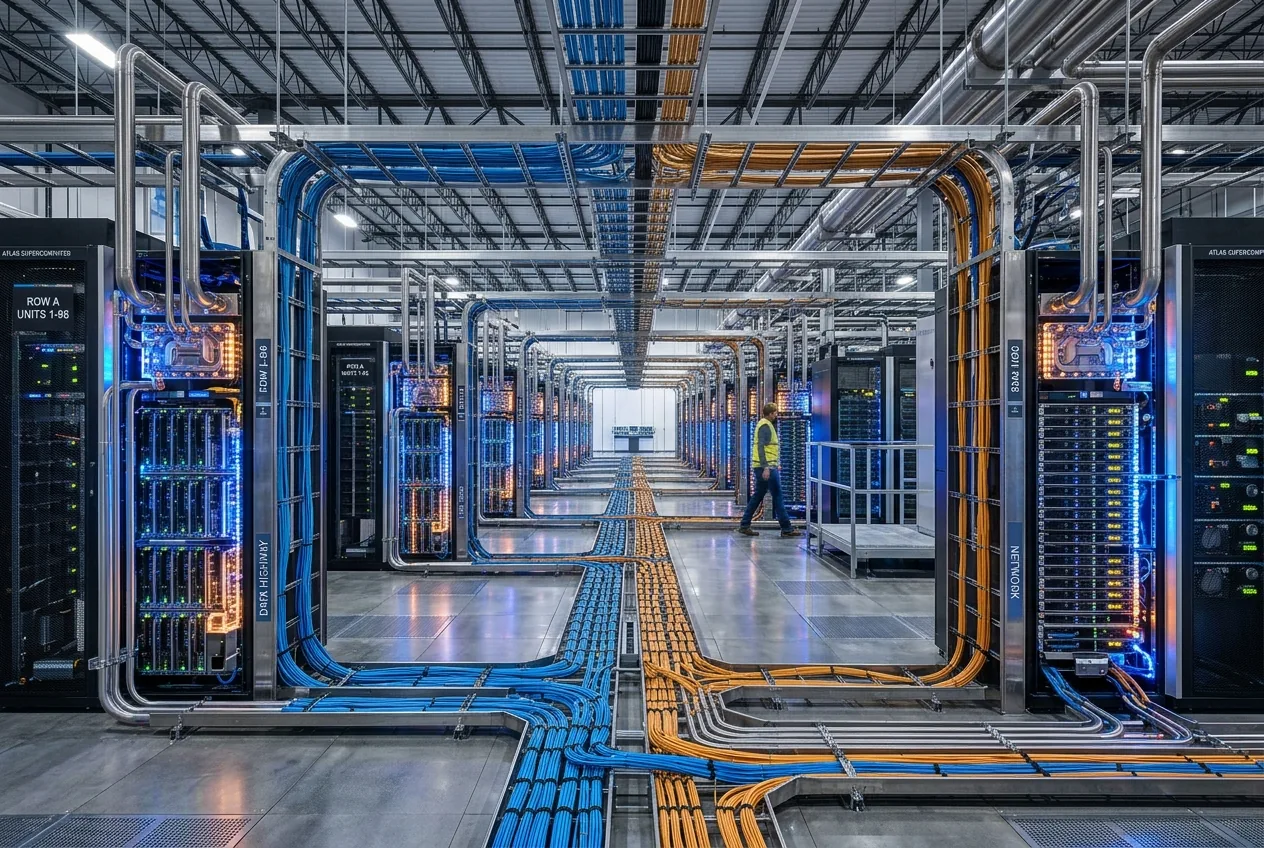
At this density, the engineering challenges shift from software orchestration to mechanical and electrical plant design. Modern architectures built around hardware like NVIDIA’s Blackwell NVL72 or bespoke cloud accelerators such as Amazon’s Trainium2 require direct-to-chip liquid cooling manifolds, sophisticated secondary fluid loops, and heat rejection plants capable of handling thermal design power ratings that exceed 120 kilowatts per rack. Air cooling is no longer physically viable at the compute densities required to keep interconnect latencies low enough for distributed tensor parallelism.
Furthermore, interconnect fabric has become the primary bottleneck of frontier compute. When distributing an autoregressive transformer across hundreds of thousands of nodes, optical transceivers, co-packaged optics, and proprietary switching backplanes dictate throughput far more than raw theoretical teraflops. The capital Anthropic is amassing serves as an upfront prepayment to lock down advanced packaging capacity, customized networking topologies, and dedicated silicon lines at foundries like TSMC, long before the first weight of a new model is initialized.
The Strategic Wedge Between Amazon, Google, and Microsoft
Anthropic’s ascent past the market footprint of OpenAI highlights the shifting dynamics among the hyperscalers underwriting this arms race. While OpenAI initially secured an early lead through its deep partnership with Microsoft Azure, that close alignment eventually produced friction points around infrastructure allocation, intellectual property boundaries, and hardware exclusivity. Anthropic, by contrast, engineered a dual-engine architecture by establishing deep strategic alliances with both Amazon Web Services and Google Cloud.
As enterprise clients seek independence from single-ecosystem lock-in, Anthropic’s platform-agnostic stance has turned into a formidable commercial moat. Enterprise developers can run Claude models natively across AWS Bedrock, Google Cloud Vertex AI, or private virtual clouds without re-architecting their underlying data pipelines. This broad deployment surface allows Anthropic to capture enterprise workloads with lower friction than proprietary stacks tethered to single infrastructure providers.
Will Enterprise Automation Justify Trillion-Dollar Balance Sheets?
The central question confronting hardware engineers and market analysts alike is whether enterprise workflows can generate the revenue velocity necessary to service this unprecedented capitalization. Valuations approaching a trillion dollars demand hundreds of billions in recurring high-margin cash flow—a reality that pure consumer subscriptions and conversational chat applications cannot support. The endgame is not conversational search; it is deterministic industrial automation and end-to-end task execution.
Yet moving from experimental desktop agency to enterprise-grade reliability requires massive systemic redundancy. An autonomous agent that hallucinates or executes an invalid API call five percent of the time is fundamentally unviable in mission-critical industrial or enterprise settings. Closing that final reliability gap requires continuous inference verification, multi-agent debate architectures, and real-time reinforcement learning—processes that multiply per-task compute consumption exponentially. The capital being amassed today is directly funding the inference capacity required to make these multi-step autonomous pipelines economically viable at industrial scales.
The Infrastructure Bottleneck Moves to the Grid
Even with tens of billions in liquidity, the growth curve of frontier AI is colliding with a hard physical barrier: energy infrastructure. Capital can purchase GPUs, but it cannot unilaterally compress the five-to-seven-year permitting and construction timelines required for regional high-voltage transmission lines, substation step-down transformers, and new baseload generation capacity. The primary locus of competition has shifted from software optimization to power purchase agreements.
Major technology operators are already securing long-term power off-take agreements from nuclear facilities, natural gas plants with carbon capture provisions, and dedicated utility-scale microgrids. As frontier data centers approach power draws of one to two gigawatts per campus—equivalent to the electrical demand of a medium-sized metropolitan city—the capability to scale is increasingly rationed by local electrical grid capacity rather than capital constraints.
Anthropic’s multi-cloud, multi-partner model provides a crucial buffer in this geography of power. Rather than relying on a single geographic hub, workloads can be dynamically routed across Amazon and Google’s global footprint, capitalizing on stranded power, regional cooling efficiencies, and international grid variations. Managing this compute logistics network is quickly becoming as vital an operational competency as designing model loss functions.
The Dawn of Capital-Intensive Machine Intelligence
Anthropic’s aggressive capital surge confirms that the era of the scrappy, software-centric AI startup has closed. We have entered the phase of sovereign-scale capital deployment, where synthetic intelligence is constructed through the brute-force convergence of advanced silicon fabrication, massive high-bandwidth memory allocations, and industrial energy infrastructure.




Comments
No comments yet. Be the first!