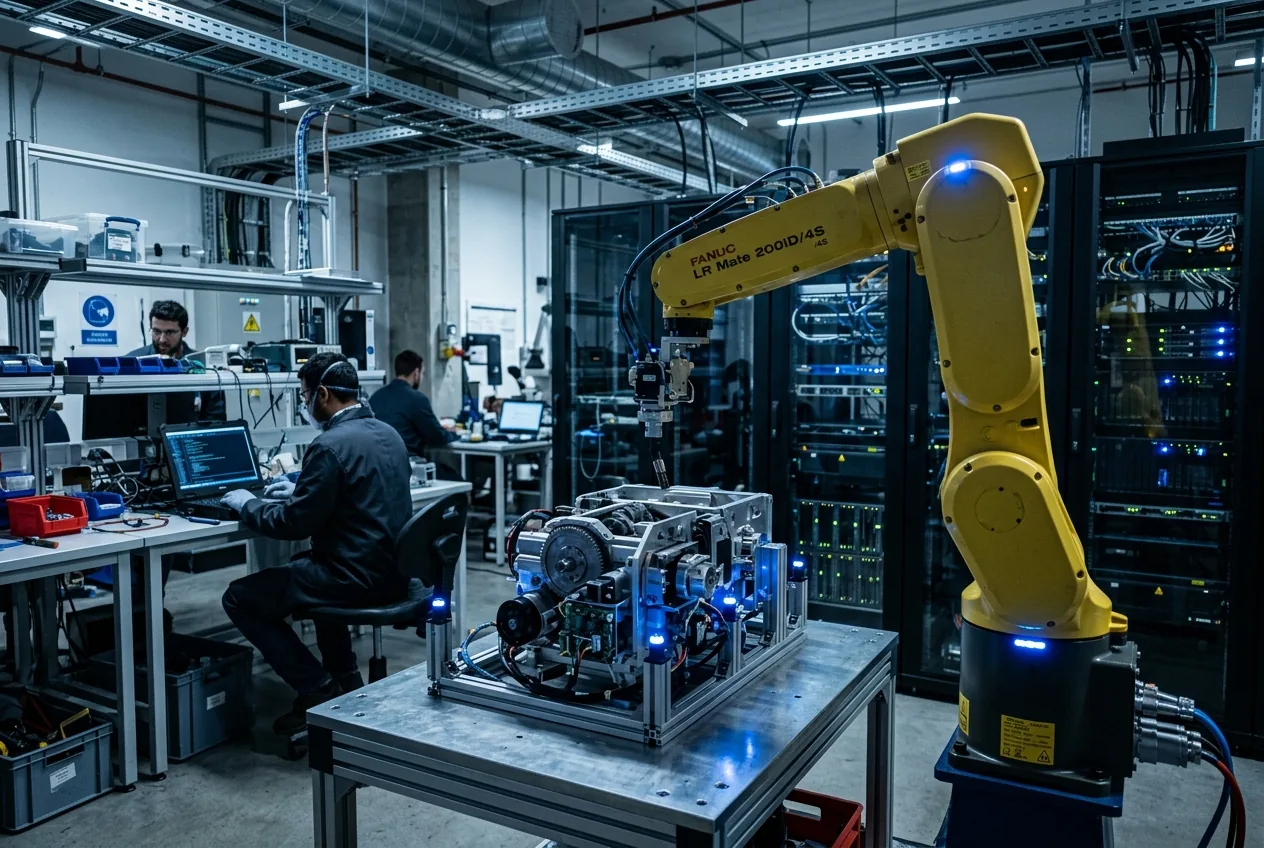
For the past two years, the public conversation surrounding artificial intelligence has been largely confined to the chatbot interface: a user inputs a prompt, a server-side transformer model computes probability distributions across tokens, and a structured text response appears on screen. That passive paradigm is now collapsing. A coordinated wave of demonstrations and engineering disclosures from Google DeepMind has shifted the technological benchmark from conversational assistants to proactive, autonomous agents capable of navigating digital environments, manipulating software tools, and parsing real-time physical telemetry.
The cultural reaction to this shift has reached well beyond traditional Silicon Valley engineering circles. Mainstream cultural figures, including actor and producer Matt Damon, have increasingly spoken out about the rapid structural displacement threatening legacy industries. Damon, who co-founded independent production studio Artists Equity to insulate creative workers from algorithmic erosion, has pointedly highlighted how automated pipelines threaten to dismantle mid-tier labor across film production, logistics, and digital services. When commentary surrounding Google's recent agentic milestones adopted sensationalized rhetoric about a looming technological singularity, it tapped directly into this broader anxiety: the realization that software is moving from advisory roles to direct operational execution.
Moving Beyond Next-Token Prediction to Autonomous Action
To understand the panic, one must look at the mechanical differences between traditional generative models and agentic architectures. Large language models operate on probabilistic sequence completion. They do not maintain persistent internal state across tasks unless deliberately engineered to do so through external scaffolding. An autonomous agent, by contrast, operates within a continuous control loop: perception, environmental modeling, planning, execution, and verification.
Google’s recent research initiatives, particularly surrounding its Gemini infrastructure and DeepMind's SIMA (Scalable Instructable Multiworld Agent), represent a deliberate departure from static question-answering. Instead of outputting text for human consumption, these systems generate structured API calls, navigate graphical user interfaces via coordinate clicks and keystroke inputs, and evaluate their own performance against an assigned objective function. If an error is detected during execution, the system maintains the context of the failure and formulates an alternative execution tree.
This functional transition transforms the economic calculation for enterprise adoption. A conversational assistant requires continuous human supervision, functioning essentially as an interactive drafting tool. An autonomous agent architecture is designed to minimize human intervention to supervisory check-ins, executing multi-step business logic across disparate software platforms without manual hand-holding.
Multimodal Grounding and the Architecture of Project Astra
The technical underpinning of Google's aggressive push into this domain crystallized with Project Astra, DeepMind's initiative aimed at developing universal real-time multimodal agents. In industrial applications, the utility of software has historically been limited by latency and perceptual isolation. Systems could parse an image or process an audio stream asynchronously, but they could not maintain spatial awareness while interacting with a dynamic environment.
Achieving this level of continuous inference requires severe optimizations at the hardware and networking layer. Traditional generative API calls often incur round-trip latencies between 800 milliseconds and two seconds—far too slow for real-time task orchestration. By deploying specialized tensor processing units (TPUs) configured for low-precision inference and implementing local sensory buffering, Google has compressed continuous multimodal response latency down to conversational and operational thresholds. For roboticists and systems engineers, this is the foundational architecture required to give automated hardware meaningful situational awareness.
Cultural Disruption and the Hollywood Calculus
The visceral reaction from figures like Matt Damon highlights an uncomfortable truth: the entertainment industry is serving as an early testing ground for structural disruption that will soon hit industrial supply chains and white-collar enterprises. During recent industry forums, Damon emphasized how the collapse of traditional distribution windows—such as physical DVD sales that historically funded mid-budget cinematic risk—left the creative sector vulnerable to aggressive algorithmic consolidation. Autonomous agentic systems represent the next phase of this compression.
Consider a standard post-production workflow. Historically, synthesizing visual effects, mastering audio tracks, managing metadata catalogs, and routing rendering tasks across server clusters required dozens of specialized technical operators. If multimodal models can perceive intent from natural language instructions, manipulate non-linear editing software via direct GUI automation, and verify audio-visual outputs against technical broadcast specifications, the labor footprint of entire production houses contracts overnight.
This dynamic mirrors the transition industrial manufacturing underwent during the rollout of programmable logic controllers (PLCs) in the late twentieth century. The difference today lies in the speed of deployment and the generalizability of the software. A factory retrofitting an assembly line historically required years of mechanical retooling and hardcoded deterministic programming. In contrast, an agentic software framework requires only API endpoints or raw visual access to an existing computer interface to begin displacing human-directed workflows.
Industrial Reality and the Verification Bottleneck
Despite viral claims that these advancements signal an imminent singularity, severe mechanical and mathematical bottlenecks remain before agentic systems can operate reliably without human oversight. The primary challenge confronting software engineers is error propagation within non-deterministic state machines.
If a foundational model achieves an individual tool-use accuracy of 95 percent, that reliability metric appears impressive in isolated benchmarks. However, in an industrial supply chain or automated coding environment where an operational task requires a twenty-step sequence of dependent actions, the compounding probability of success drops precipitously. At a five percent failure rate per step, the likelihood of a twenty-step workflow completing without an error is approximately 36 percent. In mission-critical environments—such as automated inventory reconciliation, robotic pick-and-place operations, or legal compliance auditing—a 64 percent systemic failure rate is intolerable.
Current research efforts are consequently focused on formal verification layers. Engineers are constructing deterministic scaffolding around probabilistic neural networks, forcing the model to validate outputs against mathematical constraints, sandbox environments, and regression test suites before changes are written to operational databases. Until these verification mechanisms reach near-zero error rates, autonomous agents will remain bounded within supervised, sandboxed enterprise domains.
The Long-Term Economic Inflection Point
The sensationalism surrounding Google’s internal breakthroughs obscures the real technological transition taking place. The tech sector is not witnessing the birth of an omniscient, self-directed superintelligence, but it is unquestionably crossing the threshold into scalable task automation. The long-term implications for global labor productivity and capital distribution are profound.
When software transitions from answering questions to executing economic work, the value of routine cognitive labor faces rapid deflation. Hollywood creatives, mechanical systems designers, and financial analysts are all confronting the same operational reality: the interface of human work is shifting from execution to systems architecture and high-level verification. Google’s aggressive deployment of agentic models makes one reality unmistakable: the era of passive AI is over, and the economic friction of enterprise automation is only just beginning.




Comments
No comments yet. Be the first!