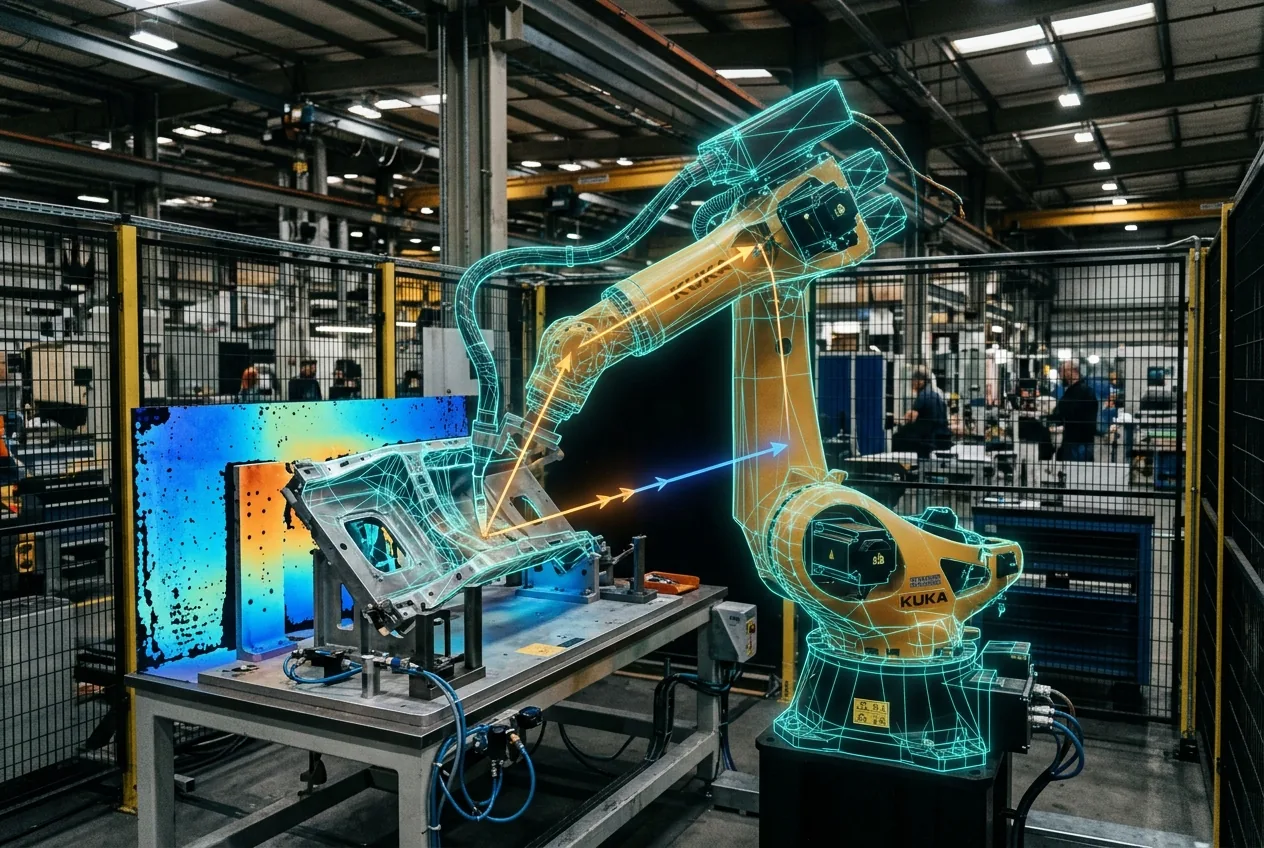
For the past five years, the metric of progress in frontier artificial intelligence has been deceptively straightforward: scale up transformer architectures, expand pre-training token budgets, and observe the emergent power of next-token prediction across language and code. Yet inside advanced robotics laboratories and industrial automation facilities, this paradigm has long hit an unyielding wall. A model capable of writing nuanced legal briefs or generating syntactic Python scripts still struggled to grasp the physical dynamics of an unstructured assembly line, comprehend spatial geometries in three dimensions, or execute long-horizon physical planning without catastrophic failure. The latest evolutions in frontier neural architectures—typified by persistent reasoning frameworks, continuous video-stream integration, and unified agentic loops—mark the boundary where pure linguistic computation ends and spatial intelligence begins.
As research institutions and frontier labs push deeper into multi-modal architectures designed to observe, deliberate, and act within live sensory environments, the technological stakes have radically expanded. The conversation is no longer about conversational fluency; it is about whether a software model can internalize the fundamental laws of physics, mechanical tolerances, and spatial causality. Analyzing the mechanics of this architectural transition reveals not just a quantitative leap in benchmark scores, but a qualitative restructuring of how machines interpret physical reality.
The Pivot from Autoregressive Guessing to Verifiable Reasoning
To understand why the next tier of frontier intelligence represents a departure from earlier generative systems, one must look directly at inference-time compute. Standard large language models operate as intuitive, fast-forward engines: given a sequence of tokens, they sample the most statistically probable continuation in a single forward pass. While effective for synthesizing prose, this reactive mechanism fails systematically when applied to complex, multi-step optimization problems such as robotic trajectory generation, structural kinematic planning, or industrial process orchestration.
Continuous Sensory Streams and the Death of Static Prompts
Industrial applications do not happen in discrete, isolated batches; they exist within a continuous temporal flux. Traditional multimodal models operated on static snapshots—a high-resolution JPEG fed into an encoder, projected into a shared semantic vector space, and matched against textual tokens. This approach provided zero intuition for velocity, momentum, or occlusion over time, severely limiting its utility in real-time robotic perception or dynamic logistical monitoring.
The current frontier leap integrates real-time, high-frame-rate spatial perception directly into the model’s core latent space. Instead of translating images into disjointed semantic labels, the architecture consumes raw temporal video and sensory feeds as an unbroken stream of physical data. This enables the model to construct persistent, internal world models that track objects through visual occlusions, measure relative velocities, and predict collision risks hundreds of milliseconds before they materialize.
In a high-throughput distribution warehouse or an aerospace composite manufacturing cell, this temporal continuity is transformative. An intelligent perception system cannot afford to restart its contextual understanding with every camera frame. By maintaining an active, rolling state vector of the environment, a frontier model can detect tool wear via micro-vibrations in video feeds, identify supply chain bottlenecks across interconnected conveyor lines, and guide automated guided vehicles through dense, human-dense shared workspaces without relying on rigid, pre-mapped floor fiducials.
The Compute Economics of Next-Generation Deployments
In industrial automation, latency is a critical constraint. A factory floor running high-speed programmable logic controllers operates on deterministic cycle times measured in single-digit milliseconds. If an intelligent supervisory model requires several seconds of high-precision compute cluster deliberation to resolve an edge case, it cannot be placed directly inside the primary safety-critical control loop. Instead, the architectural integration follows a tiered hierarchy:
- Tier 1: Deterministic Real-Time Control: Edge microcontrollers and PLCs running hard real-time operating systems, executing microsecond-level motion planning and immediate emergency stops based on deterministic hardware thresholds.
- Tier 2: Edge-Optimized Neural Primitives: Compact, quantized vision-language-action models running locally on ruggedized industrial GPUs, handling millisecond-level sensory feedback, part orientation, and pick-and-place trajectories.
The capital expenditure required to provision this infrastructure means that deployment must demonstrate immediate, measurable returns. Automation engineers are not deploying these systems to generate ambient productivity; they are deploying them to eliminate the millions of dollars lost annually to retooling down-time, programming overhead for custom fabrication batches, and scrap rates caused by rigid, brittle legacy automation systems.
Will Probabilistic Software Ever Satisfy Industrial Safety?
The central controversy surrounding the integration of massive frontier models into physical industry is not computational power; it is the fundamental philosophical divergence between modern neural networks and traditional control theory. For decades, mechanical engineers and systems safety professionals have relied on standards such as ISO 13849 and IEC 61508, which mandate deterministic, mathematically verifiable reliability for safety-instrumented systems. A mechanical brake, an interlocked gate, or a dual-channel safety relay operates on proven physics with predictable failure probabilities.
Frontier AI architectures, regardless of how advanced their internal reasoning chains may be, remain probabilistic engines. They operate across high-dimensional latent distributions where 99.999% reliability is vastly different from absolute certainty. A robotic arm powered by an end-to-end neural network might execute five thousand successful palletizing maneuvers, only to encounter a rare lighting permutation or a novel surface reflection that induces an unpredictable kinematic deviation. In an industrial environment where machinery carries the kinetic energy to cause catastrophic structural damage or severe human injury, the word 'probably' is unacceptable.
Overcoming this divide requires rigorous hybrid engineering. Rather than ceding direct motor control to neural models, industrial implementers are building layered architectures where frontier models generate operational intent, which is then parsed, validated, and bounded by deterministic software sandboxes. If an intelligent model suggests a motion trajectory that violates kinematic limits, exceeds safe operational velocity envelopes, or approaches an exclusion zone, the underlying deterministic safety controller instantly clamps the signal. The intelligence proposes, but deterministic physics disposes.
The Long Horizon Toward True Autonomous Agency
The progression toward unified frontier intelligence marks the beginning of an unalterable convergence between software cognition and hardware execution. As models grow increasingly adept at parsing the nuances of the physical world—understanding friction, mass, structural stability, and tool dynamics—the historical barrier between digital planning and physical labor will systematically erode.
For manufacturing engineers, supply chain architects, and enterprise technologists, the imperative is to look past the marketing narratives that invariably accompany new frontier model releases and focus entirely on the architectural parameters: latency budgets, continuous contextual coherence, verifiable inference paths, and integration overhead. The systems poised to redefine global industry will not simply be the ones that score highest on synthetic linguistic tests, but the ones capable of surviving the rugged, unpredictable, and uncompromising reality of the physical world.




Comments
No comments yet. Be the first!