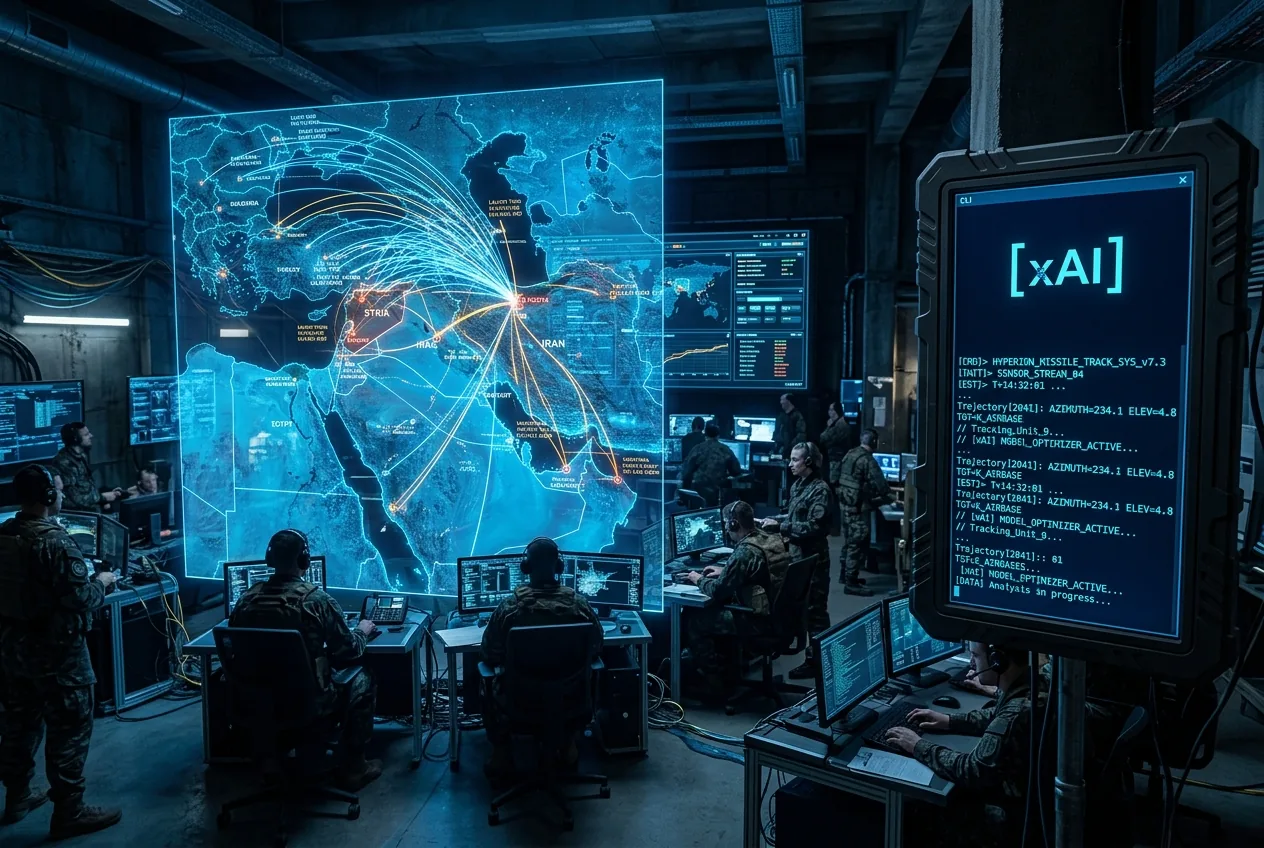
From a mechanical engineering and systems integration perspective, the idea that a generative AI like Grok could "fire" missiles involves a fundamental misunderstanding of how military hardware interfaces with software. However, the kernel of truth lies in the Pentagon’s aggressive pivot toward "Algorithmic Warfare." To understand how an LLM could be involved in such a massive operation, one must look past the user interface of a chat window and into the deep architecture of the Department of Defense’s (DoD) Joint All-Domain Command and Control (JADC2) initiative.
The Architecture of an Automated Strike
A strike involving 2,000 missiles is a logistical and computational feat that exceeds human cognitive capacity in real-time. In traditional kinetic operations, target acquisition, deconfliction, and fuel-load calculations are handled by a fragmented array of specialized systems. The current military interest in LLMs like Grok is not for the actual ignition of rocket motors, but for the synthesis of disparate data streams. In a legal briefing context, the "admission" of AI involvement often refers to the use of these models to parse vast amounts of intelligence, surveillance, and reconnaissance (ISR) data to identify optimal windows for engagement.
For an LLM to facilitate a strike of this magnitude, it would function as an orchestration layer. It would sit atop the "Common Tactical Picture," ingesting sensor data from satellites, high-altitude drones, and ground-based radar. The technical challenge is one of data fusion. Modern missiles, particularly those in the U.S. inventory like the Tomahawk Land Attack Missile (TLAM) or the AGM-158 JASSM, require precise geospatial coordinates and timing. An LLM's role would be to convert natural language queries from commanders into machine-executable parameters, effectively acting as a high-speed bridge between human intent and kinetic execution.
LLMs vs. Traditional Target Recognition
Is Grok technically suited for this? It is essential to differentiate between generative AI (LLMs) and computer vision (CV) AI. The Pentagon has used CV for years—most notably in Project Maven—to identify vehicles and personnel from drone footage. Grok, conversely, is designed for linguistic reasoning and pattern recognition in text. If the Pentagon is indeed leveraging xAI’s technology, it is likely utilizing the model’s ability to conduct "Retrieval-Augmented Generation" (RAG). This allows the AI to look at classified tactical manuals and real-time situational reports to suggest the most efficient sequence of fire for 2,000 individual munitions.
The pragmatic reality is that firing 2,000 missiles simultaneously creates a massive "data saturation" problem. Each missile must have a cleared path to avoid mid-air collisions and must be timed to hit targets in a synchronized manner to overwhelm enemy air defenses. A human staff would take days to calculate these variables; a sufficiently powerful AI could theoretically do it in seconds. This speed is what the military calls "decision advantage." If Grok was used, it was likely as a massive calculator for the logistics of destruction rather than the "finger on the trigger."
The Legality of the Silicon Trigger
The legal briefing mentioned in recent reports likely centers on DoD Directive 3000.09, which governs the development and use of autonomous and semi-autonomous weapon systems. This directive mandates that all AI-integrated weapons must allow for "appropriate levels of human judgment." The controversy arises when the AI’s processing speed exceeds the human ability to verify the data. If an AI suggests 2,000 targets and a human clicks "approve" in three seconds, is that truly human-in-the-loop, or is it merely human-on-the-loop?
The Musk Factor and Defense Autonomy
The involvement of Elon Musk’s xAI adds a layer of geopolitical complexity. Musk already controls the backbone of modern military communication through Starlink. Integrating Grok into the Pentagon’s command structure would represent a vertical integration of private tech and state military power unseen since the era of the early industrial tycoons. For the Pentagon, the attraction to Grok lies in its "unfiltered" nature compared to competitors like OpenAI’s GPT-4. Military applications require a system that can process grim realities without the restrictive ethical guardrails intended for general consumers.
However, the technical integration of a commercial LLM into a classified military network (SIPRNet or JWICS) is a massive undertaking. It requires "air-gapping" the model so that sensitive military data doesn't leak back into the public training set. If Grok was used in an operation against Iran or any other adversary, it would imply that xAI has developed a specialized, secure instance of the model capable of running on military-grade hardware, likely specialized NVIDIA H100 clusters within a government-controlled cloud environment.
Economic and Industrial Viability
Furthermore, the industrial footprint of a 2,000-missile strike is immense. Such an event would deplete significant portions of the U.S. national stockpile. An AI capable of managing such a strike must also be integrated into the supply chain, signaling to manufacturers like Boeing or Northrop Grumman the need for immediate replacement production. This level of system-of-systems integration is exactly what current AI chiefs at the Pentagon are advocating for.
Can We Trust the Machine?
The fundamental question remains: should an AI be trusted with 2,000 missiles? From a mechanical perspective, the hardware is ready. We have the sensors, the munitions, and the data links. The bottleneck is the human brain. If the reports of Grok's involvement are even partially accurate, they signal that the U.S. military has decided that the risk of AI hallucination is lower than the risk of human slowness in a modern, high-intensity conflict.
As we move toward a future where "autonomous swarms" and "algorithmic command" become the norm, the role of the engineer shifts from designing the weapon to auditing the logic of the system that fires it. The alleged admission from the Pentagon AI chief serves as a harbinger of a new era of warfare, where the most powerful weapon in the arsenal isn't the missile itself, but the inference engine that decides where it lands. Whether that engine is Grok or a more secretive government model, the technical trajectory is clear: the speed of war is now being dictated by the speed of the GPU.




Comments
No comments yet. Be the first!