The Latency Problem: Why Legacy Voice Interfaces Stumbled
To appreciate the technical achievement of true real-time interaction, one must first examine the compounding inefficiencies of the systems that preceded it. Historically, engaging with a voice-enabled artificial intelligence involved a sequence of decoupled subsystems operating in series. When a user spoke, their acoustic signal was captured, digitized, and routed to an automatic speech recognition (ASR) engine, such as OpenAI's Whisper. This engine processed the waveform, generated a textual transcript, and passed that text payload to the primary large language model.
The compounding effect of this three-stage pipeline was devastating to natural conversation. Total round-trip latency routinely fluctuated between two and four seconds. In practical applications, this latency created an uncanny conversational barrier. Users were forced to pause, wait for processing cycles, and endure awkward conversational collisions whenever an interruption occurred. Furthermore, this decoupled pipeline suffered from catastrophic loss of context. An ASR model strips out pitch, emotional inflection, background noise, and cadence, reducing rich acoustic data to flat ASCII text. The synthesis engine on the other end was left to guess the appropriate tone, generating sterile, robotic cadence devoid of situational awareness.
The Omni Architecture: Collapsing the Pipeline
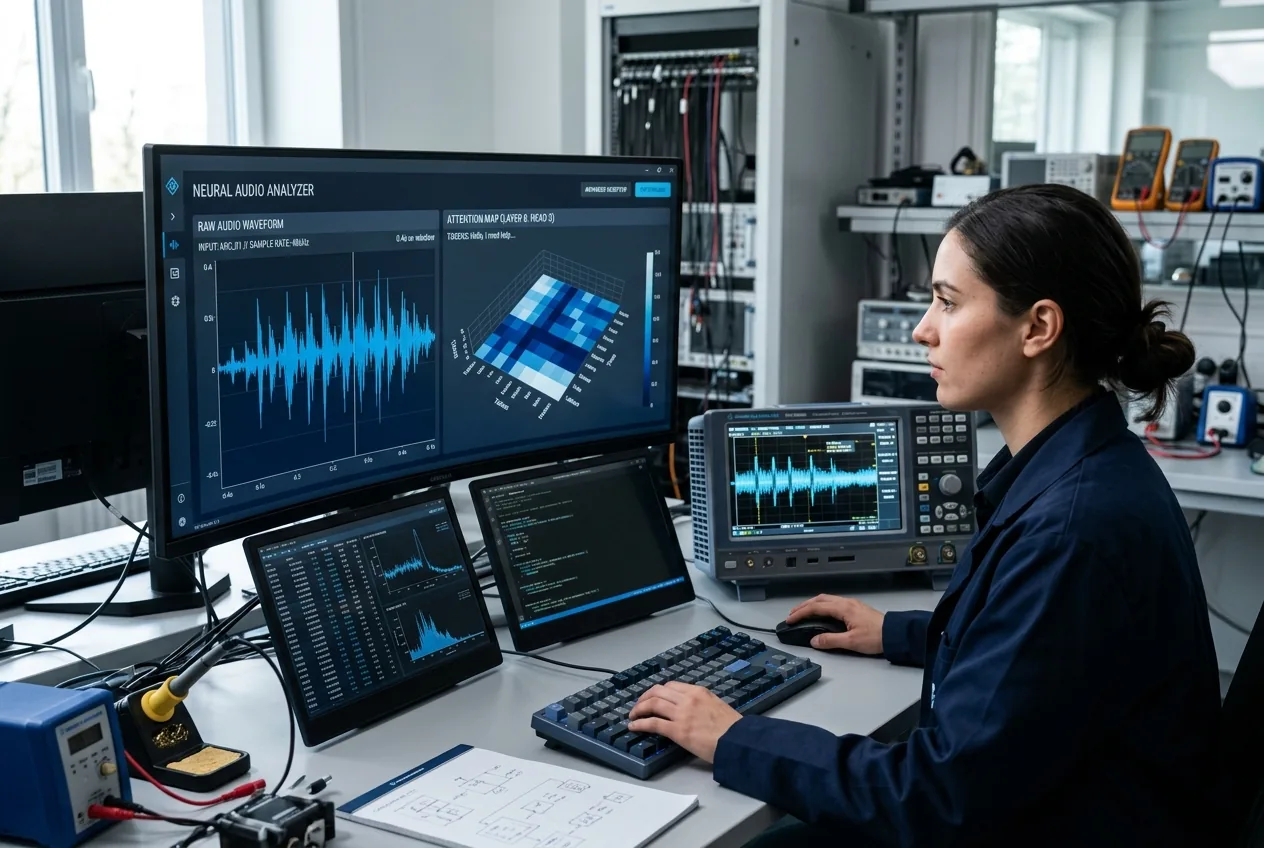
The core innovation behind systems like GPT-4o lies in unified tokenization. Rather than treating audio, visual frames, and text as separate data modalities requiring translation into intermediate text representations, an omni-modal architecture trains a single transformer across all inputs and outputs natively. Audio waveforms are tokenized directly into the model's latent space, allowing the neural network to process acoustic features alongside semantic text tokens within the exact same attention heads.
This architectural consolidation eliminates the ASR and TTS handoffs entirely. The network receives raw or compressed audio tokens and emits corresponding audio tokens directly, achieving response latencies as low as 232 milliseconds, with an average resting near 320 milliseconds. This performance envelope precisely matches the natural response dynamics of human-to-human conversation.
More importantly, preserving audio fidelity within the latent space enables bidirectional nuance that text-only models cannot replicate. The network can detect subtle variations in pitch, hesitation, vocal strain, and speech pacing. In return, the model can dynamically adjust its own synthetic output—modulating tone, introducing deliberate pauses, or speaking more rapidly in urgent contexts. When a user interrupts, the model does not require an external circuit breaker to halt playback; the incoming audio stream immediately alters the attention weights during subsequent token generation steps, naturally yielding the conversational floor.
Desktop Integration and the Operating System Layer
Low latency alone is insufficient if the model remains trapped behind a web browser tab. Knowledge work and industrial monitoring require continuous access to contextual operating environments. OpenAI's push to embed these capabilities directly into desktop operating systems, beginning with dedicated client applications for macOS and Windows, represents an intentional effort to capture ambient machine telemetry.
An application capable of capturing frame buffers directly from the operating system bypasses this data entry bottleneck. An engineer troubleshooting an automation programmable logic controller (PLC) or analyzing a real-time computer-aided design (CAD) assembly can surface an overlaid inspection interface instantly. Because the underlying model processes image matrices alongside natural voice instructions, the user can point to visual anomalies on screen while verbally asking for structural calculations or code refactoring, treating the screen buffer as a shared canvas rather than an isolated artifact.
Compute Scaling and the Economics of Real-Time Multimodality
While the architectural elegance of unified multimodal transformers is undeniable, running these systems at enterprise scale presents staggering computational challenges. Real-time audio and high-framerate visual streaming demand significantly more compute resources than conventional text-based key-value (KV) caching. A continuous audio stream requires high-frequency token sampling, rapidly expanding the active context window and placing immense memory pressure on high-bandwidth memory (HBM) subsystems within modern accelerator clusters like Nvidia's H100 and H200 fleets.
To make these capabilities viable for hundreds of millions of users, infrastructure providers must balance inference economics against strict Quality of Service (QoS) guarantees. This economic reality explains why tiering mechanisms remain essential. Centralized datacenters must prioritize compute allocations, shifting idle sessions, rate-limiting intensive video streams, and falling back to smaller distillation models when server clusters face peak capacity crunches.
Furthermore, managing bidirectional audio streams over variable internet connections requires robust client-server synchronization protocols. Small drops in packet transmission that would be imperceptible in asynchronous text generation can cause audible artifacts, stuttering, or desynchronized token generation in a live voice environment. Balancing low latency with loss-tolerant audio codecs is an active engineering frontier that straddles the boundary between deep learning inference and classical telecommunications engineering.
Beyond the Hype: The Operational Reality Ahead
As industry observers look past speculative model release cycles and focus on operational fundamentals, the path forward is unmistakably clear. The value of generative AI in enterprise settings will not be measured by benchmark point differentials on abstract standardized tests. Instead, it will be evaluated on deterministic latency, platform integration depth, and the model's ability to act as an unencumbered bridge between human operators and complex software environments.
Moving computational processing out of siloed pipelines and into native multimodal networks establishes the foundation for truly autonomous agents. When an AI system can simultaneously see the engineer's screen, hear the cadence and tone of their operational commands, and deliver sub-second solutions directly back into the native workflow, the interface between human operator and digital machine reaches an unprecedented level of mechanical cohesion. The future of workplace automation is not about waiting for a mythic model iteration; it is about engineering the low-latency pipelines that turn existing intelligence into a natural, persistent extension of human industry.




Comments
No comments yet. Be the first!