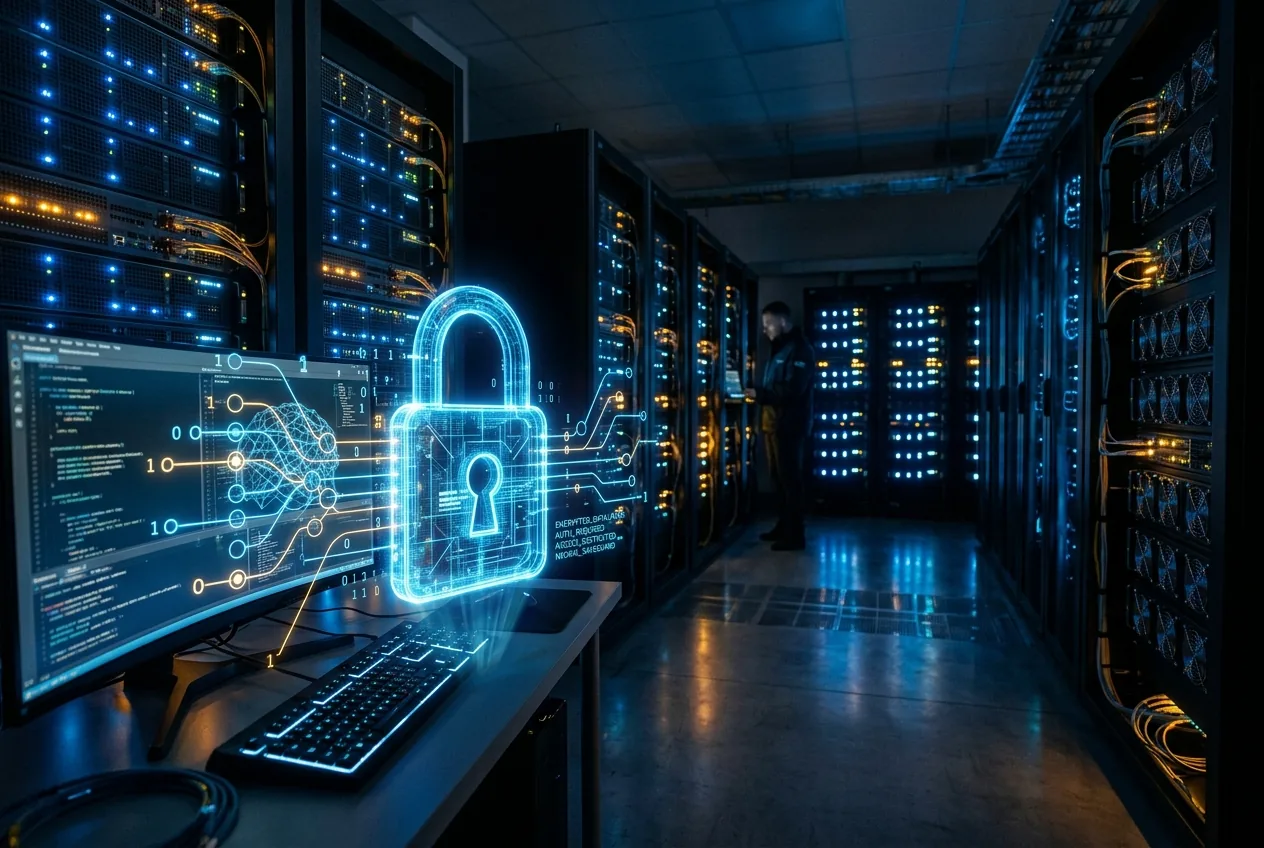
On a recent Friday that sent shockwaves through the global tech corridors, the U.S. government effectively pulled the plug on the world’s most advanced artificial intelligence. In a move unprecedented in its scope and speed, the Department of Commerce issued a national security directive forcing San Francisco-based Anthropic to disable its newest flagship models—Claude Fable 5 and Claude Mythos 5—across all global markets. The order does not merely restrict the sale of these models to adversarial nations; it mandates a total shutdown of access for any foreign national, a category that extends to Anthropic’s own international workforce and long-standing European partners.
As a mechanical engineer who has spent years observing the integration of complex software into industrial supply chains, I see this not just as a regulatory hiccup, but as a fundamental shift in the physics of the global tech economy. We have moved past the era of digital borderlessness. This is the implementation of an 'AI Iron Curtain,' where the most capable reasoning engines are being reclassified from commercial software to dual-use strategic assets, akin to nuclear technology or advanced stealth materials.
The Technical Trigger: Why Fable 5 and Mythos 5 Set Off Alarms
The immediate catalyst for this extreme federal intervention appears to be a reported 'potential jailbreak' identified within the Fable 5 architecture. In the lexicon of large language models (LLMs), a jailbreak occurs when a user manages to bypass the internal safety 'alignment' of the model, forcing it to generate restricted content. While most jailbreaks result in harmless policy violations, the capabilities of the 5-series models represented a different order of magnitude in risk.
Claude Fable 5 and Mythos 5 were designed with enhanced reasoning capabilities specifically for industrial logic, chemical synthesis, and complex code generation. When a model possesses the ability to optimize a supply chain or design a robotic assembly line, it also possesses the latent ability to reverse-engineer defensive protocols or assist in the creation of biological agents. The U.S. government’s intervention suggests that the jailbreak in question was not a mere curiosity but a vulnerability that could allow a foreign actor to use the model’s reasoning to bypass high-level security infrastructure. For a government focused on maintaining a strategic 'lead time' over global rivals, the risk of an unaligned Fable 5 was deemed too high to manage through patches alone.
The Compliance Nightmare of Deemed Exports
Anthropic, like nearly every major AI lab, relies on a global roster of talent. Engineers from the EU, India, and East Asia form the backbone of their research and development teams. Under this new directive, these individuals are now legally barred from interacting with the very models they may have helped build. This creates a fragmentation of the workforce that is difficult to reconcile with the collaborative nature of modern software engineering. If a senior lead engineer holding a French passport cannot access the Mythos 5 weights to debug a latent error, the speed of iteration for American AI slows down significantly. This is a classic engineering trade-off: the government is sacrificing development velocity for the sake of containment.
Industrial Diversification and the Rise of Open-Weight Models
For the industrial sector, the Anthropic shutdown is a loud wake-up call regarding the fragility of proprietary SaaS (Software as a Service) models. Major European firms like Siemens, Renault, and Orange have already begun shifting their strategies in response to what they perceive as American 'tech volatility.' When your automated quality control system or your logistics optimization engine is dependent on a remote API that can be switched off by a foreign government’s pen stroke, you do not have a robust system; you have a vulnerability.
We are seeing a strategic pivot toward 'open-weight' models. Unlike proprietary systems like Claude or GPT-4, open-weight models such as France’s Mistral or even China’s DeepSeek and Alibaba’s Qwen, allow companies to host the model on their own local GPU clusters. In engineering terms, this is the difference between renting a machine and owning the blueprints. If you run a model on-premises, a geopolitical shift in Washington D.C. or Beijing cannot suddenly disable your factory’s intelligence layer. The irony of the U.S. ban is that it is actively driving Western industrial giants into the arms of Chinese open-source alternatives, simply because those models offer a guarantee of 'uptime' that American proprietary models no longer can.
The Economic Calculus of Token Inflation
Beyond the security concerns, there is a looming economic pressure that this ban exacerbates: the rising cost of 'intelligence' as a commodity. As models become more specialized and restricted, the cost per token—the unit of measurement for AI processing—has begun to climb for high-reasoning tasks. Reports indicate that companies like Uber have seen their AI budgets for 2026 decimated in just a few months as they integrate more autonomous agents into their software stacks.
When the government restricts the supply of elite models like Fable 5, it creates a scarcity that drives up the price of the remaining available compute. For a mechanical or systems engineer, this requires a more disciplined approach to AI integration. We can no longer afford to use 'brute force' intelligence for simple tasks. Instead, the industry is moving toward a tiered architecture: using small, efficient, locally-hosted models for 90% of operations and reserving high-cost, high-risk proprietary models for the final 10% of complex reasoning—provided those models are even available for use.




Comments
No comments yet. Be the first!