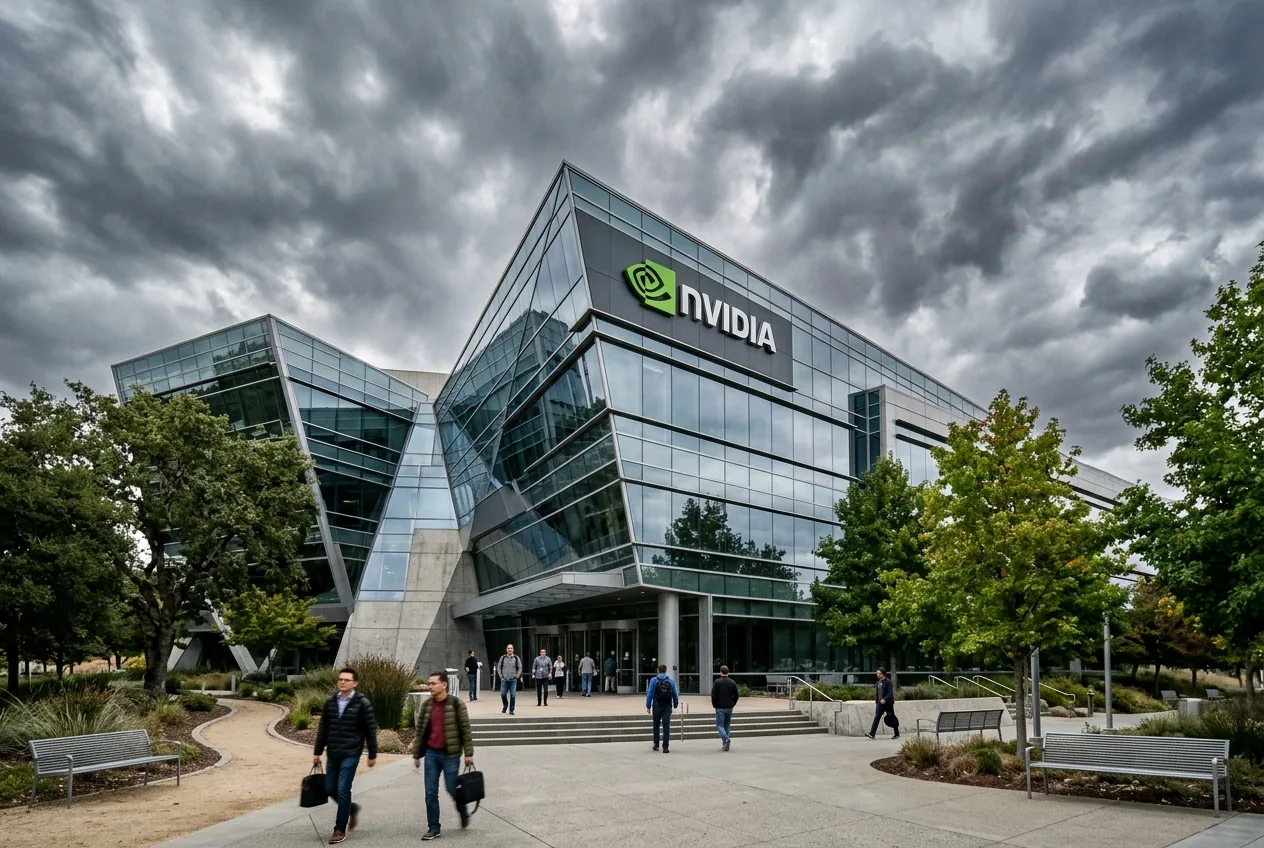
Semiconductor titan Nvidia has initiated an independent internal inquiry after co-founder and Chief Executive Officer Jensen Huang acknowledged engaging in an extramarital affair with a businesswoman whom United States intelligence agencies suspect of operating on behalf of Beijing. The disclosure, first outlined in an internal memorandum sent by Huang to company staff, has sent shockwaves through the technology sector, triggering corporate governance interventions and immediate scrutiny from congressional leaders in Washington.
The development places the world's preeminent supplier of artificial intelligence silicon squarely in the crosshairs of geopolitical counterintelligence. Huang, who has spent three decades building Nvidia from a niche graphics chip designer into a multi-trillion-dollar linchpin of global compute infrastructure, apologized directly to employees for his personal conduct while pledging his continued leadership during the board's review.
The Scope of the Allegations
The woman at the center of the intelligence inquiry has been identified as Alice Huang, an executive associated with Megaspeed International, a Singapore-based enterprise specializing in data center hosting and high-density compute infrastructure. According to investigative reports and briefings provided to federal officials, United States intelligence agencies came to believe that she was tasked by China's Ministry of State Security to establish relationships with high-level American technology executives.
Federal counterintelligence assessments reportedly concluded that Alice Huang sought access to strategic insights surrounding advanced semiconductor supply channels, data center deployment schedules, and hardware distribution logistics. China's foreign ministry has rejected the intelligence claims, characterizing the allegations of espionage as groundless speculation intended to disrupt international commerce.
In his letter to Nvidia personnel, Jensen Huang addressed his conduct in personal terms rather than addressing espionage specifics directly. 'I was unfaithful to my wife. My actions hurt her and our children. There is no excuse for what I did. I am deeply sorry,' Huang wrote, emphasizing that he intends to work to rebuild the trust of the company's workforce and commercial partners while remaining focused on operational execution.
Corporate Governance and Internal Damage Control
While personal indiscretions are typically treated as private matters, the nexus between Huang's role as the architectural visionary of Nvidia and the involvement of a suspected foreign intelligence operative fundamentally alters the corporate equation. For a hardware company whose graphics processing units form the backbone of modern machine learning clusters, operational security is indivisible from enterprise value.
Nvidia's board moved quickly to reassure investors, hardware partners, and regulatory authorities that initial internal checks found no evidence of an operational or intellectual property breach. The company maintains that its core systems, design repositories, and hardware verification pipelines remain fully secure, with no indication that proprietary microcode or export-restricted technology transferred outside authorized channels.
Washington Demands Operational Scrutiny
The political reverberations of the revelation were swift. Leaders across key United States House committees dispatched formal correspondence to Nvidia demanding detailed accounting of the executive suite's counterintelligence safeguards. Lawmakers are focusing specifically on how a corporate leader overseeing critical dual-use technology could become entangled with an alleged foreign intelligence asset without triggering earlier internal alarms.
Congressional leaders have formally invited Huang to appear before Capitol Hill panels to discuss Nvidia's internal security architecture and protocols against foreign adversary espionage. Committee chairs voiced sharp concerns over whether the People's Republic of China obtained indirect visibility into upcoming silicon iterations, yield optimization data, or sensitive shipping conduits designed to comply with strict Commerce Department export controls.
Over the past three years, the United States Bureau of Industry and Security has progressively tightened restrictions on the transfer of high-bandwidth accelerators to China, specifically capping interconnect bandwidth and floating-point compute thresholds. With Nvidia repeatedly re-engineering its high-end Blackwell and Hopper architectures into specialized SKUs to comply with shifting statutory limits, any unauthorized foreknowledge of regulatory compliance strategies or performance bins could provide foreign competitors with an immense strategic advantage.
What Technical Assets Were at Stake?
To evaluate the industrial implications of the inquiry, engineers and supply chain analysts look closely at the boundary between executive management and physical intellectual property. While a chief executive rarely handles raw register-transfer level source code or low-level layout masks for leading-edge nodes, executive visibility covers high-leverage commercial and architectural variables that are intensely valuable to a competing nation's domestic semiconductor push.
High-level hardware roadmaps contain precise timelines for foundry tape-outs, advanced packaging allocations from partners like Taiwan Semiconductor Manufacturing Company, and proprietary silicon packaging techniques such as CoWoS chip-on-wafer bonding. Knowledge of these procurement volumes, substrate bottlenecks, and interposer design constraints can allow foreign state-backed fabs to identify vulnerabilities in the global hardware supply chain.
Furthermore, Megaspeed International's business model as a regional data center operator places it in proximity to high-density compute procurement. In an era where export controls have driven a sophisticated gray market for high-performance computing hardware across Southeast Asia, counterintelligence investigators are keenly focused on whether commercial relationships were exploited to circumvent tracking or divert sanctioned compute infrastructure into restricted jurisdictions.
Can Operational Continuity Hold?
The broader technology sector now faces the question of whether Nvidia can maintain its breakneck pace of annual architectural rollouts while navigating an executive-level federal inquiry. The company currently commands the vast majority of the worldwide market for generative AI accelerators, with hyperscalers and sovereign compute programs committing tens of billions of dollars annually to its hardware ecosystem.
For enterprise customers, stability at the apex of Nvidia is critical. Huang has long served as the principal evangelist and technological conductor for the firm's unified CUDA software ecosystem, networking fabrics such as Quantum InfiniBand, and integrated rack-scale systems. A prolonged congressional inquiry or findings of security negligence could complicate Nvidia's lucrative contracts with United States national laboratories, defense research agencies, and federally backed supercomputing initiatives.
As outside investigators commence their review and lawmakers prepare formal hearings, Nvidia's leadership faces an unprecedented test of operational discipline. For an engineering culture built on mathematical precision and relentless hardware execution, the coming months will test whether institutional safeguards can successfully insulate the world's most critical compute platform from personal human fallibility.



Comments
No comments yet. Be the first!