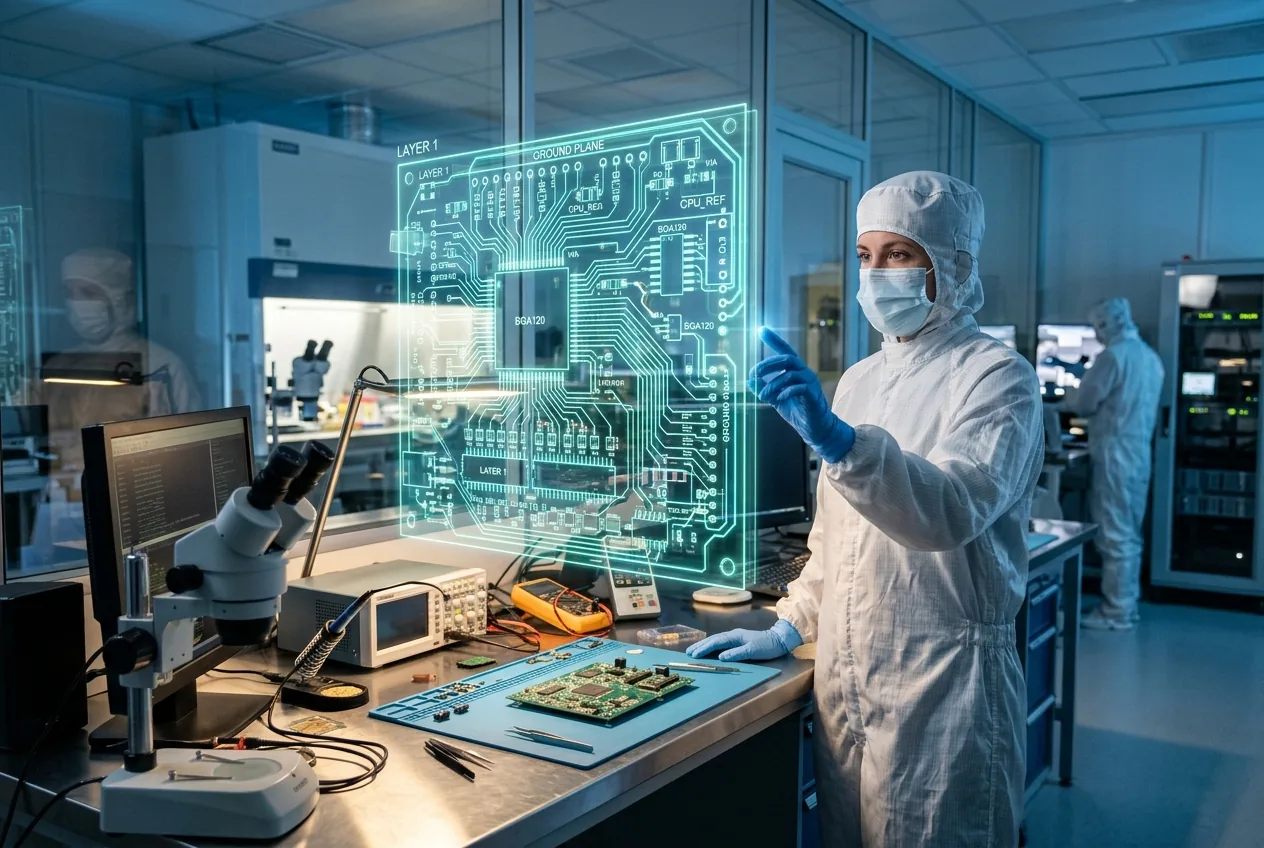
When OpenAI introduced its latest flagship model, GPT-6 Astra, the company framed the release with a phrase once relegated to academic papers and speculative philosophy: early artificial general intelligence. While executive statements surrounding artificial general intelligence have historically been dismissed as Silicon Valley hyperbole or calculated mystique, the financial markets reacted with immediate, surgical precision. Investors did not pause to debate the philosophical definitions of synthetic cognition. Instead, they scoured the product demonstrations to identify which industrial software business models had just been made structurally obsolete.
Within hours of a brief technical demonstration showing the model autonomously executing printed circuit board layout—a workflow that has historically required specialized engineering talent and licensed toolchains costing tens of thousands of dollars per seat—shares in leading electronic design automation software vendors fell sharply. The sudden repricing demonstrated a fundamental shift in how advanced machine intelligence impacts the real economy. The financial disruption is no longer a broad, theoretical shockwave rolling across white-collar knowledge work; it is an aggressive, targeted displacement of specialized high-barrier technical tasks.
The Engineering Reality of Automated Physical Layout
To understand why the markets reacted so violently to a printed circuit board demonstration, one must examine the mechanical and electrical bottlenecks of modern hardware development. Electronic design automation, or EDA, has spent four decades building deterministic, rule-based software environments to help electrical engineers place components and route traces. Balancing high-speed trace lengths, differential pairs, thermal dissipation, layer stackups, and parasitic capacitance is an extraordinarily labor-intensive optimization problem. Human layout engineers must constantly balance physical manufacturing constraints against electromagnetic interference and high-frequency signal integrity.
When an artificial intelligence model demonstrates competent, multi-layer routing directly from a netlist without requiring continuous human-in-the-loop parameter adjustments, the economic dynamics of hardware fabrication change fundamentally. Historically, complex board layout could take an engineering team weeks of iterative routing, thermal modeling, and design rule checking. Compressing that timeline into an automated computation does not merely speed up the prototyping cycle; it threatens the recurring licensing revenue of the specialized software platforms that engineers rely on to conduct those manual workflows.
Moreover, printed circuit board design serves as the canary in the coal mine for broader semiconductor physical synthesis. The jump from routing traces on an FR-4 fiberglass substrate to placing logic cells on a three-nanometer silicon die is technically immense, governed by extreme quantum effects and photolithography masks. Yet the underlying mathematical principles—spatial partitioning, timing closure, and iterative routing optimization—share the same algorithmic lineage. If frontier foundation models can parse topological layout rules at the board level, the multi-billion-dollar tollbooths controlling microchip synthesis will face similar computational erosion.
The Structural Paradox of Collapsing Token Prices
While the threat to established engineering software appears immediate, the financial architecture supporting these frontier models is grappling with severe internal contradictions. At the exact moment models are demonstrating high-value industrial utility, the unit cost of delivering model inference is experiencing an unprecedented deflationary collapse. Wall Street research analysts noted that benchmark token pricing across frontier models fell by nearly thirty percent over a four-week stretch, driven by brutal algorithmic competition, open-weight parameter pruning, and aggressive infrastructure subsidies.
This margin squeeze creates an acute capital paradox across the technology sector. For an enterprise relying on commercial access to AI models, computational execution has never been cheaper or more capable. Yet for the infrastructure providers sinking hundreds of billions of dollars into high-density data centers, custom silicon accelerators, and multi-gigawatt utility contracts, collapsing token prices threaten long-term capital recovery. The physical cost to run compute clusters—measured in concrete, liquid cooling loops, high-voltage transformers, and megawatts—remains firmly tethered to physical supply constraints and rising utility rates.
The Psychology and Utility of Apocalyptic Marketing
The aggressive positioning of GPT-6 Astra as an emergent AGI also aligns with a well-established pattern of high-stakes corporate posturing. Over the past several hardware generations, frontier AI developers have oscillated between breathless warnings of catastrophic societal risk and aggressive commercial deployment schedules. The rhetoric of existential danger and frontier supremacy frequently serves a dual commercial function: it discourages regulatory intervention from open-source alternatives by framing the underlying software as dangerous military-grade infrastructure, while simultaneously justifying astronomical valuations to institutional investors.
This divide between marketing mythology and mechanical utility explains the bifurcation on trading desks. While regulatory bodies and public safety committees debate long-term governance and risk mitigation frameworks, industrial operators are quietly integrating these models into computer-aided engineering pipelines. The actual economic disruption of frontier machine intelligence is happening through the mundane, systematic erosion of discrete engineering software niches rather than wholesale workplace collapse.
The Hidden Vulnerability of High-Skill Workflows
The sudden devaluation of specialized software categories highlights an overlooked reality of modern engineering productivity. For decades, the conventional wisdom held that physical, manual tasks and routine clerical labor were uniquely exposed to automation, while highly specialized design engineering remained shielded by complex mathematical training and physical intuition. The commercial rollout of GPT-6 Astra upends that assumption by demonstrating that any workflow relying on structured inputs, rigid rulebooks, and digital canvas generation is intrinsically vulnerable to synthetic optimization.
Design engineers are unlikely to vanish entirely, but the operational leverage required to bring an industrial product to market is shifting radically. A single hardware architect utilizing multi-modal autonomous routing models can replicate the weekly throughput of a complete physical layout department. The economic pressure does not merely land on the software providers whose per-seat licenses are terminated; it lands on junior and mid-level engineering personnel whose traditional entry point into the hardware industry was manual layout execution, board bring-up, and design-rule verification.
This transition mirrors the structural shifts seen across mechanical drafting during the migration from manual drafting boards to parametric computer-aided design in the late twentieth century, but unfolds at machine speed. What once took decades of software adoption now materializes over a single product release cycle. When the tools to execute complex engineering workflows become ambient capabilities embedded inside centralized machine learning services, the barrier to hardware creation drops—and the specialized labor markets that formed around the old frictions are irrevocably rewritten.
Navigating the Hardware-Software Rebalance
As the initial market shock subsides, the industrial manufacturing sector must navigate a fundamentally rebalanced commercial landscape. The electronic design automation giants that saw their valuations dented by the Astra announcement possess immense proprietary intellectual property, highly defensive patent portfolios, and deep integration with foundries that cannot be easily dislodged by a software demo. The ultimate contest will not be fought between pure-play foundation models and legacy engineering systems, but rather over who successfully synthesizes generative topological routing with verifiable physical manufacturing tolerances.
At the same time, institutional investors are learning that assessing the artificial intelligence economy requires rigorous technical scrutiny rather than speculative enthusiasm. Capital can no longer flow uniformly into the sector under the vague assumption that all enterprise technology will capture equal windfalls. Distinguishing between genuine industrial utility and subsidized inference will dictate which balance sheets survive the inevitable contraction in capital spending. The line between high-value physical workflow automation and commoditized software generation has been permanently drawn, and the industrial landscape will continue to register the aftershocks long after the marketing claims of synthetic sentience have faded.



Comments
No comments yet. Be the first!