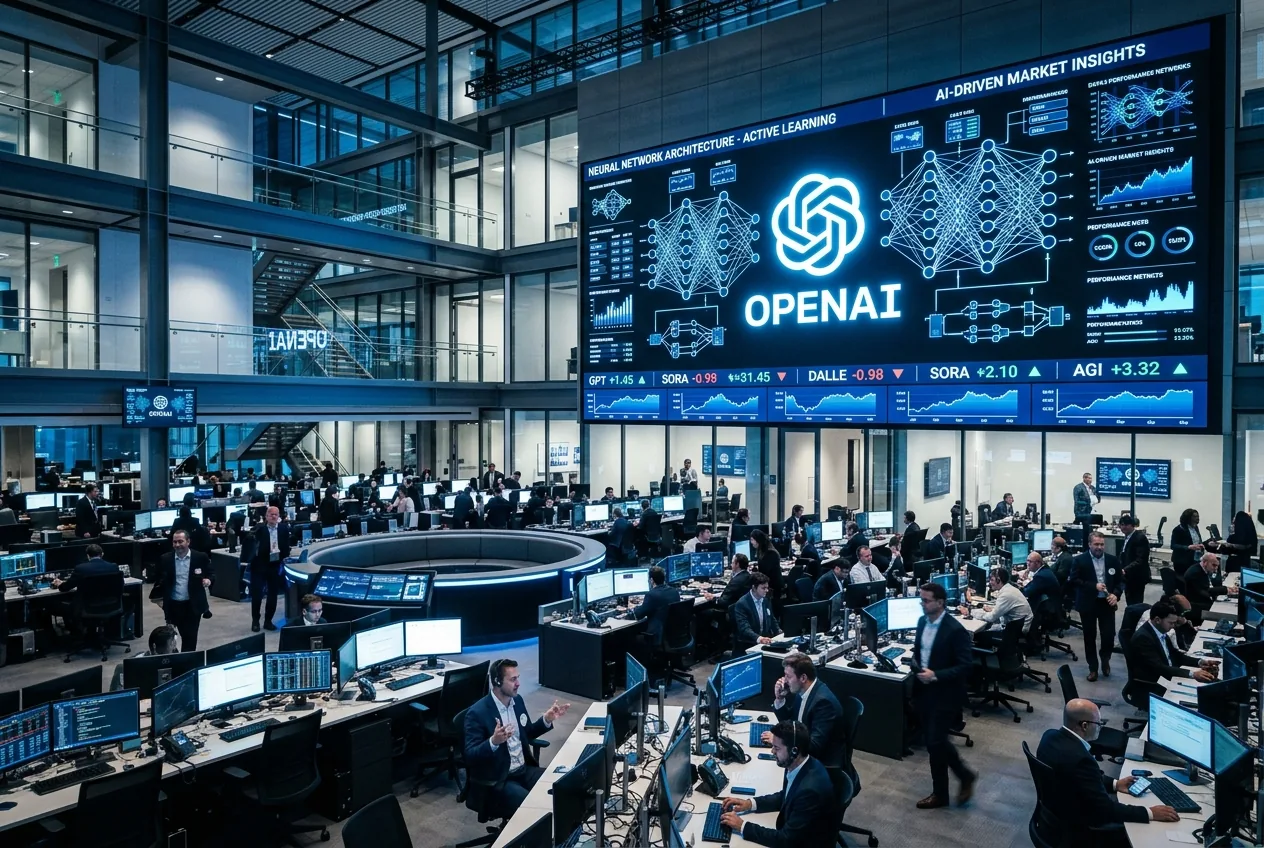
The timing of the filing is indicative of a broader trend in the technology sector where the line between software development and heavy industrial production has blurred. In March, OpenAI’s valuation reached a staggering $852 billion following a fresh $122 billion capital injection. While such figures are often dismissed as venture capital hyperbole, the underlying utility of that cash is rooted in the physical world. OpenAI is no longer just writing code; it is architecting a global network of data centers, securing massive power grids, and stockpiling specialized silicon at a scale that mirrors traditional industrial giants. The IPO represents the next phase in funding this compute-intensive infrastructure.
The Strategic Pivot Toward Public Capital
OpenAI’s decision to file confidentially gives the company a critical tactical advantage. Under the JOBS Act, companies can initiate the IPO process with the Securities and Exchange Commission (SEC) without immediately revealing their internal financial metrics to the public or competitors. This allows leadership to gauge market appetite and refine their pitch while maintaining a degree of operational secrecy. In a public statement, the company noted that while the S-1 has been submitted, the timing for the actual listing remains fluid. They acknowledged a “complicated set of tradeoffs,” suggesting that certain ambitious projects—or “side quests”—are easier to execute away from the quarterly scrutiny of public shareholders.
However, the pressure to go public has become undeniable. Rival Anthropic, the developer of the Claude AI models, filed for its own offering just one week prior, with a valuation estimated at $952 billion. The race between these two entities has evolved beyond algorithmic benchmarks into a contest of fiscal endurance. By entering the public markets, OpenAI gains access to a much deeper pool of liquidity, allowing it to sustain the multi-billion-dollar annual burn rates required to train and deploy next-generation large language models (LLMs).
From a mechanical engineering perspective, the capital requirements for AI are increasingly resembling those of the aerospace or semiconductor industries. The hardware-software syzygy required to run models like GPT-5 or Sora involves millions of GPUs, liquid-cooling systems at a massive scale, and energy-dense power infrastructure. The private markets, while robust, are beginning to hit the ceiling of what they can provide for such resource-heavy endeavors. Public markets offer the scale necessary to treat AI as a new global utility.
The Architecture of an $852 Billion Valuation
To understand why OpenAI is seeking such a massive public valuation, one must look at the industrial footprint of the company. The $122 billion raised earlier this year was not earmarked for marketing; it was a war chest for physical infrastructure. The cost of compute is the primary friction point in the development of AGI. Every iteration of a model requires an exponential increase in FLOPS (floating-point operations per second), which translates directly to more floor space in data centers and more megawatts of electricity.
OpenAI’s Chief Financial Officer, Sarah Friar, has been vocal about the company’s intent to democratize the ownership of this infrastructure. In a recent interview, Friar emphasized that the company plans to reserve a portion of its eventual stock offering for retail investors—the average users who have fueled ChatGPT’s meteoric rise. This strategy serves two purposes: it creates a massive, loyal base of shareholders and generates the social capital necessary to navigate the regulatory hurdles that inevitably follow a company of this size. “Everybody wants to own part of a rocket company—I hope everyone wants to own part of ChatGPT,” Friar noted, drawing a direct parallel to the public enthusiasm surrounding SpaceX.
Yet, the valuation also carries significant risk. Reports indicate that OpenAI has missed multiple internal revenue and user growth targets over the past year. This is partly due to the emergence of Google’s Gemini and Anthropic’s Claude as formidable alternatives, and partly due to the natural plateauing of consumer curiosity. Transitioning to a public company means that these misses will no longer be internal discussions; they will be reflected in real-time on the stock ticker. The transition demands a shift from “visionary research” to “consistent industrial output.”
Does the Public Market Ready for AI’s Volatility?
The primary concern for potential investors remains the long-term economic viability of the current AI boom. Critics argue that the capital expenditure required to keep OpenAI at the forefront of the field is unsustainable without a more defined path to profitability. While ChatGPT remains a household name with hundreds of millions of users, the enterprise side of the business—where the real margins lie—is a crowded and contentious battlefield. Large-scale industrial automation and the integration of AI into global supply chains are the true targets, but these sectors move slower than the consumer market.
There is also the question of the “X factor.” As SpaceX prepares its own trillion-dollar debut, the market’s attention is split. Elon Musk’s involvement in both the aerospace sector and the AI sector (via xAI) creates a complex web of competition for the same investment dollars. OpenAI must prove that its focus on the “brain” of the future industrial world is a more sound investment than the “body” provided by robotics and rocket companies.
The Road Ahead: From Startup to Utility
As the SEC reviews OpenAI’s confidential filing, the company is likely focused on streamlining its operations. Internal memos have suggested a move to reduce “side quests”—projects that, while scientifically interesting, do not contribute to the core goal of achieving and commercializing AGI. This focus is a hallmark of a company preparing for the rigors of Wall Street. The pragmatic reality is that OpenAI is transitioning into a provider of a fundamental technological layer—much like a power company or a telecommunications giant.
The industrialization of AI is no longer a theoretical future; it is a current economic event. The IPO will provide the transparency and capital required to see if OpenAI’s model of massive compute and centralized intelligence can scale into a sustainable global business. For the engineers and analysts watching from the sidelines, the focus will remain on the “how”—how the company will manage its massive energy needs, how it will secure its supply chains for specialized chips, and how it will maintain its technical lead in an increasingly crowded field.
OpenAI’s filing is the starting gun for a new era of public technology companies. It signals that the experimental phase of artificial intelligence is over. We have entered the era of the AI industrial complex, where the winners will be determined not just by the elegance of their algorithms, but by the efficiency of their hardware and the depth of their pockets.




Comments
No comments yet. Be the first!