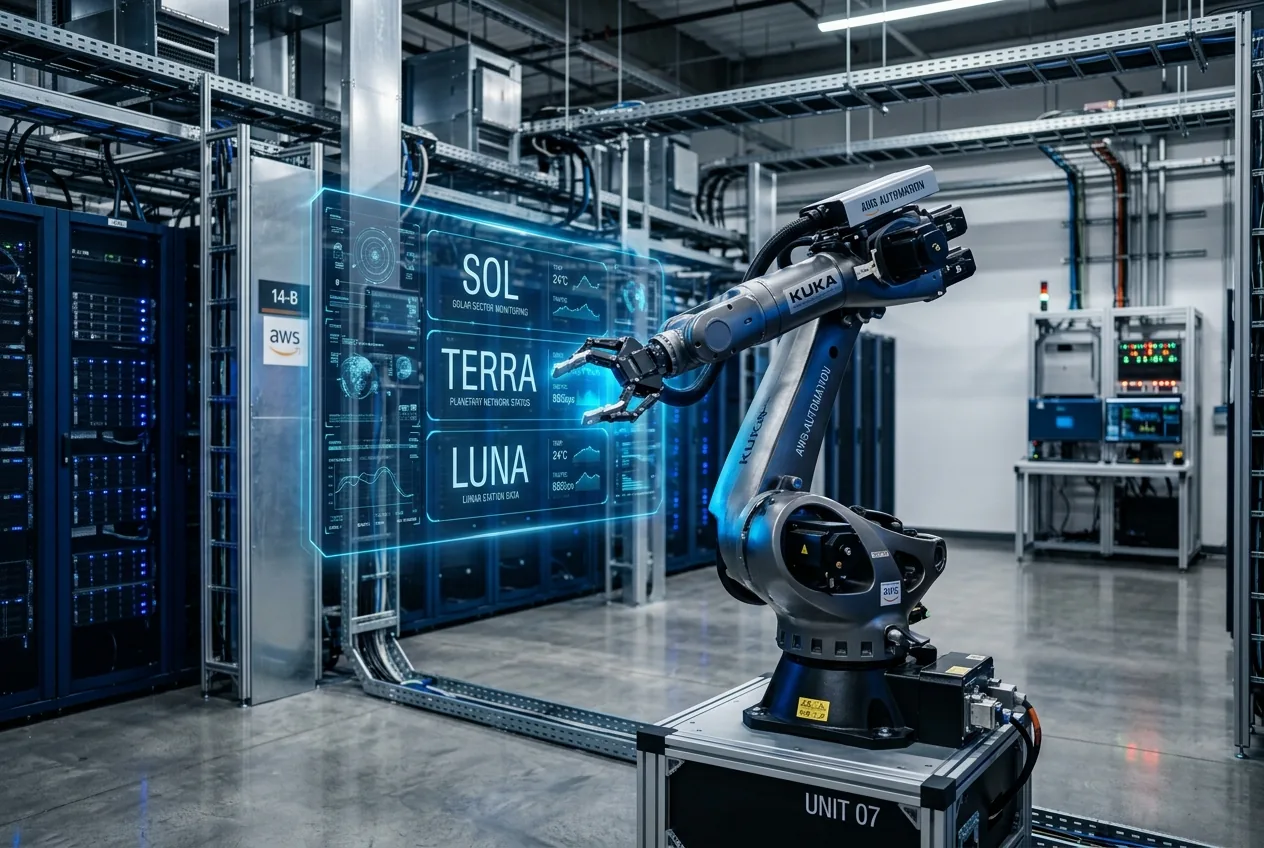
In a move that fundamentally recalibrates the economic landscape of generative artificial intelligence, OpenAI has announced the general availability of its GPT-5.6 model family—codenamed Sol, Terra, and Luna—on Amazon Bedrock. This deployment marks a pivotal shift in OpenAI’s distribution strategy, moving beyond its historical exclusivity with Microsoft Azure to capture the massive enterprise and industrial footprint of Amazon Web Services (AWS). To sweeten the migration for legacy industrial players, OpenAI is simultaneously implementing a radical pricing reset, cutting costs on select GPT-5.6 models by as much as 80%.
For those of us in the mechanical engineering and robotics sectors, this is not merely another software update. It represents the maturation of Large Multimodal Models (LMMs) into specialized tools capable of handling the high-stakes, high-precision requirements of industrial automation. By tiering their architecture into three distinct models, OpenAI is addressing the three primary friction points of industrial AI: computational overhead, latency, and unit economics.
The Triad Architecture: Sol, Terra, and Luna
The GPT-5.6 suite is designed around the philosophy of 'right-sized' intelligence. In previous iterations, engineers were often forced to use a monolithic model for every task, leading to massive inefficiencies where a trillion-parameter model was essentially being used to perform basic Boolean logic on a factory floor. The new architecture solves this through functional specialization.
Sol is the flagship of the fleet. It is a high-parameter, dense model designed for complex reasoning, multi-step engineering simulations, and advanced R&D. In a robotics context, Sol is the 'brain' that handles the high-level path planning and strategic decision-making in unpredictable environments. It features a vastly expanded context window and a refined attention mechanism that reduces hallucinations in technical specifications—a critical requirement for any system integrated into a Bill of Materials (BOM) or a CAD workflow.
Terra serves as the workhorse, or the 'foundation' model. It is optimized for Retrieval-Augmented Generation (RAG) and middle-office tasks. For supply chain managers, Terra is the bridge between unstructured logistical data and structured ERP systems. It balances reasoning capabilities with a significantly higher tokens-per-second (TPS) rate than Sol, making it the ideal candidate for real-time fleet management and predictive maintenance scheduling.
Luna, the most intriguing of the three from a mechanical perspective, is a lightweight, highly quantized model designed for edge deployment. Luna is built for the interface. It is the model that will reside on autonomous mobile robots (AMRs) and localized PLC (Programmable Logic Controller) systems. With its low memory footprint, Luna allows for near-zero latency processing of sensor data, enabling robots to interpret natural language commands and visual cues directly on the factory floor without needing a round-trip to a centralized cloud server.
Does an 80% Price Cut Signal a Race to the Bottom?
Enterprise customers have been vocal about the 'economic ceiling' of AI. While a pilot program using GPT-4 might show promise, scaling that program to handle ten million automated quality inspections per day becomes cost-prohibitive at legacy prices. By resetting the price floor, OpenAI is attempting to lock in enterprise volume before competitors can solidify their positions on Amazon Bedrock. This is a classic 'land and expand' strategy, facilitated by the fact that Bedrock already hosts competitors like Anthropic’s Claude and Amazon’s own Titan models.
The 80% reduction specifically targets the Terra and Luna models, incentivizing high-frequency, high-volume automation. It forces a question upon the industry: If the cost of high-level reasoning is no longer a barrier, what happens to the traditional software stack? We are likely to see a displacement of specialized, rigid automation software in favor of more flexible, AI-driven agents that can be deployed at a fraction of the previous operational expenditure (OPEX).
Why Amazon Bedrock is the Strategic Neutral Ground
The move to Amazon Bedrock is a pragmatic acknowledgment of where industrial data actually lives. While Microsoft has made significant inroads with its Office 365 and Azure ecosystem, a staggering amount of the world’s industrial telemetry, manufacturing execution systems (MES), and logistics data resides on AWS. For a robotics firm based in Atlanta or a logistics hub in Singapore, the ability to pull GPT-5.6 models into their existing AWS Virtual Private Cloud (VPC) is a matter of security and latency.
Bedrock provides a unified API to access multiple models, allowing engineers to swap between Luna for edge tasks and Sol for complex analysis without rewriting their entire data pipeline. This 'plug-and-play' capability is essential for the rapid prototyping required in modern mechanical engineering. Furthermore, Bedrock’s governance and security features—specifically its ability to ensure that proprietary industrial data is not used to train the base OpenAI models—removes the final hurdle for conservative manufacturing giants.
Implications for Robotics and Industrial Automation
In the world of mechanical engineering, the 'holy grail' has always been the seamless integration of computer vision, natural language, and physical actuation. The GPT-5.6 release, particularly the Luna model, brings us closer to this reality. When we talk about robotics, we are moving away from 'scripted' machines toward 'intent-based' machines. An intent-based robot doesn't need a thousand lines of G-code to pick up a box; it needs to understand the visual context of the box and the verbal command of the operator.
The specialized training of the GPT-5.6 family includes a much higher density of technical and spatial reasoning data. This improves the model's ability to interpret 3D environments and provide actionable feedback to robotic controllers. When combined with the massive cost reduction, we can expect to see a surge in 'AI-native' hardware—robots and industrial tools that are designed from the ground up with the assumption that a high-level LLM is always available to process intent.
However, the technical community must remain analytical. A price cut of this magnitude suggests that OpenAI has achieved significant breakthroughs in inference optimization, likely through hardware-aware model distillation or more efficient kernels. As engineers, we must monitor whether this 80% reduction in price comes at the cost of 'model collapse' or a reduction in the nuanced reasoning required for safety-critical industrial applications. Initial benchmarks suggest that GPT-5.6 maintains its lead in logic and math, but real-world stress tests on the factory floor will be the ultimate arbiter.




Comments
No comments yet. Be the first!