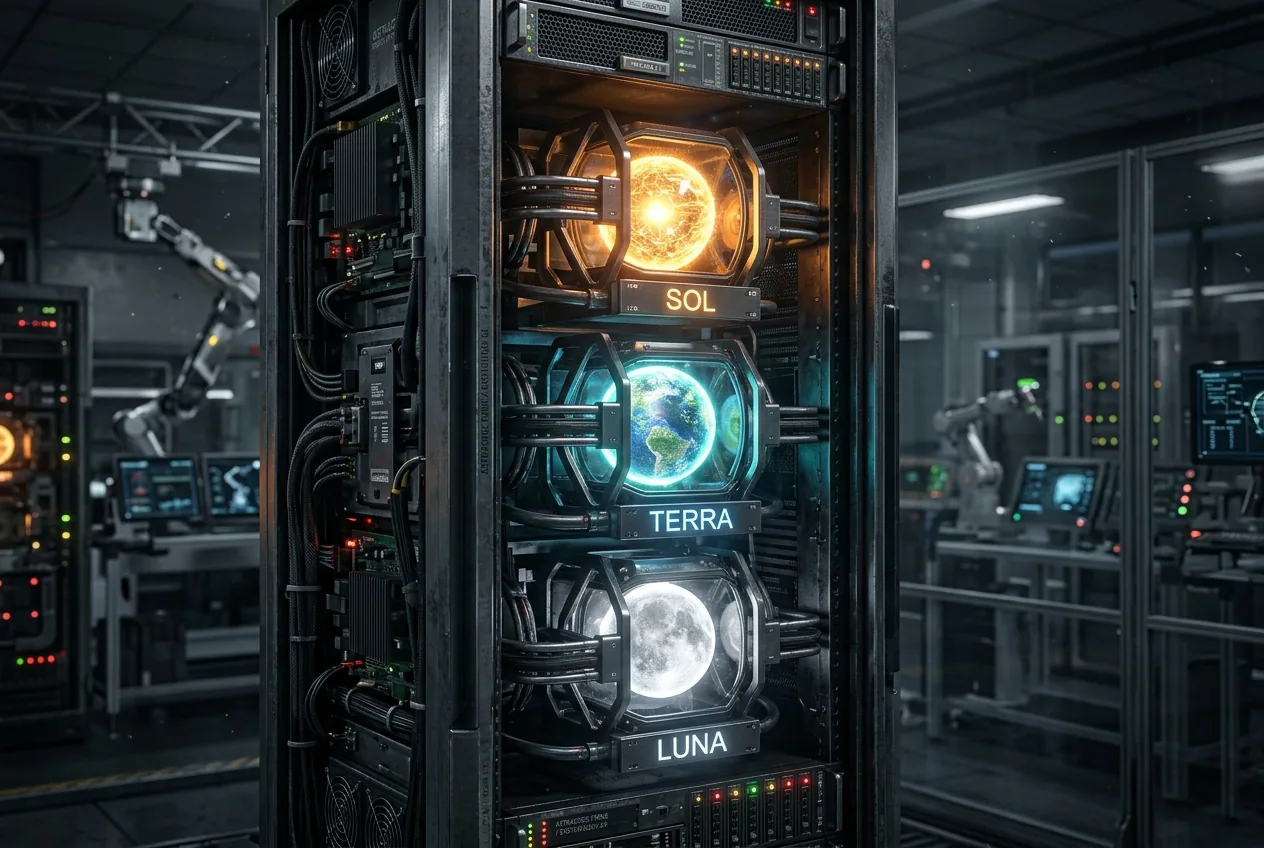
OpenAI has officially moved the needle in the global artificial intelligence arms race with the limited release of its GPT-5.6 lineup. Deviating from the singular model drops of years past, this launch introduces a tiered family of architectures internally codenamed Sol, Terra, and Luna. While the company has kept specific parameter counts under wraps, the flagship model, Sol, is being marketed as the most robust reasoning engine ever developed, specifically aimed at high-complexity industrial, scientific, and mathematical workflows.
The announcement signals a pivot in how Large Language Models (LLMs) are being positioned in the marketplace. Rather than a general-purpose assistant, the GPT-5.6 family appears to be a direct response to the demands of enterprise-level automation and the burgeoning field of humanoid robotics. For those of us monitoring the interface of software and mechanical hardware, the introduction of specialized tiers like Sol and Luna suggests that OpenAI is no longer just optimizing for chat—they are optimizing for physical and logic-heavy integration.
The Architecture of the GPT-5.6 Family
The decision to split the GPT-5.6 release into three distinct entities—Sol, Terra, and Luna—reflects a maturing understanding of compute economics. In the industrial sector, the 'one-size-fits-all' approach to AI often fails because of the inherent trade-off between latency and reasoning depth. By fragmenting the architecture, OpenAI is attempting to provide the right tool for specific mechanical and digital environments.
Sol sits at the apex of this hierarchy. Early technical documentation suggests that Sol is optimized for 'deep-reasoning' tasks, which involve long-context windows and multi-step logical verification. For mechanical engineers and industrial designers, this is the model intended for complex stress testing, generative design in CAD environments, and the simulation of intricate kinematic chains. It is less about rapid-fire response and more about the accuracy of the output, making it a potential cornerstone for R&D departments that cannot afford the 'hallucinations' prevalent in smaller models.
Terra, the middle-tier offering, is designed as the workhorse for enterprise logistics and supply chain management. It balances computational cost with high-speed data processing. In a warehouse setting, Terra is the model that would oversee fleet management and inventory optimization, where the variables are numerous but the logic remains within a bounded set of operational parameters. It is effectively the bridge between the high-level strategy of Sol and the real-time execution of the lower-tier models.
Luna, the most lightweight of the trio, represents perhaps the most significant opportunity for the robotics industry. In hardware applications, latency is the primary enemy. A robotic arm operating in a collaborative environment with humans needs to process sensor data and adjust its torque or trajectory in milliseconds. Luna is likely optimized for edge deployment, potentially running on local hardware with reduced precision requirements to ensure that the feedback loop between 'see' and 'do' remains as tight as possible.
How Sol Redefines the Industrial AI Arms Race
The timing of the GPT-5.6 release is a tactical maneuver in a market that has become increasingly crowded with competitors like Anthropic’s Claude and Google’s Gemini. However, OpenAI’s emphasis on the 'strength' of Sol points toward a focus on reliability—a metric that has historically hindered the adoption of AI in heavy industry. When we discuss the 'strength' of a model in a technical sense, we are looking at its ability to maintain logical consistency across thousands of tokens of input.
For industrial automation, this means the AI can finally be trusted to interpret complex safety manuals, regulatory frameworks, and sensor logs simultaneously to diagnose a fault in a manufacturing line. The 'Sol' architecture reportedly utilizes a new training methodology that emphasizes 'verifiable' outputs. If the model can show its work—breaking down a mechanical problem into its constituent physics equations—it moves from being a black-box novelty to a genuine engineering tool. This transparency is the missing link required to bridge the gap between AI research labs and the factory floor.
Will Limited Access Stifle or Secure the Rollout?
The Economic Viability of Next-Gen LLMs
From an engineering standpoint, the question isn’t just whether an AI can solve a problem, but whether it can solve it cost-effectively. The GPT-5.6 launch is a litmus test for the economic viability of frontier AI. If Sol requires $100 of compute to solve a problem an engineer can solve in an hour for $60, the technology remains an academic curiosity. However, if Sol can perform a week’s worth of structural analysis in seconds, the ROI for industrial firms becomes undeniable.
The tiered model suggests that OpenAI is moving toward a 'pay-for-reasoning' pricing structure. Luna will be cheap and fast, suited for high-volume, low-complexity tasks like sorting packages or basic quality control. Sol will be expensive and deliberate, reserved for the high-stakes decisions that define a company’s technological edge. This segmentation is critical for the integration of AI into global supply chains, where every cent of operational expenditure is scrutinized.
What Does This Mean for the Future of Robotics?
The ultimate destination for models like GPT-5.6 is not the desktop computer, but the robotic chassis. The 'Sol' release marks a point where the software is beginning to outpace the current generation of hydraulic and electric actuators. We now have models capable of understanding the nuances of friction, load distribution, and material fatigue; the challenge now shifts back to the hardware engineers to build machines that can keep up with the AI’s instructions.
In the coming months, we should expect to see 'Sol-integrated' robotics platforms emerging. These will be machines that don't just follow a pre-programmed path, but machines that can 'think' through a task, adjusting for broken parts or unexpected obstacles in real-time. The AI arms race is no longer just about who has the better chatbot—it is about who will provide the 'brain' for the next generation of industrial civilization.
OpenAI’s GPT-5.6 is a declarative statement that the era of general-purpose AI is transitioning into an era of specialized, industrial-grade intelligence. Whether Sol, Terra, and Luna can live up to the immense hype remains to be seen, but the architectural shift toward tiered, reasoning-heavy models is exactly the move required to turn AI into a true utility for the physical world.




Comments
No comments yet. Be the first!