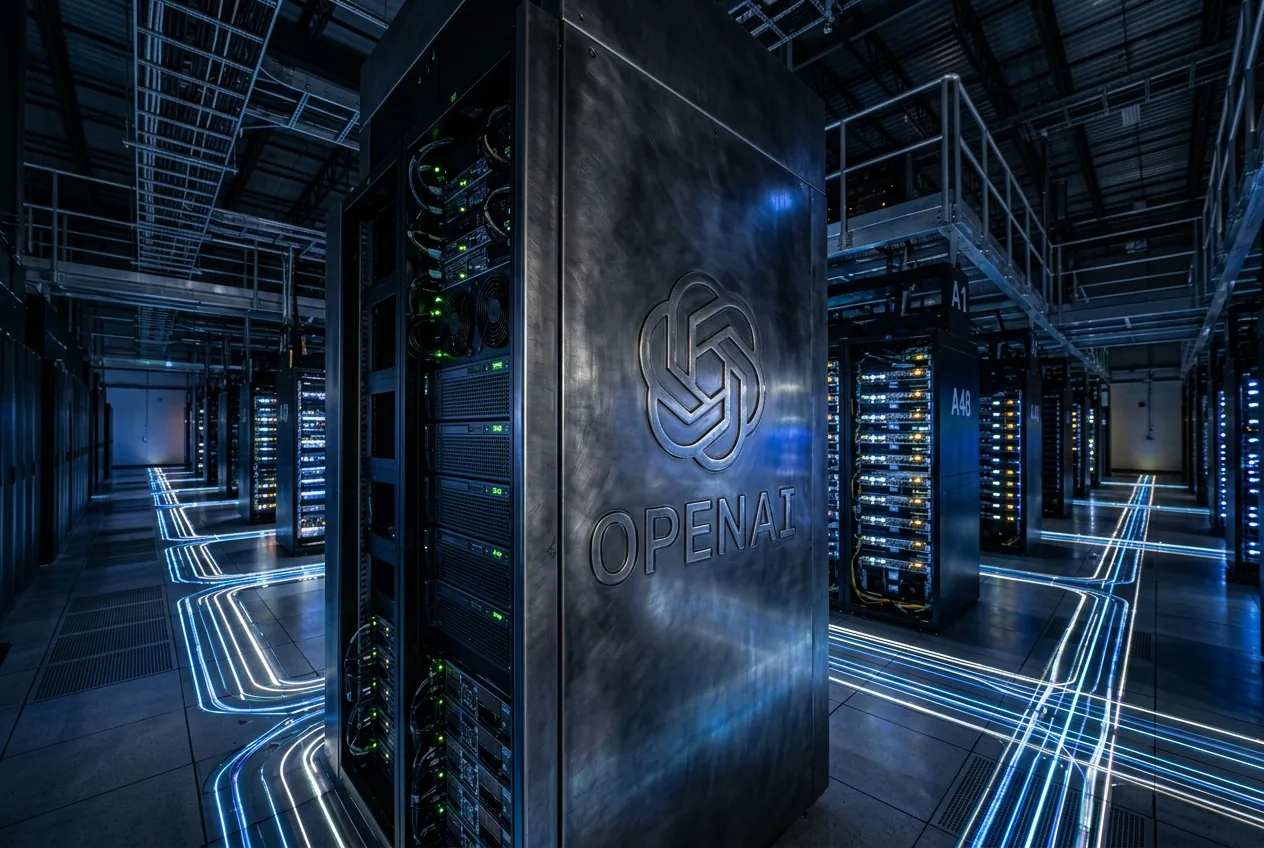
In a move that signals the end of the experimental era for generative artificial intelligence and the beginning of its industrial maturation, OpenAI has formally submitted a confidential S-1 registration statement with the U.S. Securities and Exchange Commission. The filing, led by a heavyweight trio of underwriters including Goldman Sachs, Morgan Stanley, and JPMorgan Chase, positions the ChatGPT creator for an initial public offering that could see the company valued at more than $1 trillion. This would not only make it the largest technology listing on record but would also serve as the ultimate litmus test for the economic viability of frontier AI models.
The decision to file confidentially under the JOBS Act allows OpenAI to keep its detailed financial records, including specific margins on its compute spending and revenue per token, out of the public eye until just 15 days before the investor roadshow begins. However, the announcement itself, made public on June 8, 2026, was characterized by the company as a proactive step to get ahead of inevitable leaks. While the timing of the actual debut remains fluid—with some analysts eyeing a September window—the filing marks a definitive pivot for a company that began its life as a non-profit research lab and is now seeking to become a foundational pillar of the global public markets.
The Mechanics of a $1 Trillion Valuation
To understand the scale of a $1 trillion IPO, one must look at the trajectory of OpenAI’s private valuation. As recently as March 2026, the company closed a massive $122 billion funding round backed by a consortium including Nvidia, Amazon, and SoftBank. That round valued the company at approximately $852 billion. To reach the $1 trillion milestone in the public markets, OpenAI must convince institutional investors that its growth curve is not only sustainable but that its path to dominance justifies a valuation roughly four times larger than Alibaba’s record-breaking 2014 debut.
The High Price of Intelligence
Despite the eye-watering revenue figures, OpenAI’s financials reveal a harsh reality inherent in the current generation of large-scale transformer models. During the first quarter of 2026, the company reportedly lost $1.22 for every dollar it earned. This puts the projected full-year loss for 2026 at approximately $14 billion. For a traditional industrial company, such a ratio would be catastrophic. For OpenAI, it is the cost of doing business in a hardware-constrained environment where the price of compute acts as a massive recurring tax on every unit of output.
The primary driver of these losses is the capital expenditure required to maintain and scale compute infrastructure. Training frontier models like GPT-5 and its successors requires massive clusters of the latest-generation GPUs, often numbering in the hundreds of thousands. Beyond the initial purchase of hardware from partners like Nvidia, the operational costs—including electricity, cooling, and data center maintenance—create a high floor for operating expenses. Goldman Sachs and Morgan Stanley face the significant challenge of selling this "growth-at-all-costs" model to a public market that has historically been wary of long-term cash burns, even in the tech sector.
Can Scale Solve the Efficiency Problem?
A central question for potential investors is whether OpenAI can achieve the economies of scale necessary to flip its current loss ratio. In the realm of mechanical systems, efficiency often increases with scale until a point of diminishing returns. In AI, the "scaling laws" suggest that larger models perform better, but the energy and compute costs grow at a nearly exponential rate. OpenAI is betting on a breakthrough in inference efficiency—reducing the cost of running a model once it has been trained—to bridge the gap between its current $14 billion annual loss and its target for profitability, which is currently slated for the 2029–2030 window.
Navigating the 2026 IPO Congestion
OpenAI is not entering the public market in a vacuum. The year 2026 is shaping up to be the most significant for technology listings in over a decade. Just one week prior to OpenAI’s announcement, its primary rival, Anthropic, filed its own confidential S-1 for an October listing. Anthropic is reportedly targeting a valuation near $1 trillion as well, though it faces its own accounting questions regarding how it recognizes revenue from its cloud partnerships. The simultaneous arrival of these two AI giants creates a unique competitive dynamic on Wall Street, as they vie for the same pool of institutional capital.
Furthermore, the broader tech landscape is crowded. SpaceX, Elon Musk’s aerospace and satellite giant, is currently on a June roadshow for its own highly anticipated offering. This clustering of multi-hundred-billion-dollar companies suggests that the market is currently in a state of high appetite for "frontier" technology. However, there is a risk of liquidity exhaustion. If investors are forced to choose between the physical infrastructure and proven launch manifests of SpaceX and the high-margin but high-loss software potential of OpenAI, the resulting pricing could be more volatile than the lead banks would prefer.
Structural Risks and Regulatory Scrutiny
The transition to a public company brings OpenAI under the intense microscope of the SEC and global regulators. One of the most significant risks outlined in the pre-filing discussions is the ongoing legal battle over copyright and data usage. If a court ruling were to ever mandate that OpenAI must compensate creators for the training data used in its models, the cost-per-token would increase overnight, potentially pushing the profitability target even further into the 2030s. The confidential S-1 likely contains a robust section on these legal liabilities, which will become a point of contention once the document is made public.
Additionally, the company’s governance remains a point of interest for analysts. The pivot from a non-profit-controlled entity to a public corporation requires a level of transparency and fiduciary duty that may conflict with the company's stated mission of ensuring AGI benefits all of humanity. Investors will be looking for a clear board structure that prioritizes shareholder value while managing the unique existential and safety risks associated with frontier AI development. The underwriters must convince the market that OpenAI’s mission-driven culture is an asset, not a liability for quarterly earnings targets.
The Path Forward for Investors
As the market awaits the public version of the S-1, the focus remains on the "how" of OpenAI’s business model. This is an engineering problem as much as a financial one. To justify a trillion-dollar valuation, OpenAI must demonstrate that it can continue to outpace its rivals in model performance while simultaneously de-linking its revenue growth from its compute costs. If the company can prove that its software layer can eventually run on more efficient hardware or that its enterprise stickiness allows for significant price increases, the IPO will likely be a success.




Comments
No comments yet. Be the first!