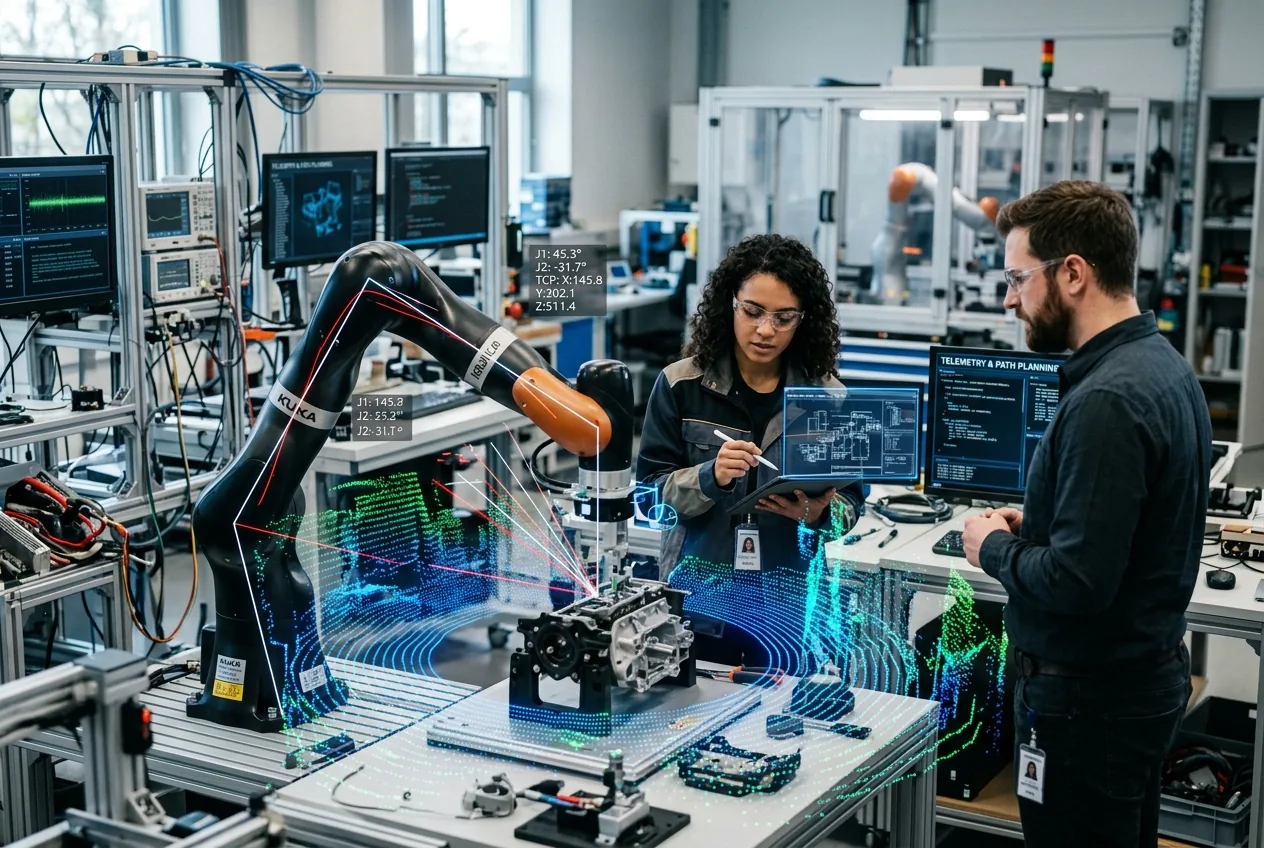
OpenAI has officially pulled back the curtain on GPT-6 Astra, marking a deliberate shift from conversational text generation toward real-time spatial cognition and physical systems integration. Positioned as an advanced evolution of the company’s frontier reasoning models, Astra is engineered to process high-frequency sensory telemetry, streaming video feeds, and continuous coordinate systems with latency profiles low enough to interface directly with industrial machinery and autonomous agents. Rather than focusing solely on synthetic text benchmarks, the launch underscores a broader industry pivot toward embodied artificial intelligence, where software intelligence directly commands physical hardware.
The announcement introduces an architecture designed to bridge the persistent gap between probabilistic natural language models and the deterministic control systems required in industrial automation. For manufacturing facilities, logistics hubs, and robotics labs, Astra represents a tangible attempt to bring adaptive common-sense reasoning to machines that historically relied on rigid, pre-programmed kinematics. While access is currently rolling out across select developer tiers and enterprise infrastructure partners, the implications of its underlying architecture extend deep into the global supply chain.
Architectural Shifts: From Discrete Tokens to Continuous State Streams
At the core of GPT-6 Astra is a reconstructed multimodal engine that departs significantly from classic autoregressive token generation. Standard language models operate on discrete lexical or visual patches, quantising inputs into isolated vectors that are processed across static attention windows. While effective for document synthesis and static image comprehension, this paradigm collapses when applied to high-speed dynamic environments, such as a six-axis robotic arm sorting irregularly shaped components on a high-throughput conveyor belt.
Furthermore, Astra builds upon the test-time compute paradigms pioneered in OpenAI’s earlier reasoning-focused systems. When presented with anomalous mechanical failures or spatial collisions, the model dynamically allocates additional inference-time reasoning steps before emitting an action tensor. This internal verification loop allows the system to simulate kinematic trajectories and verify clearance tolerances prior to physical execution, curbing the erratic hallucinations that have historically disqualified foundation models from high-consequence operational environments.
Bridging Foundation Models with Industrial Robotics
For mechanical engineers and automation architects, the primary hurdle in deploying foundation models has never been a lack of semantic intelligence; it has been the chasm between natural language and hardware-level actuation. Traditional industrial robots operate within the deterministic boundaries of industrial communication protocols like EtherCAT, Profinet, and the Robot Operating System (ROS2). Astra directly targets this interface by incorporating native kinematic and spatial coordinate output layers.
Rather than generating high-level textual instructions that an intermediary interpreter must translate into code, Astra natively outputs spatial vectors, end-effector pose matrices, and joint velocity targets. In live technical demonstrations, OpenAI demonstrated Astra running within a distributed edge-cloud loop, guiding an autonomous mobile manipulator through an unmapped warehouse environment. The system simultaneously processed LiDAR depth maps, stereo camera streams, and thermal sensors, dynamically routing around human workers while recalculating payload balances on uneven terrain.
The Economics of Frontier Inference on the Factory Floor
The technical capabilities of GPT-6 Astra inevitably collide with the harsh economics of industrial capital expenditure. Deploying a model of this magnitude requires enormous computational density, raising fundamental questions about unit economics for manufacturing plants operating on tight margins. Running frontier foundation models on sustained high-frequency inference loops can quickly outpace the labour savings they are designed to produce.
OpenAI has structured Astra around a hybrid edge-orchestration model to mitigate these operational costs. High-level reasoning, kinematic path planning, and edge-case diagnosis are offloaded to dedicated enterprise cloud clusters powered by next-generation accelerator hardware. Simultaneously, lightweight, distilled task-specific parameter blocks are compiled down to run locally on industrial edge servers equipped with specialised neural processing units. Under normal operating conditions, the localized model handles routine sorting, picking, and trajectory tracking. The cloud-hosted Astra foundation model is queried only when the edge system encounters an out-of-distribution event, such as an unfamiliar component geometry or an unexpected physical obstruction.
This tiered computing model radically lowers continuous bandwidth requirements and shields industrial operations from internet connectivity dropouts. If the external link to OpenAI’s servers is severed, the on-premise edge layer retains the operational state and executes safe deceleration sequences, preventing the chaotic line stoppages that traditionally plague cloud-dependent automation software.
Deterministic Constraints Versus Probabilistic AI
Critics within the industrial robotics sector point out that Astra’s reliance on learned spatial priors, while impressive in dynamic lab settings, does not easily satisfy functional safety standards like ISO 13849 or IEC 61508. These standards require mathematically provable limits on hardware performance and systematic failure probabilities. If a vision-language-action model misinterprets a reflective metallic surface or an anomalous optical artifact, the resulting kinematic path could damage costly tooling or imperil human technicians working in collaborative cells.
OpenAI’s documentation emphasizes that Astra is not intended to replace low-level programmable logic controllers (PLCs) or certified hardware safety relays. Instead, the model is architectured to sit atop the control hierarchy as a supervisory orchestrator. It manages semantic workflows, high-level path suggestions, and adaptive sorting, while downstream deterministic safety controllers retain unilateral veto power over any actuator command that breaches physical or kinematic limits.
Access Tiers and Deployment Protocols
Rolling out a model with direct hardware implications requires a fundamentally different deployment strategy than distributing a conversational text API. OpenAI has segmented access to GPT-6 Astra across distinct tiers to balance developer experimentation with enterprise verification.
For enterprise industrial clients, deployment is being handled through bespoke co-engineering initiatives. These installations include on-site hardware gateways pre-configured to communicate with industrial fieldbuses, allowing factories to securely ingest sensor feeds without exposing internal operational data to the public internet. As OpenAI expands access over the coming months, the ultimate viability of GPT-6 Astra will not be determined by digital benchmark scorecards, but by its reliability, economic return, and safety record on actual factory floors.




Comments
No comments yet. Be the first!