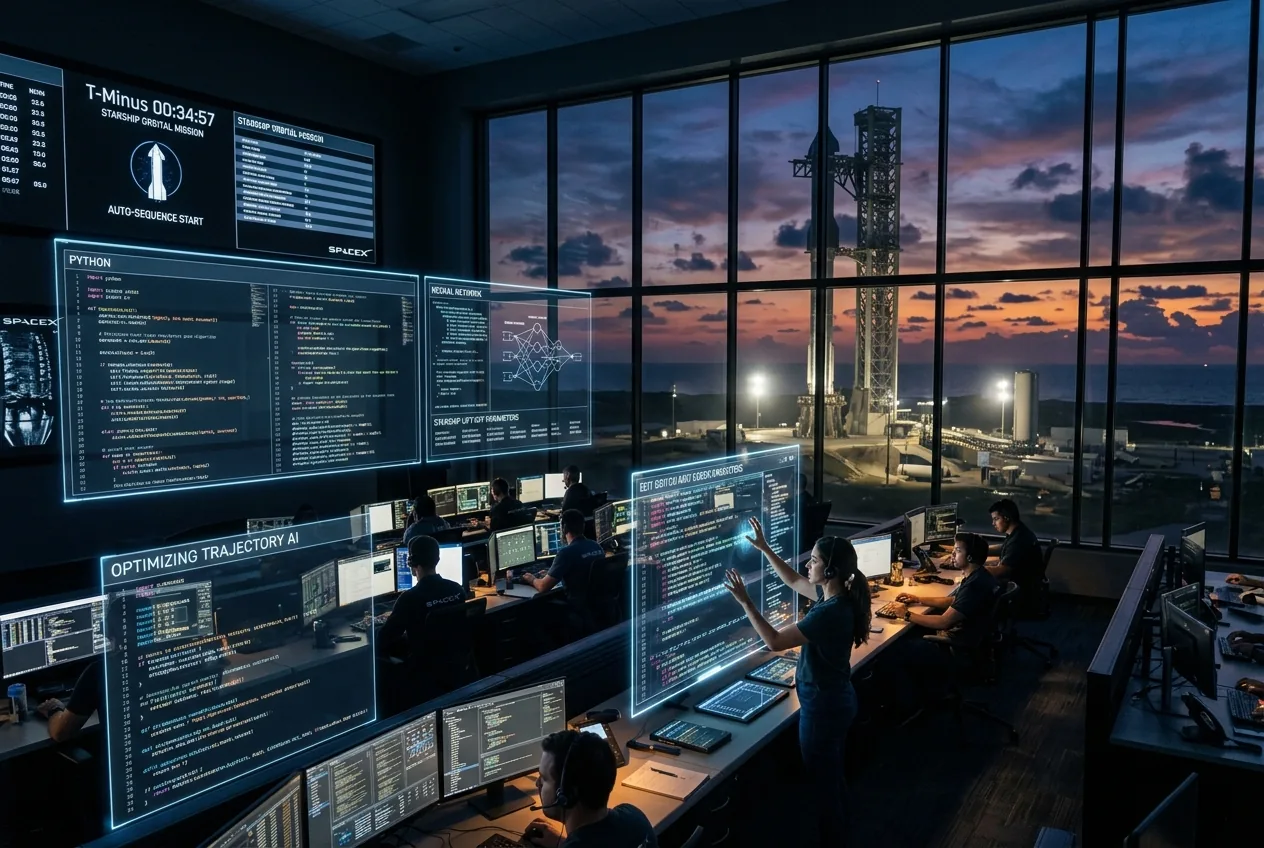
The landscape of aerospace engineering shifted fundamentally this week as SpaceX announced the acquisition of Cursor, the AI-native code editor, for a valuation of $60 billion. While the price tag represents one of the largest acquisitions in the history of the technology sector, the move signals a deeper strategic pivot for Elon Musk’s private spaceflight company. SpaceX is no longer merely a manufacturer of orbital delivery vehicles; it is positioning itself as a vertically integrated intelligence powerhouse where the barrier between hardware design and software execution is effectively erased.
For those monitoring the industrial evolution of the 21st century, the logic behind this acquisition rests in the increasing complexity of modern aerospace systems. As SpaceX scales its Starship program and expands the Starlink megaconstellation, the volume of code required to manage these systems has grown exponentially. By acquiring Cursor, SpaceX is not just buying a tool; it is securing the underlying infrastructure used to build, debug, and optimize the software that keeps its hardware in flight. This is an engineering-first play designed to solve the bottleneck of human-centric software development in a high-stakes, rapid-iteration environment.
The Engineering Logic of an AI Editor
To understand the $60 billion valuation, one must first look at the technical specifications of what Cursor offers. Unlike traditional Integrated Development Environments (IDEs) that rely on static analysis or simple autocomplete features, Cursor was built from the ground up to utilize Large Language Models (LLMs) like Claude and GPT-4o as core components of the coding process. It possesses a deep understanding of entire codebases, allowing engineers to ask complex questions about system architecture or request sweeping refactors across thousands of files simultaneously.
In the context of SpaceX, this capability is transformative. A Starship launch involves millions of lines of code governing everything from thrust vector control to life support systems. Traditional debugging processes are time-consuming and prone to human error. By integrating Cursor’s context-aware AI directly into their engineering workflow, SpaceX can accelerate its development cycles. An engineer can now instruct the AI to "update the cryogenic valve logic across all Raptor engine control modules to account for the new sensor telemetry," and the IDE can execute that change while checking for regressions and edge cases that a human might miss. This is the definition of high-throughput engineering.
Furthermore, the acquisition addresses the problem of technical debt. In the fast-paced world of aerospace prototyping, code is often written quickly to meet launch windows, leading to inefficiencies. Cursor’s ability to proactively suggest optimizations and rewrite legacy code into more efficient structures ensures that SpaceX’s software stack remains as lean and high-performing as the hardware it controls. For a company focused on reaching Mars, the reliability and efficiency of code are just as critical as the tensile strength of the stainless steel used in their hull plates.
Vertical Integration and the Software Bottleneck
Elon Musk has long been a proponent of vertical integration—the practice of bringing as much of the supply chain in-house as possible. At SpaceX, this has meant building their own engines, their own electronics, and even their own specialized alloys. However, software remained a field where they relied heavily on external frameworks and standardized tools. By bringing Cursor under the SpaceX umbrella, the company is effectively manufacturing its own development tools, ensuring that the software pipeline is as proprietary and optimized as its rocket manufacturing line.
This move also serves to insulate SpaceX from the fluctuations and privacy concerns of the broader AI market. When developing sensitive aerospace technology, data security is paramount. Owning the code editor allows SpaceX to run these advanced AI models within their own air-gapped or highly secured environments. They can fine-tune Cursor’s underlying models specifically on their own proprietary telemetry data, mission logs, and engineering documents. This creates a feedback loop where the software becomes more specialized for aerospace applications every time a SpaceX engineer uses it, creating a competitive moat that rivals like Blue Origin or traditional aerospace giants like Boeing will find difficult to cross.
The economic viability of a $60 billion price tag is often questioned, but in the realm of high-capital industry, time is the most expensive variable. If Cursor allows SpaceX to shave even 15% off the development time of a new Starship variant or a Starlink satellite generation, the cost savings in labor, materials, and opportunity could easily exceed the acquisition price over a decade. In the aerospace sector, being first to market with a functional, reusable heavy-lift vehicle is worth hundreds of billions in future government and commercial contracts.
Is Generative AI Ready for Critical Systems?
A significant point of debate within the engineering community is whether AI-generated code is robust enough for safety-critical systems. In aerospace, a minor software glitch can result in the catastrophic loss of a multi-billion-dollar vehicle. Skeptics argue that relying on LLMs to write or refactor code introduces a layer of unpredictability that is incompatible with the rigorous standards of the Federal Aviation Administration (FAA) and NASA. The "hallucination" problem inherent in current AI models is a major concern when the code in question controls explosive propellants.
This transition reflects a broader trend in industrial automation where the focus is moving from physical robotics to the automation of the cognitive processes that design those robots. Just as SpaceX revolutionized the physical manufacturing of rockets through iterative design and vertical integration, they are now attempting to revolutionize the digital manufacturing of the intelligence that drives those rockets. The goal is a seamless pipeline where an engineering concept can be converted into a tested, verified, and deployed piece of software with unprecedented velocity.
Global Connectivity and the Starlink Synergy
The implications of this deal extend beyond just the rockets. Starlink, SpaceX’s satellite internet division, is essentially a massive, orbiting mesh network consisting of thousands of nodes. Managing the routing, latency, and handoffs across such a dynamic network is one of the most complex software challenges in existence. Cursor’s ability to manage large-scale, distributed system codebases makes it an invaluable asset for the Starlink team as they look to scale the network to tens of millions of users globally.
There is also the potential for Cursor to be integrated into the broader Musk ecosystem, including xAI and Tesla. Tesla’s Full Self-Driving (FSD) software and the Optimus humanoid robot program rely on similar principles of massive data ingestion and rapid software iteration. By owning Cursor, SpaceX provides a centralized hub for software excellence that can be leveraged across all of Musk’s technical ventures. This creates a unified front in the race for general-purpose AI, where the software is not just an application, but a tool used to build the future of physical infrastructure.
Looking forward, the $60 billion acquisition of Cursor will likely be remembered as the moment when the distinction between an "aerospace company" and a "software company" vanished. For Noah Brooks and the team at Apollo Thirteen, this represents the ultimate synthesis of mechanical engineering and computer science. We are entering an era where the speed of our progress in space will be limited not by the physics of propulsion, but by the speed at which we can write the intelligence to control it. SpaceX has just secured the fastest pen in history.




Comments
No comments yet. Be the first!