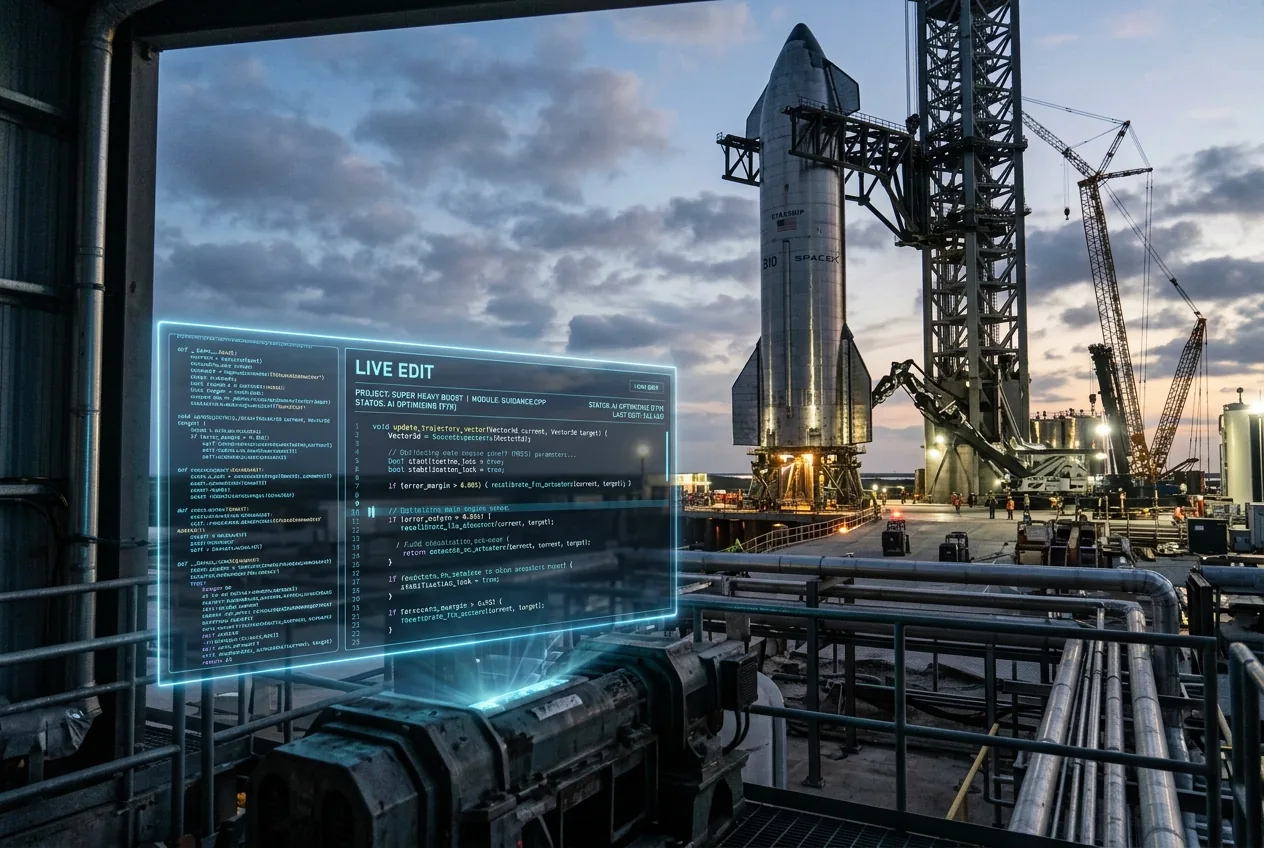
In a move that signals the definitive merger of heavy aerospace industry and advanced autonomous software, SpaceX has entered into a definitive agreement to acquire Anysphere, the startup behind the market-leading AI coding agent Cursor. The deal, valued at approximately $60 billion in an all-stock transaction, comes on the heels of SpaceX’s historic initial public offering (IPO), which catapulted the company’s valuation to $2.66 trillion. By absorbing the most sophisticated AI development environment currently on the market, SpaceX is not merely buying a tool; it is vertically integrating the very logic that governs its orbital and terrestrial hardware.
The acquisition represents one of the largest software deals in history, placing Cursor’s parent company on par with major industrial mergers of the past decade. For SpaceX, the move is a pragmatic response to the escalating complexity of its Starlink and Starship programs. Managing a constellation of tens of thousands of satellites and the rapid iterative cycles of the world’s largest rocket requires a software throughput that traditional human-led engineering teams are increasingly finding difficult to sustain. Cursor, which rose to prominence for its ability to handle massive codebases through a paradigm known as "vibe-coding," offers a path toward intent-based engineering that matches the velocity of SpaceX’s hardware production.
The economics of a $60 billion lifeline
The financial structure of the deal is as significant as its scale. According to filings released shortly after the announcement, the transaction is entirely stock-based, leveraging SpaceX's newly liquid and highly valued shares. This move effectively ties the future of the Cursor development team to the success of SpaceX's broader mission. It is a strategic masterstroke for Anysphere, which only weeks ago was being written off by social media analysts following the release of Anthropic’s Claude Code. The market perceived the rise of first-party coding tools from large language model (LLM) providers as a death knell for third-party wrappers and specialized agents.
However, the $60 billion valuation suggests that SpaceX sees a depth in Cursor’s architecture that the general market overlooked. Unlike generic chat interfaces, Cursor was built from the ground up as a fork of VS Code, focusing on deep indexation of local files and the ability to act as a stateful agent within a complex environment. For a company like SpaceX, which operates under stringent security requirements and maintains massive, proprietary C++ and Rust codebases for flight control, the ability to run an agent that understands the specific architectural nuances of Starship's avionics is worth more than any general-purpose LLM.
Interestingly, the deal appears to have been structured with an alternative pathway. Early reports from the negotiation phase suggested SpaceX had the option to either buy the company outright for $60 billion or pay a $10 billion fee for the collaborative work already performed. The decision to go with the full acquisition indicates that SpaceX intends to take Cursor off the public market eventually, or at the very least, ensure that its most advanced features are optimized for the unique constraints of aerospace telemetry and real-time systems. This ensures that SpaceX's competitors in the launch and satellite sectors cannot easily replicate the software efficiency gains provided by Anysphere’s technology.
Why does a rocket company need an AI coding agent?
From a mechanical engineering perspective, the bottleneck in modern aerospace is no longer just material science or propulsion—it is the integration of software and hardware. Every Starship launch generates terabytes of telemetry data that must be analyzed to inform the next iteration of the flight software. In the traditional model, human engineers would review this data, identify edge cases, and manually refactor code. Cursor’s agentic capabilities allow for a significant portion of this loop to be automated. An agent that can navigate a codebase of millions of lines, understand the intent behind a specific control law, and propose a validated fix in seconds is an industrial force multiplier.
Furthermore, SpaceX's Starlink network is effectively the world's largest distributed robotic system. Maintaining the routing tables and orbital maneuvers for over 6,000 satellites requires constant software updates and patches. By integrating Cursor directly into the Starlink engineering workflow, SpaceX can reduce the lead time for deploying critical security updates or performance optimizations. The "vibe-coding" approach—where an engineer describes a desired behavior and the AI generates the necessary boilerplate and logic—allows SpaceX's senior engineers to move from being writers of code to being architects of systems, focusing on high-level design while the agent handles the technical debt and implementation details.
This acquisition also addresses the challenge of space-based data centers. As SpaceX looks toward the future, the need for autonomous software that can run and heal itself on hardware located far from Earth-based dev-ops teams becomes critical. Cursor’s development team, led by MIT graduates Michael Truell, Sualeh Asif, Arvid Lunnemark, and Aman Sanger, has demonstrated a unique ability to build tools that prioritize developer intent and code security. In the vacuum of space, where communication latency makes traditional troubleshooting impossible, having a robust, agentic AI resident on the spacecraft could be the difference between mission success and a total loss of the vehicle.
Does this signal the end of the independent AI agent?
This deal also puts pressure on other tech titans like Microsoft and Amazon. While Microsoft owns GitHub and its Copilot service, the agility of Cursor has consistently allowed it to outpace Copilot in terms of feature set and user experience. SpaceX, by owning Cursor, now possesses a software development toolchain that is arguably more advanced than those used by established defense contractors like Lockheed Martin or Boeing. This creates a new kind of technological moat—one built not just on rockets and satellites, but on the speed at which those rockets and satellites can think and adapt.
The path to fully autonomous engineering
The ultimate trajectory for this acquisition is the realization of the autonomous engineering office. We are moving toward a state where the interface between a mechanical engineer's design and the resulting control software is seamless. At Starbase, where the ethos is to "delete the part" and "simplify the process," the manual writing of code is increasingly seen as a process that can be simplified, if not deleted entirely, for routine tasks. The $60 billion price tag is a bet that the first company to truly master AI-driven software development will dominate not just the space industry, but any industry where hardware and software must move in lockstep.
For the engineering community, this is a wake-up call. The days of the siloed software developer are numbered. The future belongs to the system architect who can effectively direct a fleet of AI agents like Cursor to build, test, and deploy complex systems at a scale that was previously unimaginable. SpaceX has always been a company that builds the tools it needs to build the future; with Cursor, it has acquired the most powerful tool in the modern engineer's kit. As these agents become more integrated into the physical world, the line between writing code and building a rocket will continue to blur, ushering in a new era of rapid, AI-augmented industrialization.



Comments
No comments yet. Be the first!