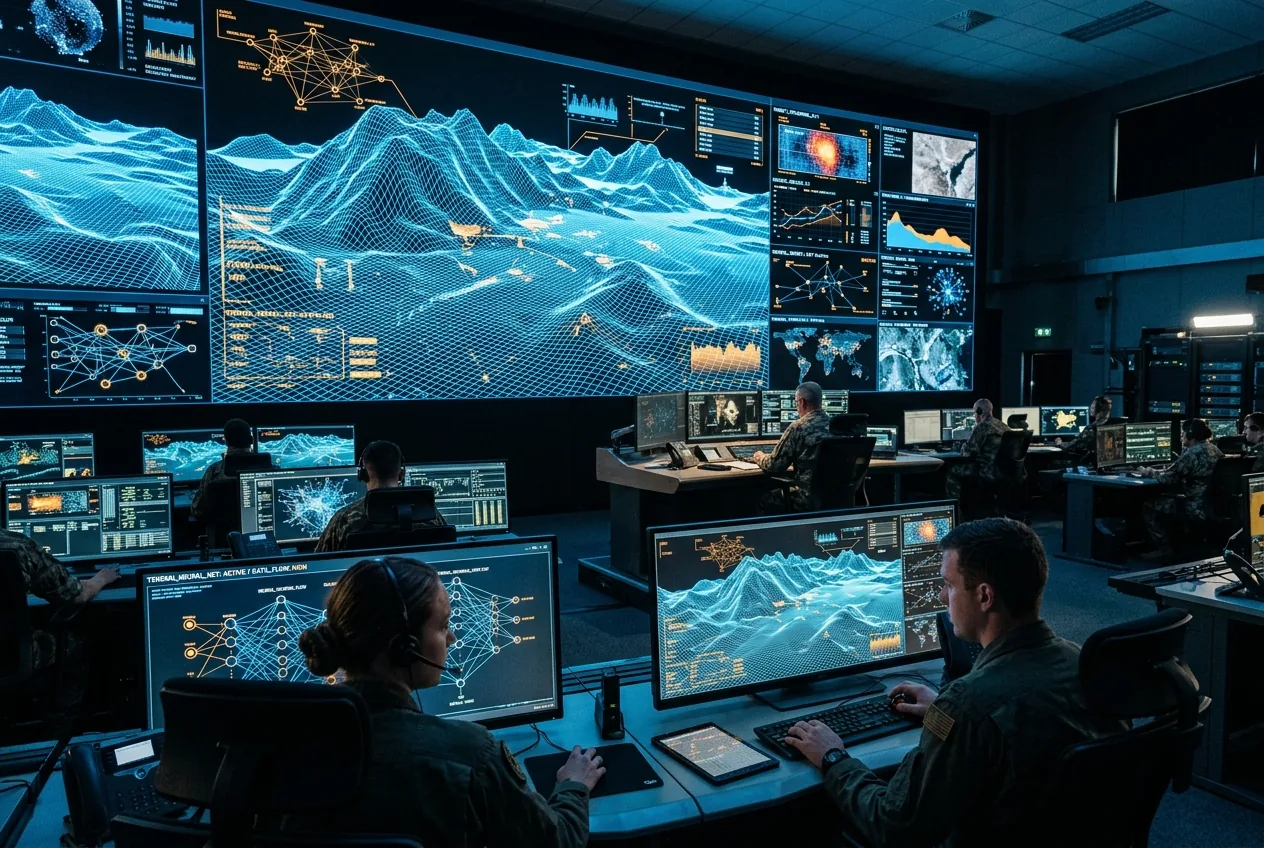
The integration of artificial intelligence into kinetic warfare has transitioned from a theoretical optimization problem to a documented battlefield reality. Recent reports, including those emerging from international outlets like The Indian Express, suggest that the United States military has utilized advanced algorithms—specifically linked to Elon Musk’s xAI and its Grok platform—to facilitate the targeting and deployment of more than 2,000 munitions in the Middle East. For those of us in the mechanical engineering and robotics sectors, this represents a significant shift in the 'kill chain,' moving beyond simple automated guidance toward a generative, high-throughput model of target identification.
While the Department of Defense (DoD) has long experimented with computer vision through initiatives like Project Maven, the inclusion of a Large Language Model (LLM) or its underlying architecture suggests a more complex synthesis of data. The scale of the operation—2,000 munitions—indicates that AI is no longer merely a secondary check for human analysts; it is becoming the primary engine for processing the vast streams of signals intelligence (SIGINT) and geospatial intelligence (GEOINT) required to maintain a high-tempo military campaign.
The Architecture of AI-Assisted Targeting
To understand how a system like Grok could be utilized in a combat environment, we must look past the consumer-facing chatbot interface. At its core, xAI’s technology relies on high-performance compute clusters and neural networks capable of 'grokking'—or deeply understanding—multimodal data. In a military context, this translates to the ability to ingest satellite imagery, drone feeds, and intercepted communications, then identifying patterns that human eyes might miss in the noise.
The technical challenge of the Middle East theater is the identification of mobile targets: rocket launchers, logistics hubs, and command nodes that are often hidden within civilian infrastructure or moved frequently to evade detection. Standard computer vision algorithms are excellent at identifying a static tank in a field, but they struggle with contextual nuance. This is where the 'reasoning' capabilities of advanced AI models come into play. By synthesizing historical movement patterns with real-time sensor data, the AI can provide a probabilistic assessment of where a target is likely to be, significantly shortening the time between detection and engagement.
In the reported strikes against Iranian-backed groups, the sheer volume of munitions suggests an industrial-scale application of this logic. When we talk about 2,000 munitions, we are talking about a logistical and targeting workflow that would overwhelm traditional human-centric analysis cells. The automation of the 'Find, Fix, Track, Target, Engage, and Assess' (F2T2EA) cycle is the primary value proposition of integrating xAI-style technologies into the Air Force’s Distributed Common Ground System.
The Intersection of Private Tech and National Security
The involvement of Elon Musk’s ventures in national security is not unprecedented, but it is increasingly consequential. We have already seen the strategic importance of Starlink in the conflict in Ukraine, providing the resilient communication backbone necessary for drone operations. The reported use of Grok or xAI infrastructure represents the software-side evolution of this partnership. From a mechanical and systems engineering perspective, the bridge between private-sector AI and military hardware is a matter of API integration and edge computing.
There is also the matter of technical reliability. In industrial automation, an AI hallucination might result in a misplaced component on a factory floor. In the context of 2,000 munitions being fired in a volatile region like the Middle East, a hallucination or a false positive carries existential geopolitical weight. The engineering community must ask: what are the fail-safes when an LLM-derived targeting suggestion is fed into a fire-control system?
How Generative Models Enhance Geospatial Intelligence
One of the more pragmatic applications of Grok-like technology in the military is the 'summarization' of the battlefield. Analysts are currently drowning in more data than they can possibly process. Every MQ-9 Reaper drone and every satellite in low-earth orbit generates terabytes of data daily. A generative AI can act as a sophisticated filter, flagging only the most relevant anomalies for human review.
Furthermore, these models can simulate outcomes. Before a single munition is fired, the AI can run thousands of permutations of a strike, calculating the probability of collateral damage, the structural integrity of the target based on its construction material, and the likely secondary effects of the blast. This is not just 'software'; it is a form of digital engineering that treats the battlefield as a complex, dynamic system. The 2,000 munitions deployed were likely the result of thousands of more simulated strikes that the AI discarded as inefficient or too risky.
The Indian Express report highlights that these strikes were focused on countering threats to US and allied forces. From a tactical standpoint, the speed of AI allows for a 'proactive' defense. If the algorithm can predict a launch sequence based on thermal signatures and vehicle positioning ten minutes before it happens, the munitions can be deployed to intercept the threat before it ever materializes. This 'left of launch' capability is the holy grail of modern missile defense, and it is entirely dependent on the processing power that companies like xAI provide.
Economic Viability and the Scalability of Conflict
From an economic perspective, using AI to manage a large-scale munitions campaign is a play for efficiency. Traditional targeting requires hundreds of highly trained analysts working in shifts. An AI-augmented system requires a fraction of the personnel to manage the same volume of strikes. In the long term, this lowers the 'cost of entry' for sustained kinetic operations. While the initial investment in compute power and data centers is massive, the marginal cost of identifying an additional target drops toward zero.
This scalability, however, changes the calculus of war. If the friction of identifying and striking targets is removed, the barrier to military intervention is lowered. As an engineer, I look at this as an optimization problem: we have maximized the output of the kill chain. But as a journalist, I must observe that the optimization of destruction is a different category of technological progress than the optimization of a supply chain or a manufacturing line.
The use of 2,000 munitions also places a strain on the industrial base. Each of these munitions—whether they are JDAMs, Hellfire missiles, or GBU-series bombs—is a complex piece of mechanical engineering that takes months to manufacture. If AI increases the rate of consumption of these assets, the US must ensure that its robotic manufacturing capabilities can keep pace. We are entering an era where the software (AI targeting) may outpace the hardware (munitions production), leading to a strategic bottleneck.
The Future of the Human-in-the-Loop
The most pressing debate remains the role of human oversight. The DoD maintains a policy that a human must always be 'in the loop' for lethal decisions. However, when an AI like Grok processes data at speeds humans cannot comprehend and presents a target with a '99% confidence interval,' the human's role becomes increasingly performative. In practice, the human becomes a rubber stamp for the algorithm's conclusions.
Ultimately, the marriage of xAI’s Grok and the US military’s kinetic capabilities is a testament to the blurring lines between Silicon Valley and the Pentagon. This is no longer the era of isolated defense research; it is the era of dual-use technology, where the same code that powers a social media chatbot is being repurposed to guide the instruments of national power. For those of us mapping the interface of robotics and industry, the message is clear: the most significant industrial application of AI today is the automation of the battlefield itself.




Comments
No comments yet. Be the first!