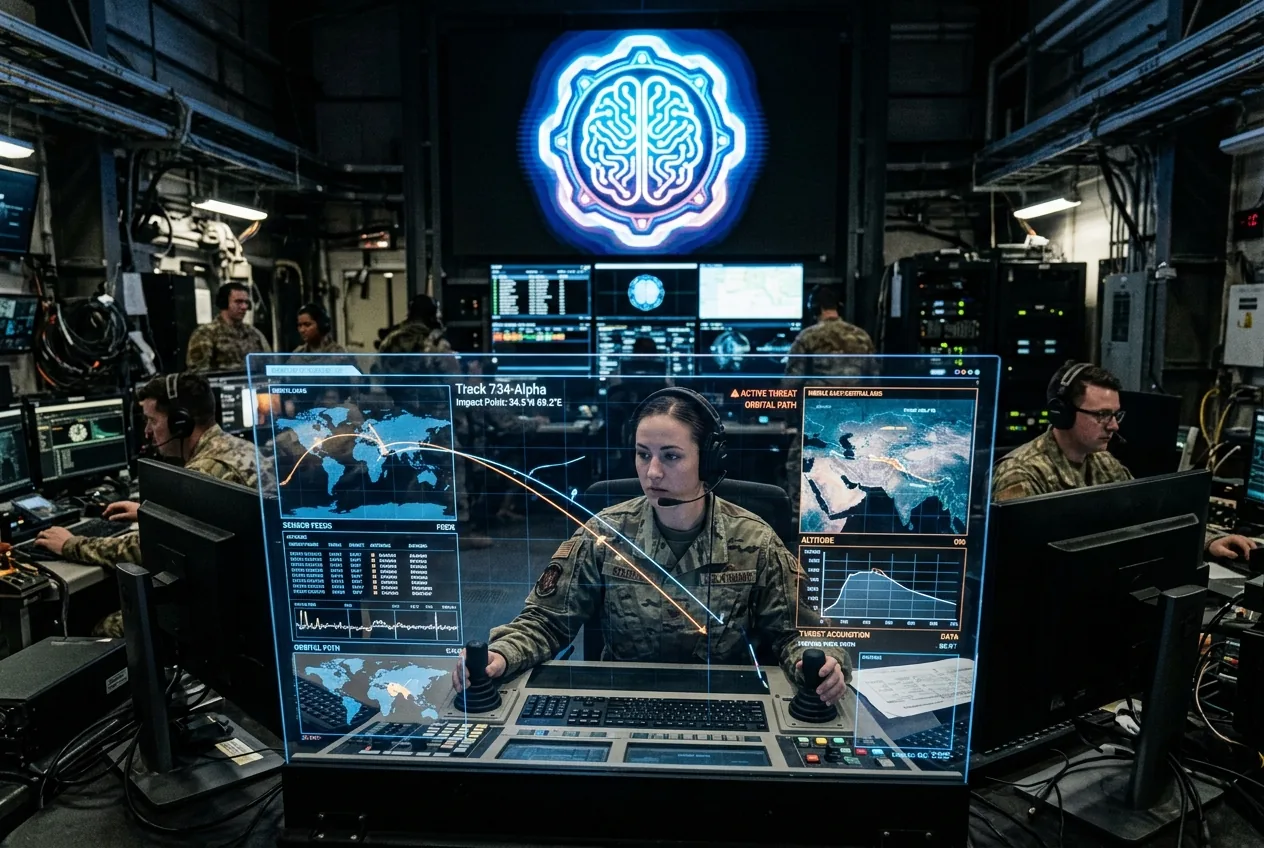
The notion that a social-media-integrated LLM like Grok could interface with the United States' strategic missile inventory ignores the physical and digital safeguards inherent in modern warfare. While the DoD is indeed aggressively pursuing AI, the systems currently under development are focused on predictive logistics, computer vision for target identification, and signal processing—not handing the keys of a kinetic launch sequence to a generative chatbot. To understand why such a scenario is currently a technical impossibility, we must look at the structural differences between probabilistic models and deterministic fire-control systems.
The Stochastic Nature of LLMs vs. Deterministic Fire Control
Integrating a generative AI into a launch loop would introduce what engineers call 'hallucinations' into a high-stakes environment. In a standard chatbot interface, a hallucination might result in a factual error regarding a historical date. In a kinetic strike scenario involving 2,000 missiles, a hallucination in the coordinate mapping or timing logic would result in catastrophic collateral damage or mission failure. The Pentagon’s current fire-control systems, such as the Aegis Combat System or the Integrated Battle Command System (IBCS), operate on hardened, closed-loop architectures that prioritize reliability over the 'creativity' that generative AI offers.
Furthermore, the computational overhead required to run a model like Grok is immense, requiring thousands of NVIDIA H100 GPUs. These models are typically hosted in centralized cloud clusters. A military strike, particularly one involving rapid-response ballistics, cannot rely on the latency of a cloud-based API. The 'kill chain'—the process of finding, fixing, tracking, targeting, engaging, and assessing—requires edge computing where the processing power is physically located on the platform or within a localized, low-latency network. Grok, in its current form, is a centralized intelligence, making it a liability in a contested electronic warfare environment where communications are frequently jammed.
Project Maven and the Real Face of Military AI
If the Pentagon isn't using Grok to fire missiles, what is it actually doing with AI? The answer lies in Project Maven, officially known as the Algorithmic Warfare Cross-Functional Team. Established in 2017, Project Maven focuses on computer vision. Its goal is to automate the processing of the massive amounts of video data captured by drones. Rather than having a human analyst stare at screens for twelve hours to identify a specific vehicle type, AI algorithms can flag objects of interest in real-time. This is a classification task, which is fundamentally different from the generative task of an LLM.
The Pentagon’s 'Replicator' initiative is another key area of focus, aiming to field thousands of autonomous, attritable systems (low-cost drones) to counter near-peer adversaries. These systems use AI for navigation and swarming behavior, but even here, the 'human-in-the-loop' doctrine remains central. DoD Directive 3000.09, which governs the development of autonomous weapons, mandates that humans must exercise appropriate levels of judgment over the use of force. Allowing an AI to independently initiate a strike on the scale of 2,000 missiles would be a direct violation of this standing military policy, as well as a logistical nightmare for the technical teams managing the hardware.
The integration of AI into the military is also visible in the Joint All-Domain Command and Control (JADC2) framework. JADC2 seeks to connect sensors from all branches of the military—Air Force, Army, Navy, Marines, and Space Force—into a single network. The role of AI here is data fusion: taking disparate data points from a satellite in low Earth orbit and a submarine in the Pacific and synthesizing them into a coherent 'common operating picture' for human commanders. This is an information-processing task, not a command-execution task.
The Economic and Hardware Realities of Grok's Integration
From an industrial and economic perspective, the cost of integrating a third-party, commercial AI into the DoD’s most sensitive systems is prohibitive. The federal government prioritizes 'sovereign' technology stacks—systems where every line of code can be audited and every hardware component is sourced from trusted suppliers. Grok is built on a massive crawl of the internet and real-time data from the X platform. For the Pentagon, this represents an unacceptable security risk. An adversary could theoretically 'poison' the training data of a commercial LLM to influence its outputs, a vulnerability known as an adversarial attack.
Moreover, the physical infrastructure of a missile launch involves a series of mechanical interlocks and cryptographic keys. To 'fire' 2,000 missiles, one would need to interface with the silos, mobile launchers, and naval tubes. These systems utilize legacy protocols and specialized hardware interfaces that are not compatible with the high-level Python-based environments where LLMs reside. Bridging the gap between a modern AI and a legacy Minuteman III silo or a Tomahawk launcher would require years of systems engineering, testing, and certification—a process that has not occurred for xAI’s products.
Elon Musk’s relationship with the DoD is primarily funneled through SpaceX and its 'Starshield' program. Starshield provides secure satellite communications and Earth observation capabilities for government use. This is a hardware-as-a-service model, utilizing the proven reliability of the Starlink constellation. While SpaceX provides the 'pipes' for data, it does not provide the 'brain' for the fire-control sequences. The distinction is critical: providing a secure communication link for a drone pilot is a far cry from an AI bot deciding to launch a missile strike.
Misinformation as a Tool of Hybrid Warfare
The emergence of viral stories claiming Grok’s involvement in military strikes highlights a new challenge in the information age: the weaponization of AI-themed satire and misinformation. These stories often originate on parody websites or 'junk news' aggregators that prioritize clicks over technical accuracy. However, when these stories are picked up by larger outlets or shared by influential figures, they can create a false perception of technical capability that impacts international relations and public trust in technology.
In summary, the technical barriers to using Grok for kinetic missile command are insurmountable with our current technology stack. Between the stochastic nature of the software, the lack of hardened hardware integration, the prohibitive latency of cloud models, and the strict 'human-in-the-loop' military doctrines, the claim of an AI-led missile strike belongs in the realm of science fiction. The future of the Pentagon's AI strategy is one of augmentation, not replacement. It is a future where computer vision and data fusion provide better information to human operators, ensuring that if 2,000 missiles were ever fired, it would be the result of a human command, not a hallucinating chatbot.




Comments
No comments yet. Be the first!