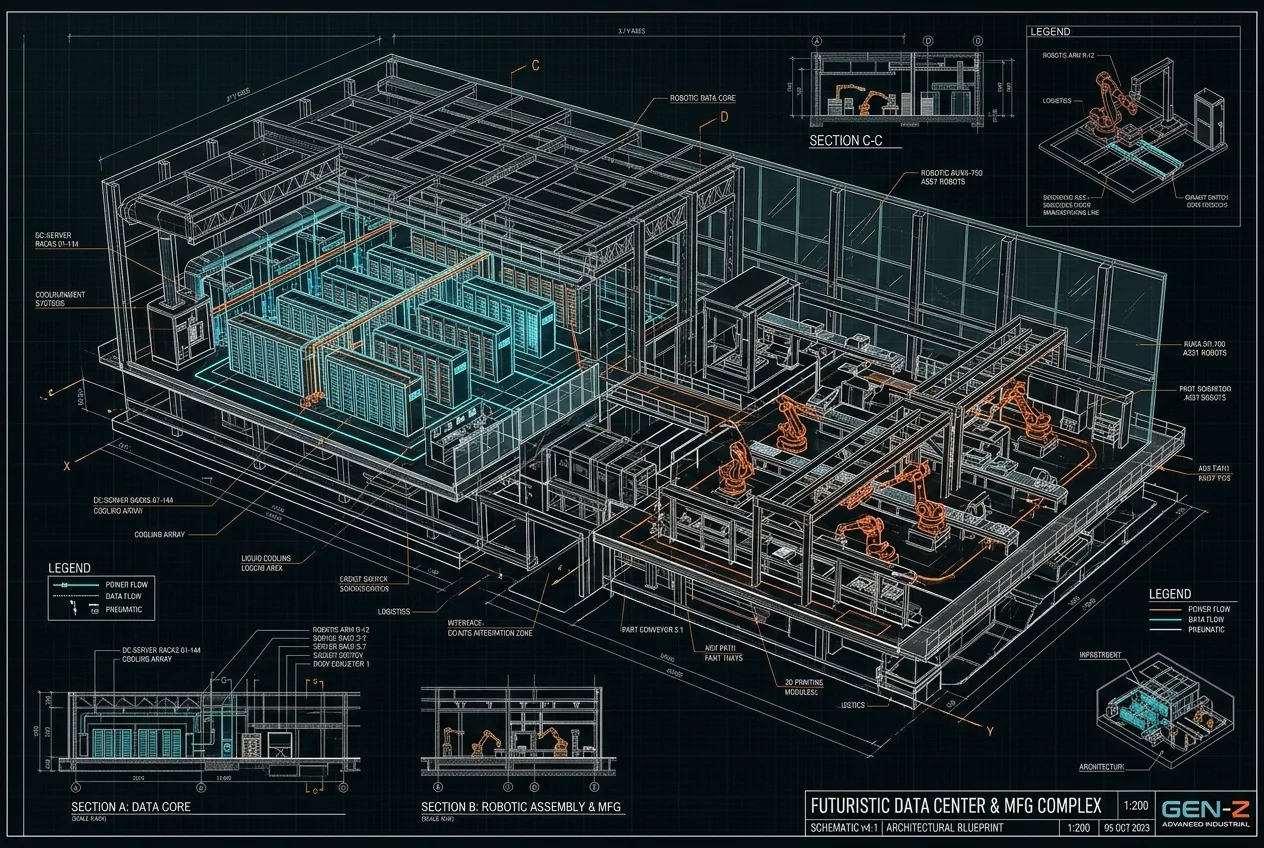
The potential for OpenAI to file for an initial public offering (IPO) as early as this week represents more than just a significant financial milestone; it marks a decisive pivot in the trajectory of artificial intelligence from experimental research to a foundational industrial utility. For years, OpenAI has operated under a unique, albeit convoluted, hybrid structure designed to prioritize safety and general intelligence over shareholder returns. However, the sheer scale of capital required to sustain the next generation of large-scale model training—specifically the hardware procurement and energy infrastructure necessary for models like the o1 series—has made a traditional corporate structure almost inevitable. For those monitoring the intersection of robotics and massive-scale computation, this shift signals that the era of 'cheap' AI research is over, replaced by a phase of intensive industrial scaling.
The Economic Necessity of Massive Capitalization
To understand why an IPO is the logical next step for OpenAI, one must look at the balance sheet of modern compute. The development of generative pre-trained transformers (GPT) and the more recent 'reasoning' models has moved beyond the realm of traditional software development. We are now in a phase of mechanical and electrical engineering on a continental scale. The capital expenditure (Capex) required to build the data centers capable of housing hundreds of thousands of Nvidia H100 and Blackwell GPUs is unprecedented in the technology sector. Reports indicate that OpenAI’s annual burn rate could reach billions of dollars, a figure that is unsustainable even with the backing of giants like Microsoft and Thrive Capital without a clear path to public markets.
An IPO provides the liquidity necessary to fund the physical infrastructure of AI. This includes not just the chips themselves, but the liquid cooling systems, the high-voltage power substations, and the specialized architectural designs required to maintain high-density server racks. From a mechanical engineering perspective, these data centers are becoming the factories of the 21st century. Unlike a software startup that can scale with minimal physical overhead, OpenAI’s path forward is tethered to the constraints of the power grid and the global semiconductor supply chain. By going public, OpenAI can tap into the deep wells of institutional capital required to secure these resources years in advance.
Architectural Restructuring for Wall Street
The primary hurdle for an OpenAI IPO has always been its governance. The company’s current structure—a non-profit board overseeing a 'capped-profit' subsidiary—is an anomaly that most institutional investors find unpalatable. For a successful public offering, the company must undergo a radical simplification. This likely involves transitioning into a for-profit benefit corporation (B-Corp), similar to its competitor Anthropic. This move would strip away the non-profit board’s power to terminate the CEO or pivot the company’s mission without shareholder consent, providing the stability that public markets demand.
This restructuring is not merely a legal formality; it is a fundamental change in the company’s operating philosophy. The 'capped-profit' model was designed to ensure that the benefits of artificial general intelligence (AGI) were distributed equitably, but it also limited the upside for early investors and employees. In the high-stakes arms race for engineering talent, being able to offer liquid, public-market stock options is a critical tool for retention. In the current climate, where engineers specializing in reinforcement learning and distributed systems are commanding multi-million dollar packages, OpenAI needs a tradable currency to remain competitive with Google DeepMind and Meta.
The Return to Physical AI and Robotics
While much of the public discourse focuses on chatbots, the industrial implications of OpenAI’s capitalization are most profound in the field of robotics. After disbanding its internal robotics team in 2021 due to technical limitations and data scarcity, OpenAI has recently re-entered the space through strategic partnerships and the development of the o1 model, which excels at the logic and spatial reasoning required for physical interaction. The 'brain' is being optimized; now, it requires a body.
The next phase of OpenAI’s growth will likely involve the integration of its models into industrial automation and humanoid robotics. Companies like Figure and 1X, which utilize OpenAI’s models for high-level reasoning and natural language processing, are demonstrating that the barrier between digital AI and physical labor is thinning. For these robots to operate in unstructured environments—such as warehouses, factories, or construction sites—they require massive onboard inference capabilities or low-latency connections to centralized hubs. Funding this 'Physical AI' revolution requires the kind of capital that only a public company can command. We are looking at a future where OpenAI doesn't just provide a search alternative, but provides the operating system for the next generation of industrial automation.
Can Safety and Scaling Coexist on the Public Market?
The most significant debate surrounding an OpenAI IPO is whether the company can maintain its commitment to AI safety once it is beholden to quarterly earnings reports. The original mission of OpenAI was to ensure that AGI benefits all of humanity. In a public market scenario, the pressure to monetize every breakthrough could lead to the premature release of models or the deprioritization of safety alignment research. This is a legitimate concern for the research community, but from a pragmatic industrial standpoint, the scale of the problem may have already outgrown the non-profit oversight model.
Safety in AI is increasingly becoming a matter of rigorous engineering standards rather than just philosophical guidelines. As these models are integrated into critical infrastructure, the definition of 'safety' shifts toward reliability, predictability, and cybersecurity. A public OpenAI will be subject to greater regulatory scrutiny and more stringent reporting requirements, which could ironically lead to a more formalized approach to safety than the current opaque board-driven model. The transition to a public company forces a level of transparency regarding operational risks and technical debt that private entities can often obscure.
The Geopolitical and Market Context
Furthermore, the development of AGI is increasingly viewed through the lens of national security. The physical infrastructure required to train these models—thousands of acres of data centers and gigawatts of power—makes OpenAI a strategic national asset. A public offering would likely involve significant oversight from government entities concerned with the export of advanced dual-use technologies. This adds another layer of complexity to the filing, as the company must navigate the balance between global market access and the protection of its core intellectual property.
As we look toward the potential filing on Friday, the technical community should focus less on the stock price and more on what this capital will build. If OpenAI successfully transitions to a public entity, it will have the resources to move from being a provider of sophisticated software to becoming the architect of a new industrial era. The focus will shift from 'what can the model say' to 'what can the model do' in the physical world. For those of us in the fields of mechanical engineering and industrial automation, this is the moment where the virtual and the physical finally begin to merge at scale. The IPO is not an end goal; it is the fueling of the engine for the next decade of technical evolution.




Comments
No comments yet. Be the first!