The aerospace industry is no stranger to astronomical figures, but the recent reports surrounding a potential $1.75 trillion initial public offering (IPO) for SpaceX represent a tectonic shift in industrial valuation. To put that figure in perspective, it would place the Hawthorne-based firm in the same rarefied atmosphere as Apple, Microsoft, and NVIDIA. For a company that specializes in the high-risk, high-cost domain of orbital mechanics and deep-space exploration, such a valuation suggests that the market is no longer viewing SpaceX as a mere launch provider, but as the foundational infrastructure for a new global—and interplanetary—economy.
From a mechanical engineering and industrial standpoint, the jump from a private valuation of approximately $180 billion to a public target of $1.75 trillion requires a rigorous analysis of the company’s hardware pipeline. As a journalist covering the intersection of robotics and industrial automation, I see this not as a speculative bubble, but as a bet on the scalability of Starship and the maturing of the Starlink constellation. However, the mention of "heavy losses" in recent filings serves as a sobering reminder of the capital expenditure (CapEx) required to build a literal railway to the stars.
The Industrial Scale of Starship Economics
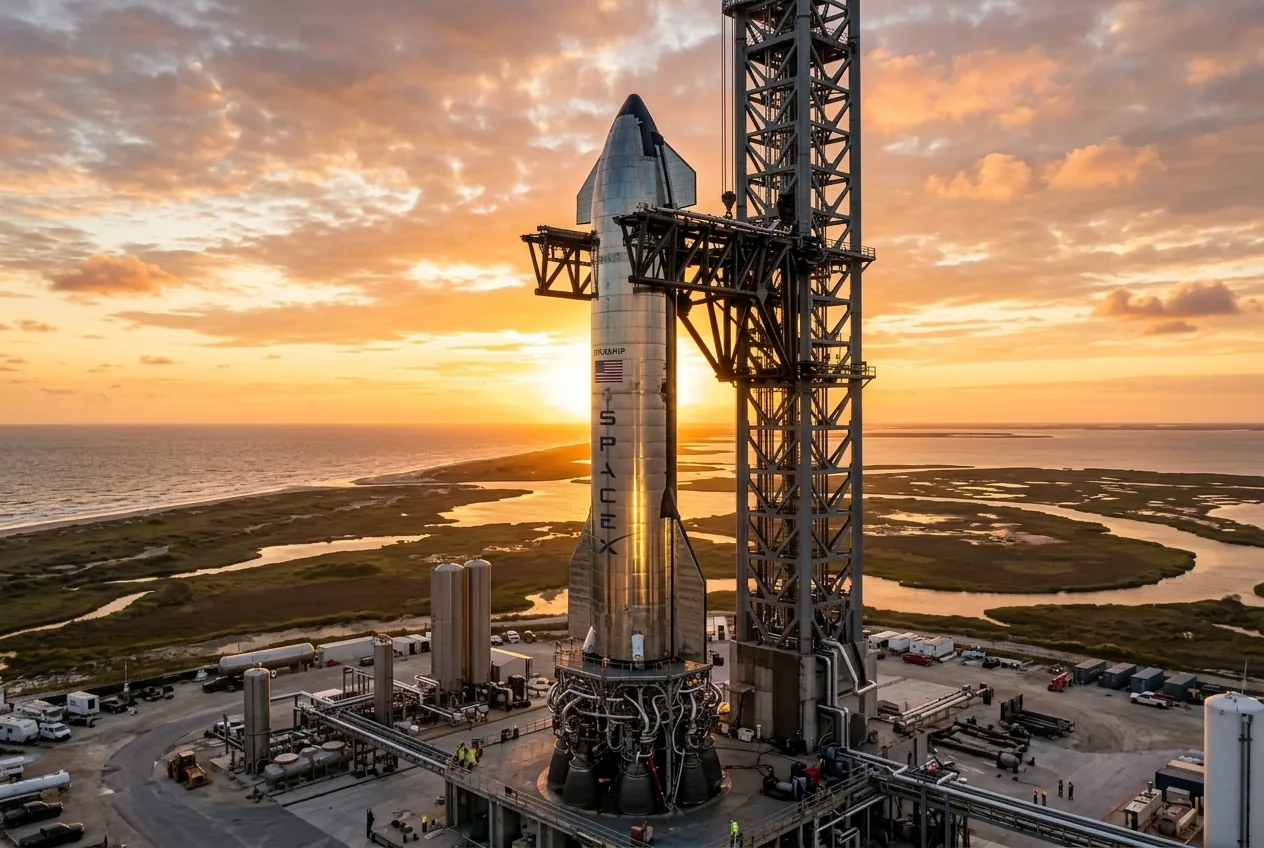
The primary driver of this valuation is not the venerable Falcon 9, but the Starship program. While the Falcon 9 has become the workhorse of the modern space era—demonstrating unprecedented reliability and reuse—it is fundamentally limited by its payload fairing size and its reliance on kerosene-based RP-1 fuel. Starship, constructed from 304L stainless steel at the Starbase facility in Boca Chica, Texas, is designed for a completely different industrial paradigm: total and rapid reusability.
Starlink as the Engine of Recurring Revenue
While Starship represents the future of heavy industry in space, Starlink is the current engine of cash flow. For any company seeking a trillion-dollar IPO, the presence of a high-margin, recurring revenue stream is essential. SpaceX has transitioned from a government contractor to a global Internet Service Provider (ISP). By deploying thousands of small satellites in Low Earth Orbit (LEO), the company has bypassed the traditional terrestrial constraints of fiber-optic and copper infrastructure.
The technical challenge of Starlink is not just in the launch, but in the mass production of the satellites themselves. SpaceX has essentially applied automotive manufacturing principles to spacecraft. In their Redmond facility, they are producing satellites at a rate that dwarfs any other aerospace firm in history. These satellites utilize krypton or argon-fueled Hall-effect thrusters for orbital station-keeping and de-orbiting, representing a significant advancement in electric propulsion automation. The integration of xAI—Elon Musk’s artificial intelligence venture—is likely to play a role here, optimizing the routing of data across the laser-linked mesh network to minimize latency. For investors, Starlink is the "utility" play that offsets the high-risk R&D of the Mars mission.
Why Heavy Losses are a Strategic Choice
The headline-grabbing mention of "heavy losses" requires a nuanced understanding of industrial growth. In the world of hardware and heavy industry, losses are often synonymous with aggressive CapEx. SpaceX is currently building several "Mega-Bay" fabrication facilities, expanding the Starbase launch site, and constructing a second launch tower at the Kennedy Space Center. Each of these projects costs hundreds of millions of dollars.
The Synergies Between SpaceX and xAI
The intersection of SpaceX and xAI represents a new frontier in industrial automation. xAI’s large language models and predictive algorithms require massive amounts of data and compute power. Starlink provides the global connectivity to feed these models, while the robotics expertise within SpaceX—developed for autonomous drone ship landings and the "Mechazilla" launch tower arms—provides a hardware testing ground for advanced AI control systems.
If SpaceX moves toward an IPO at a $1.75 trillion valuation, it is likely that the market is pricing in the potential for SpaceX to become the primary hardware provider for an AI-driven orbital economy. This includes satellite servicing, orbital manufacturing, and even lunar mining. The technical specs of the Starship HLS (Human Landing System) variant, which is contracted for NASA’s Artemis missions, show a vehicle capable of delivering 100 tons to the lunar surface. This is not just a transport vehicle; it is a mobile industrial hub. The ability to deploy AI-driven robotic miners or automated laboratories to the moon would justify a valuation that transcends traditional aerospace metrics.
Is the Public Market Ready for Starship?
The transition from a private to a public company is fraught with challenges, particularly for a firm that operates on a "fail fast" philosophy. Public markets generally demand predictability and quarterly profits, which are often at odds with the explosive and unpredictable nature of rocket development. A $1.75 trillion IPO would be the largest in history, and it would place immense pressure on SpaceX to stabilize its operations.
In conclusion, the proposed IPO of SpaceX at such a staggering valuation is a testament to the fact that space has moved from the realm of scientific exploration into the realm of global industrial infrastructure. For those of us focused on the mechanics of this shift, the interest lies not in the ticker symbol, but in the thousands of tons of stainless steel and the millions of lines of code that are currently reshaping our relationship with the vacuum of space. SpaceX is no longer just a rocket company; it is the logistics layer of the future, and that is a business model that, for better or worse, the market is beginning to value at a premium.




Comments
No comments yet. Be the first!