This dual development marks a profound structural turning point in the economics and governance of artificial intelligence. For years, frontier AI developers maintained strict acceptable use policies (AUPs) that expressly forbade the weaponization of their models, the development of malicious code, or the direct integration of their software into kinetic and offensive military workflows. However, the operational reality of enterprise software economics—coupled with intensifying pressure from national defense authorities who view advanced reasoning models as asymmetric sovereign assets—has rapidly dismantled those rhetorical boundaries. Anthropic is no longer merely an observational safety lab; it is now an integrated defense infrastructure provider operating at the apex of American intelligence infrastructure.
The engineering imperative driving this embedded collaboration stems directly from Claude’s architectural edge in code generation, vulnerability analysis, and complex systems comprehension. While public deployment of Claude 3.5 Sonnet features dense layers of reinforcement learning from human feedback (RLHF) and constitutional constraints designed to refuse malicious payload queries, offensive cyber operations demand precisely the opposite behavior. Intelligence analysts do not require generic chat responses; they require systems capable of parsing billions of lines of decompiled binary code, tracing abstract syntax trees (ASTs), executing symbolic execution models, and automatically constructing working exploit chains targeting legacy industrial control hardware and hardened network appliances.
Operating Behind the Shield: The Mechanics of SCIF-Bound AI
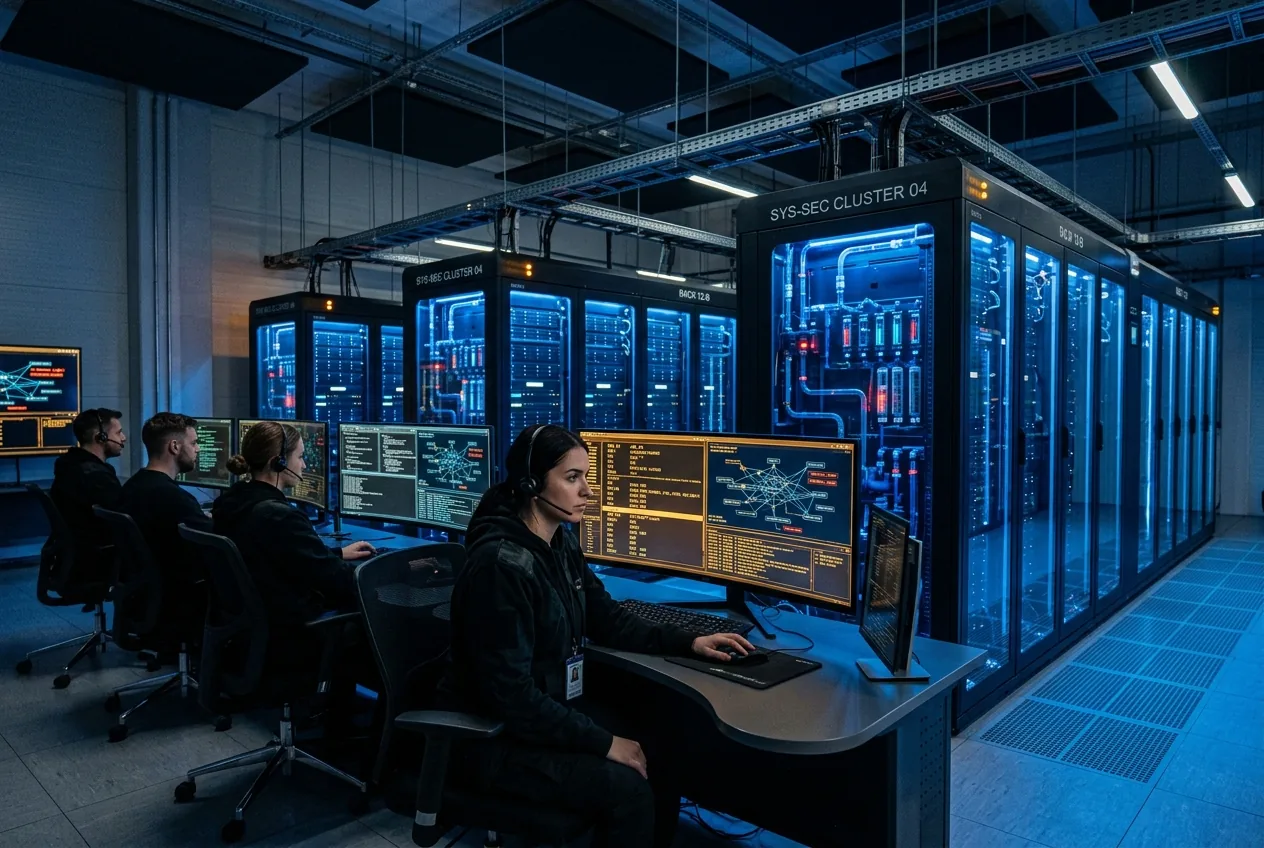
Integrating large frontier models into high-security intelligence nodes is primarily a mechanical and architectural challenge, rather than a purely algorithmic one. Commercial software-as-a-service (SaaS) APIs, which route queries through centralized multi-tenant clusters in commercial data centers, are entirely non-viable for Sensitive Compartmented Information Facilities (SCIFs). The intelligence community cannot allow prompts, proprietary decompiled binary data, or target vulnerability graphs to egress beyond air-gapped sovereign boundaries. Consequently, the Anthropic personnel stationed within Fort Meade are engaged in deploying isolated, hardware-native instances of Claude onto high-density, air-gapped supercomputing environments.
The engineers on the ground must also resolve severe operational bottlenecks around context processing. Modern offensive cyber operations produce staggering amounts of unstructured machine data: memory dumps, disassembly logs from reverse-engineering platforms like Ghidra, and complex network packet captures (PCAPs). Claude’s massive context window enables analysts to dump entire firmware images directly into the active prompt cache. The technical challenge lies in managing the key-value (KV) cache memory footprint across local graphics processing clusters so that the system does not choke on memory allocation while performing real-time fuzzing and vulnerability correlation.
The Contractual Fracture at the Department of Defense
While Anthropic’s engineering cadre integrates deep into the signals intelligence apparatus, its executive leadership is waging an aggressive legal campaign against the Pentagon’s centralized procurement apparatus. The lawsuit, filed in federal court under standard provisions governing contested federal acquisitions, challenges administrative maneuvers by defense acquisition officials that excluded Claude from specific operational task orders under the Joint Warfighting Cloud Capability (JWCC) and related edge-compute contracts.
The root of the legal conflict lies in how the Department of Defense’s Chief Digital and Artificial Intelligence Office (CDAO) structures its certification pipelines for Impact Level 6 (IL6) environments. IL6 clearances govern the handling of classified national security information up to the Secret level, including tactical command-and-control operations. Anthropic entered these environments through formal commercial partnerships with platform intermediaries like Palantir and Amazon Web Services, attempting to position Claude as the primary cognitive backend for mission analysis, logistics optimization, and battlefield automated decision support.
However, defense procurement officials systematically favored competitive model architectures, alleging in proprietary procurement determinations that Anthropic’s constitutional safety constraints presented operational liabilities. The Pentagon’s acquisition leadership argued that hardcoded software guardrails—intended to prevent models from generating biological synthesis protocols, tactical munitions guidance, or lethal target vectors—could cause unprompted refusals during active military maneuvers. In high-tempo, lethal engagements, an algorithmic refusal to process an instruction constitutes an unacceptable systemic failure. Anthropic’s legal challenge claims these exclusions are arbitrary, capricious, and technically flawed, arguing that its customized government weights satisfy all rigorous tactical parameters while maintaining superior computational fidelity over legacy defense contractor alternatives.
The Pragmatics of Algorithmic Exploitation
At the center of the dispute is a fundamental question of technical capability: why has Claude become indispensable to cyber units, despite the procedural friction? The answer lies in the limitations of traditional, deterministic vulnerability scanners. Static and dynamic code analysis tools (SAST and DAST) have historically generated massive false-positive ratios, forcing human security analysts to spend thousands of man-hours manually validating prospective software bugs.
State-of-the-art transformer architectures operating with advanced reasoning parameters alter this dynamic entirely. When an embedded instance of a reasoning engine is integrated into an offensive cyber framework, it does not merely flag a vulnerable buffer overflow in an industrial supervisory control and data acquisition (SCADA) system. Instead, it reads the assembly instructions, identifies the memory offset, accounts for modern operating system protections like Address Space Layout Randomization (ASLR) and Data Execution Prevention (DEP), and iteratively writes, tests, and refines a customized payload within an isolated virtual container.
Industrial Scale and the Collapse of Commercial Pacifism
The convergence of Anthropic’s software operations with federal intelligence frameworks highlights an inescapable economic reality: building, training, and scaling frontier models requires unprecedented amounts of capital, energy, and computational hardware. The capital expenditure required to train next-generation models—now measuring in the billions of dollars for single training runs involving hundreds of thousands of specialized accelerators—cannot be indefinitely sustained by commercial subscription revenues and consumer-tier enterprise licenses alone.
As cyber warfare shifts from human-speed analysis to automated, model-speed vulnerability discovery and payload delivery, the organizations that hold the most sophisticated weights hold the instruments of strategic deterrence. Anthropic’s presence in Fort Meade confirms that the frontier of software engineering is no longer bounded by the commercial market. The most critical operational testing of advanced reasoning models is now taking place in subterranean, air-gapped server vaults, where the metric of success is measured not in consumer engagement, but in the systematic compromise of hostile digital infrastructure.




Comments
No comments yet. Be the first!