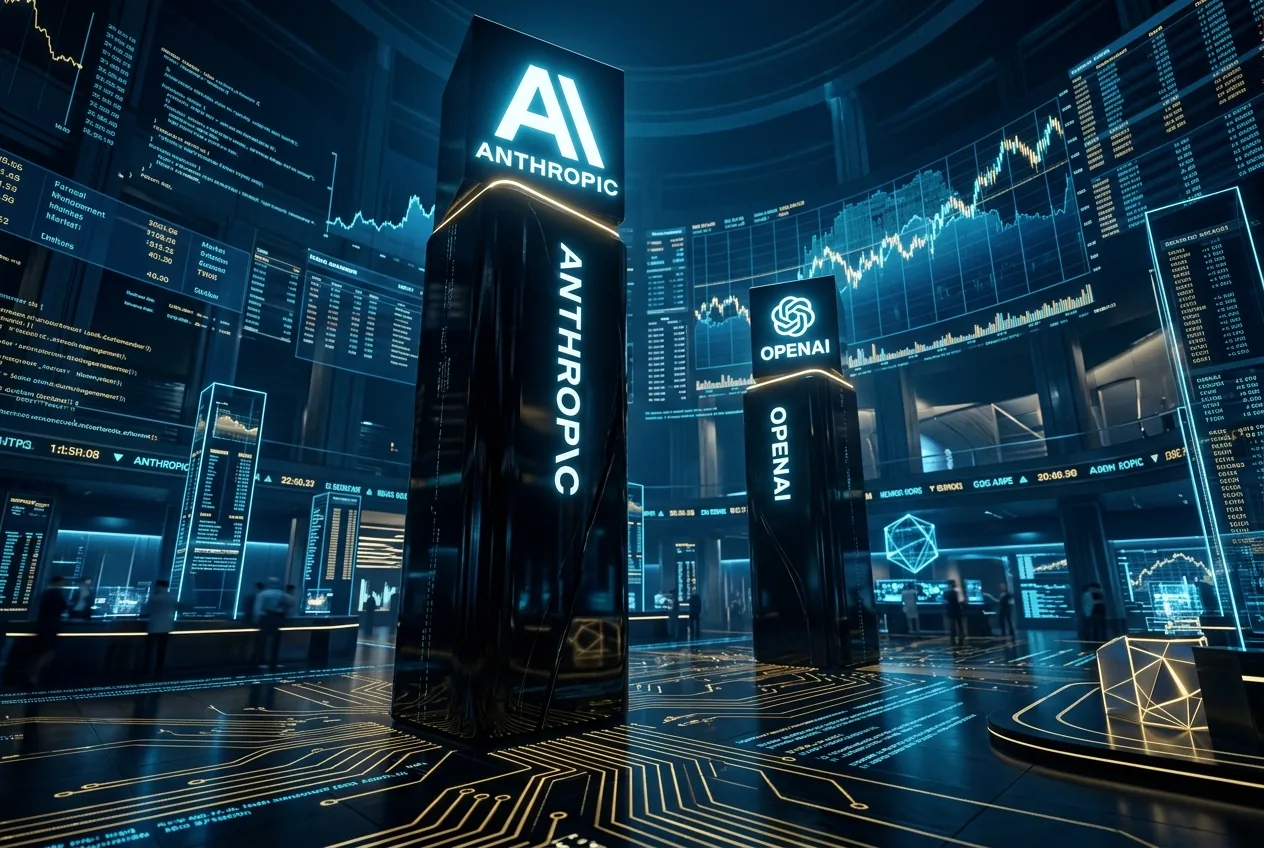
In a seismic shift for the artificial intelligence sector, Anthropic has achieved a valuation of $1 trillion on secondary markets, officially overtaking its primary rival, OpenAI. This milestone, recorded on platforms like Forge Global and confirmed by high-stakes private trades, marks the first time a dedicated AI startup has reached the trillion-dollar threshold, signaling a maturation of the industry where revenue velocity and architectural efficiency are beginning to outweigh first-mover advantage. The surge represents a staggering climb from the $380 billion valuation the company held just three months ago, highlighting an unprecedented appetite for equity in the San Francisco-based firm.
The Mechanics of the Trillion-Dollar Pivot
The valuation flip between Anthropic and OpenAI is not merely a vanity metric; it is rooted in the diverging financial trajectories of the two giants. While OpenAI has historically commanded the spotlight through ChatGPT, recent reports suggest the organization is struggling with widening losses and missed internal growth targets. In contrast, Anthropic has demonstrated a vertical climb in its annualized revenue run rate. Internal figures indicate that the company’s revenue jumped from $9 billion in late 2025 to a staggering $39 billion by March 2026. This growth is largely attributed to the widespread enterprise adoption of Claude Code, a specialized toolset that has become the industry standard for autonomous software engineering and industrial automation logic.
Revenue Velocity and the Claude Code Factor
At the core of Anthropic’s $1 trillion valuation is the success of Claude Code. In the mechanical and software engineering sectors, the tool has moved beyond a mere assistant to a core component of the development stack. Engineers are utilizing Claude Code to manage complex system integrations, refactor legacy industrial codebases, and automate the debugging of high-precision robotics software. Unlike general-purpose chatbots, Claude Code was engineered with a focus on high-fidelity context windows and a reduced hallucination rate, making it viable for mission-critical applications where a single error in logic could result in millions of dollars in hardware damage.
This utility has translated directly into bottom-line growth. The $30 billion increase in run rate within a single quarter suggests that Anthropic is successfully converting pilot programs into massive, multi-year enterprise contracts. For a company like Anthropic, which maintains a smaller workforce relative to its output, this level of revenue per employee is virtually unheard of in the history of technology. It validates the "scaling laws" of business in the AI era: that a smaller, more focused team can generate trillions in value if their core product becomes the foundational infrastructure for the global developer community.
Scarcity and the Secondary Market Frenzy
The $1 trillion figure is also a product of extreme supply-and-demand imbalances in the private markets. Unlike public stocks, which trade on open exchanges with high liquidity, Anthropic shares are tightly held by founders, early employees, and a select group of venture capital firms. As the company’s performance metrics began to leak, the secondary market saw a flood of buy orders with almost no corresponding sellers. This "scarcity premium" has driven share prices to levels that defy traditional valuation models. Rainmaker Securities and Forge Global have reported offers as high as $1.05 trillion, with some investors even attempting to trade high-value real estate assets for Anthropic equity.
From an engineering standpoint, this market behavior reflects a "flight to quality." Investors are no longer betting on the abstract potential of AI; they are looking for the company that owns the most robust "compiler" for the next generation of software. If Claude is viewed as the operating system for AI-driven industry, then a $1 trillion valuation is not just speculative—it is a calculation of the future rent Anthropic will collect on global productivity. The desperation to own a piece of this firm highlights a consensus that Anthropic has achieved a level of technical moat that OpenAI, currently grappling with internal "Code Red" restructuring, has yet to stabilize.
Efficiency vs. Scale: The Architectural Divergence
Strategic Alliances and the Enterprise Fortress
OpenAI’s reliance on Microsoft, while initially a masterstroke, has begun to show signs of friction. As Microsoft develops its own in-house models and OpenAI seeks to build its own hardware, the two are increasingly finding themselves in a "co-opetition" dynamic. Anthropic, by contrast, has maintained a more neutral stance, acting as the preferred AI partner for companies that want to avoid being locked into the Microsoft-Azure ecosystem. This neutrality has allowed Anthropic to expand its footprint across diverse industrial sectors, from automotive manufacturing to aerospace, where data sovereignty and platform independence are paramount.
Is This an AI Valuation Bubble?
The question of whether any private company is truly worth $1 trillion is currently the subject of intense debate among economists and technology analysts. From a pragmatic engineering perspective, the valuation is a bet on the total addressable market of human labor that can be augmented or replaced by AI. If Anthropic’s tools can automate 20% of global software engineering and 10% of industrial logic design, then $1 trillion is arguably a conservative figure. However, the volatility of the secondary markets means that these valuations can be brittle. A single major technical failure or a shift in regulatory sentiment could see these numbers retract just as quickly as they rose.
Yet, the fundamental metrics—the $39 billion run rate and the mass adoption of Claude Code—suggest that this isn't just hype. We are witnessing the first real-world evidence of the "intelligence economy" scaling at a pace that traditional industry cannot match. For the mechanical engineer and the industrial strategist, the takeaway is clear: the focus has shifted from the novelty of AI to the utility of AI. Anthropic has won this round of the valuation race because it successfully bridged the gap between complex neural network hardware and the practical, high-stakes requirements of the global market.
As we look toward the remainder of 2026, the focus will shift to how Anthropic manages this enormous capital and expectation. With a trillion dollars on the line, the pressure to deliver the next generation of Claude while maintaining its safety-first ethos will be immense. OpenAI is unlikely to remain stagnant, and the "Code Red" initiatives within that organization may yet produce a technological leap that reshapes the race once again. For now, however, the crown has moved. Anthropic is the new benchmark for the AI industry, proving that in the world of high-tech robotics and automation, precision and efficiency are the ultimate drivers of value.




Comments
No comments yet. Be the first!