The scale of the artificial intelligence economy has officially transcended traditional financial metrics. In a move that redefines the concept of a venture-backed startup, Anthropic is reportedly seeking $300 billion in new funding at a pre-money valuation of $9 trillion. Simultaneously, Project Prometheus—the stealth firm founded by Jeff Bezos in 2015—has disclosed a valuation of $3.8 trillion, with heavyweights like JPMorgan and BlackRock expected to anchor its upcoming round. These figures do not merely represent investor enthusiasm; they signal a fundamental restructuring of global capital toward the physical and digital infrastructure required to sustain super-intelligence.
As a mechanical engineer observing the intersection of robotics and industry, I find the sheer capital requirements of these firms to be a reflection of the hardware-heavy reality of the next decade. We are no longer in the era of capital-light software as a service. To reach a $9 trillion valuation, a company like Anthropic must move beyond model weights and into the realm of total economic integration. When a company targets a valuation that exceeds the GDP of most G7 nations, it is no longer selling a tool; it is proposing to build the primary engine of global productivity.
The technical justification for these astronomical figures lies in the radical efficiency gains reported within the firms themselves. Anthropic’s leadership recently disclosed that approximately 90% of the company’s internal code is now written by AI. This represents a seismic shift in the nature of white-collar work, transitioning the role of the human engineer from one of execution to one of oversight. In this model, the cost of scaling output is no longer tied to the headcount of software developers, but rather to the availability of compute and the efficiency of the underlying algorithms. This is the 'how' behind the $9 trillion target: a bet that the marginal cost of intelligence is heading toward zero, while its utility is becoming infinite.
The Rise of the Training and Inference Factories
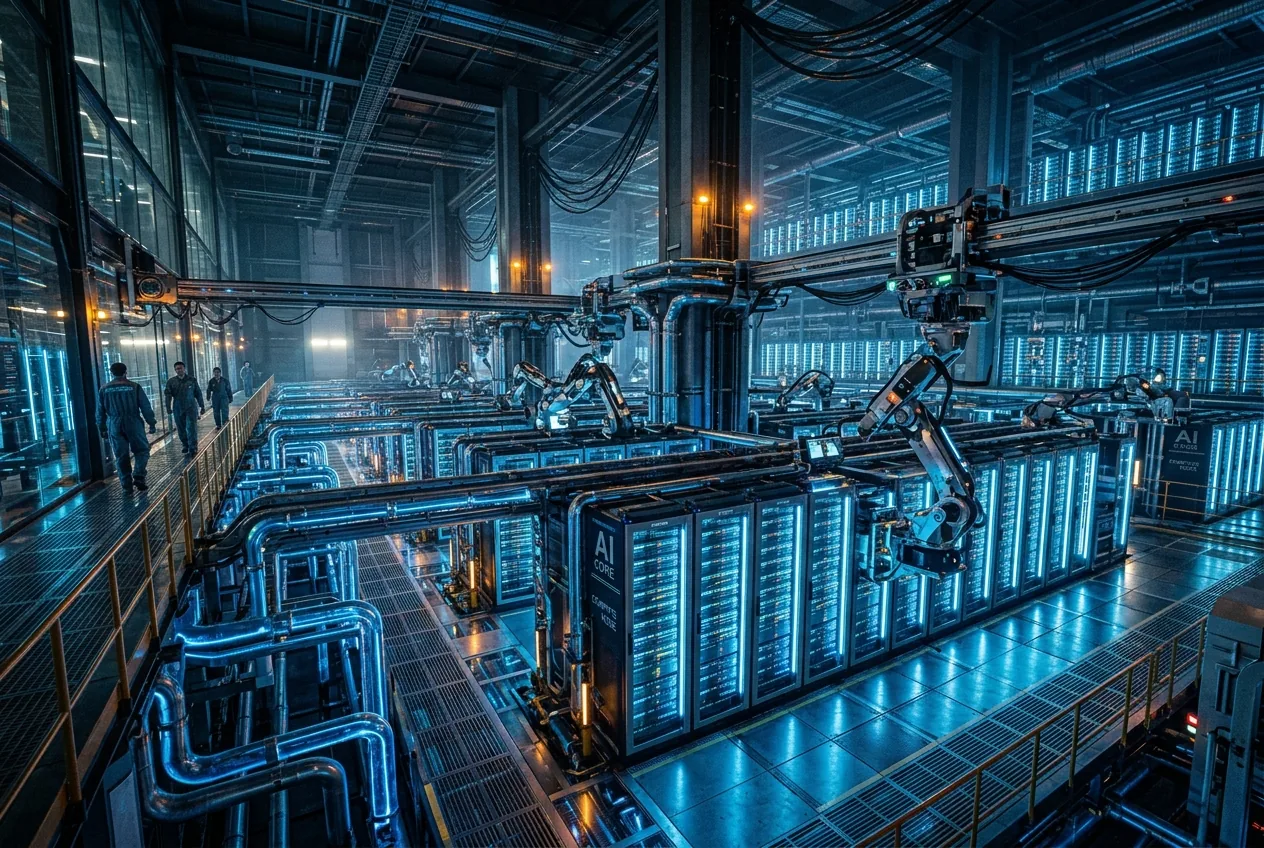
The valuation surge is directly linked to the massive investments currently flowing into the physical layer of the AI ecosystem. Alibaba CEO Wu Yongming recently noted that the current trend in AI development increasingly resembles traditional heavy manufacturing. To generate revenue in this new era, companies must build two distinct types of 'factories': the AI training factory and the AI inference factory. Both are predicated on massive data center infrastructure that consumes significant cash flow but offers a clear, high-certainty return on investment.
The training factory is the forge where foundation models are built. It requires massive clusters of GPUs, specialized cooling systems, and reliable energy grids. Currently, Alibaba reports that almost none of its servers have 'empty cards,' indicating that demand for compute is far outstripping supply. The inference factory, meanwhile, is where these models are deployed at scale to provide services to end-users. As we transition from testing models to using them in every aspect of industrial automation and supply chain management, the need for inference-specific infrastructure will become the dominant driver of the semiconductor market.
Does the Shift to Daily Active Agents Change Everything?
As the economic model of AI matures, the metrics we use to measure success are also evolving. Robin Li, founder of Baidu, recently argued that the standard unit of measurement in the AI era should be Daily Active Agents (DAA), rather than the mobile era's Daily Active Users (DAU). This is a critical distinction for the robotics and automation sectors. A user is a consumer; an agent is a producer. If the success of a platform is measured by how many autonomous agents are performing tasks for humans, the valuation of the platform becomes tied to the economic value produced by those agents.
From a mechanical and systems perspective, the DAA metric reflects the shift toward autonomous supply chains. In a warehouse or factory setting, a Daily Active Agent might be a robotic arm, a logistics drone, or a software system managing inventory in real-time. If Anthropic or Project Prometheus can demonstrate that their models are powering millions of productive agents, the leap from a billion-dollar company to a trillion-dollar entity becomes logically sound. We are moving away from measuring 'clicks' and toward measuring 'results.' This is more than a semantic change; it is a shift from the attention economy to the agency economy.
However, this transition poses a significant challenge to our current infrastructure. The move toward autonomous production requires a reindustrialization that the world is currently scrambling to accommodate. NVIDIA CEO Jensen Huang highlighted this during a recent address, noting that the AI infrastructure wave is triggering a massive demand for blue-collar skilled trades. The construction of chip factories, computer plants, and advanced manufacturing facilities requires a workforce of electricians, plumbers, and steelworkers that has been neglected for decades. The 'super-intelligence' of a $9 trillion company still relies on the physical reality of copper wire and high-pressure cooling loops.
Project Prometheus and the Bezos Strategy
While Anthropic’s numbers are grabbing headlines, the revelation of Jeff Bezos’s Project Prometheus at a $3.8 trillion valuation is perhaps even more significant for the future of industrial robotics. Founded in stealth nearly a decade ago, Prometheus appears to be the bridge between the digital intelligence of large language models and the physical requirements of global logistics. Bezos’s long-standing obsession with automation in the Amazon supply chain suggests that Prometheus is likely focused on the 'embodiment' of AI—giving models the ability to interact with the physical world through advanced robotics and automated systems.
The involvement of JPMorgan and BlackRock in the Prometheus round suggests that institutional investors are looking for a safer bet on the physical application of AI. While Anthropic represents the cutting edge of cognitive architecture, Prometheus likely represents the application of that architecture to the movement of goods and the manufacturing of products. This is where the mechanical engineering background becomes essential to understanding the value proposition. A model that can think is valuable; a model that can weld, sort, and deliver is indispensable.
The competition between these entities is driving a level of capital expenditure that has no historical precedent. We are seeing a compression of industrial cycles. What took the automotive industry fifty years to achieve in terms of automation, the AI sector is attempting to accomplish in five. This acceleration is putting immense strain on the supply chain for specialized components, from high-bandwidth memory (HBM) to the liquid cooling systems required for next-generation server racks.
Is the Trillion-Dollar Valuation Justified?
The economic viability of a $9 trillion Anthropic or a $3.8 trillion Prometheus depends on their ability to solve the bottleneck of 'real-world AI.' This means moving beyond chat interfaces and into the messy, unpredictable world of industrial operations. It requires a synergy between high-level cognitive models and the low-level control systems that govern physical machines. As the hardware becomes more capable and the models become more efficient at oversight, the gap between digital intent and physical action will close.
For those of us on the ground, designing the robotics and the automation systems that will eventually host these models, the message is clear: the scale of the task ahead is immense. The capital is there, the demand is there, and the hardware is being built. The only remaining question is whether we can train the human workforce—the electricians, the plumbers, and the engineers—fast enough to build the cathedrals of compute that these trillion-dollar valuations demand.




Comments
No comments yet. Be the first!