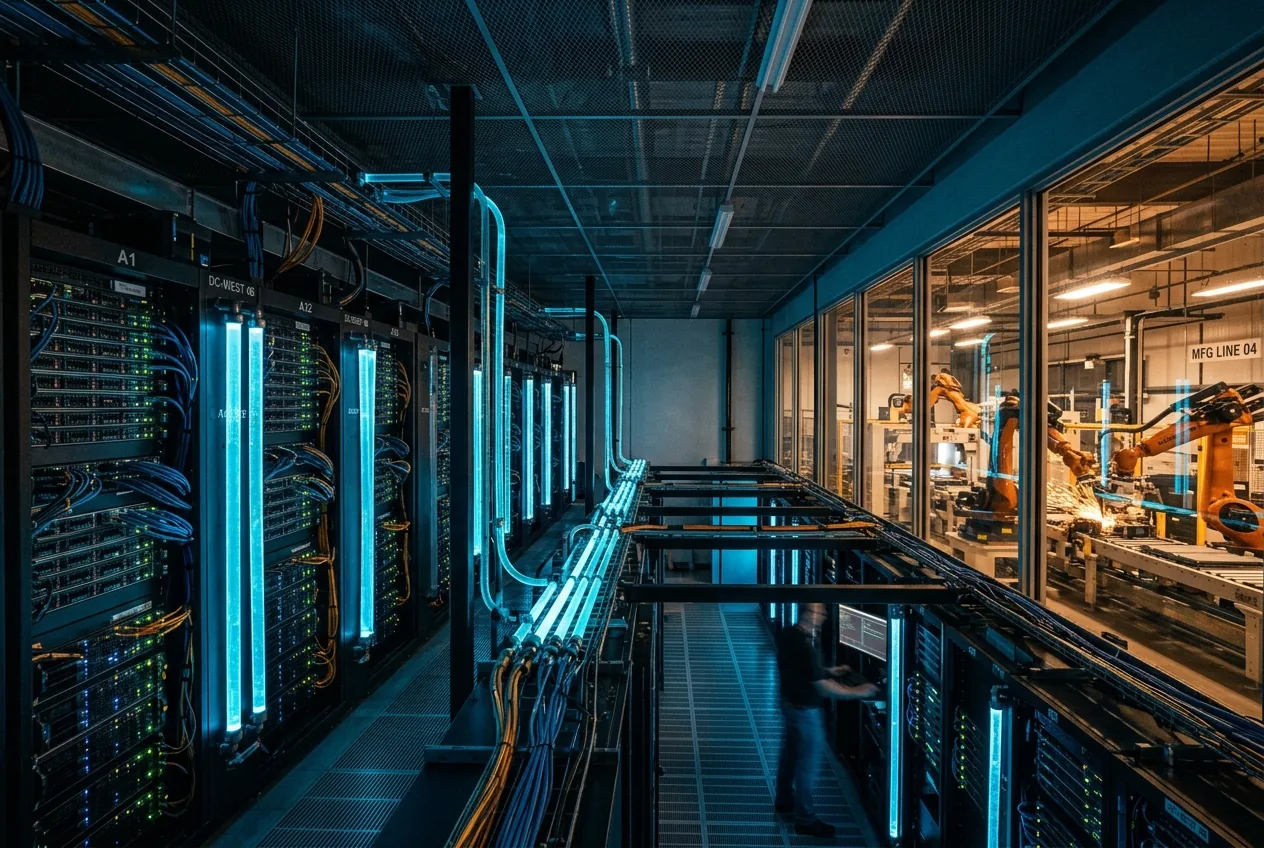
When frontier artificial intelligence models make generational leaps, the shockwaves are rarely confined to software benchmarks. They reverberate directly through electrical substations, liquid-cooling loops, and silicon fabrication schedules. With the unveiling of its Claude 5 architecture—internally codenamed the Mythos class—Anthropic has reset expectations for frontier capability. The release has immediately triggered an aggressive infrastructure war between cloud giants Amazon Web Services and Microsoft, both racing to optimize their enterprise platforms for a model family designed not merely to converse, but to autonomously govern complex physical and industrial systems.
The Mythos designation represents Anthropic’s departure from standard scaled transformer deployments. While previous iterations, such as Claude 3.5 Sonnet and Opus, pushed the boundaries of natural language comprehension and multi-modal vision, Claude 5 targets high-fidelity spatial reasoning, automated software synthesis, and end-to-end industrial control loops. For the engineering sector, this is not a marginal update to a chatbot; it is an architectural foundation engineered to interface directly with programmable logic controllers, industrial telematics, and high-throughput physical simulations.
The Anatomy of the Mythos Architecture
Under the hood, the Claude 5 Mythos class departs sharply from monolithic dense transformer scaling. While Anthropic maintains its characteristic opacity regarding absolute parameter counts, technical disclosures point to an ultra-sparse Mixture-of-Experts (MoE) topology paired with adaptive inference-time compute. This design allows the model to dynamically allocate computational depth based on problem complexity, burning significantly more compute on deterministic physical modeling and logic verification than on routine textual transformation.
For hardware engineers, the most significant shift lies in the model’s native spatial and physical reasoning engine. Anthropic has moved beyond simple image-token ingestion, training Claude 5 on volumetric datasets, kinematic coordinate systems, and direct CAD vector formats. When fed real-world sensor streams—such as point clouds from factory LiDAR or multi-axis strain sensor readouts—Claude 5 constructs an internal state estimation that mimics physics engines. This capability bridges the historical divide between statistical language modeling and the deterministic requirements of mechanical engineering, giving the system an unprecedented ability to troubleshoot complex electro-mechanical assemblies in real time.
The Cloud Infrastructure Battleground
The arrival of Claude 5 has immediately amplified friction between the primary compute brokers hosting frontier intelligence. Amazon Web Services, having invested billions into Anthropic, has positioned its Amazon Bedrock platform as the premier execution environment for Claude 5. However, the sheer computational density required to run the Mythos class at scale has exposed the hardware bottlenecks inherent in current data center designs.
To support Claude 5’s inference footprint, AWS is expediting the deployment of its custom Trainium2 and next-generation Inferentia clusters, while aggressively building out ultra-dense Nvidia Blackwell GB200 NVL72 racks. The goal is straightforward: lower the cost per token and mitigate the extreme memory-bandwidth bottlenecks that plague sparse MoE architectures. AWS is pitching industrial clients on integrated operational technology stacks, where Bedrock links Claude 5 directly to industrial data fabric services like AWS IoT SiteWise, promising sub-second latency from factory-floor sensor ingestion to automated actuation commands.
Simultaneously, Microsoft has mounted an unexpected offensive through its Azure AI Foundry ecosystem. Despite its historic exclusivity and deep alliance with OpenAI, Microsoft has systematically decoupled its enterprise platform from a single vendor, positioning Azure as the universal runtime for critical enterprise intelligence. By optimizing Azure’s custom Maia 100 silicon and high-throughput InfiniBand networking fabrics for Anthropic’s model weights, Microsoft is aggressively targeting legacy industrial conglomerates that already run their enterprise resource planning and SCADA systems on Azure infrastructure. The messaging from Redmond is clear: sovereign enterprise deployment of the Mythos class requires the security perimeters, zero-trust protocols, and hybrid cloud topology that Microsoft has spent three decades cultivating.
Rewiring the Industrial and Robotics Horizon
Beyond the cloud hosting skirmishes lies the primary battleground for Claude 5’s real-world utility: the factory floor and autonomous supply networks. For decades, industrial robotics has been constrained by rigid, deterministic programming. Industrial arms, automated guided vehicles, and automated storage systems operate within narrow tolerances; any deviation in part orientation or ambient conditions typically requires human intervention or costly reprogramming.
Claude 5’s ability to parse unstructured sensor telemetry and generate valid, real-time kinematics code challenges this paradigm. In early enterprise evaluations, the Mythos engine has been deployed to synthesize programmable logic controller code directly from high-level operational parameters, bypassing manual ladder-logic drafting. More critically, the model demonstrates an innate grasp of thermal dissipation, mechanical wear tolerances, and harmonic resonance. When tasked with balancing loads across automated CNC machining centers, Claude 5 does not merely schedule tasks; it optimizes feed rates and spindle speeds based on real-time acoustic telemetry and tool-wear modeling.
This transition fundamentally alters the economics of flexible manufacturing. Small-to-medium manufacturing operations, which historically could not amortize the massive engineering costs of specialized automation lines, now have access to a general-purpose orchestrator capable of adapting to shifting product designs with minimal physical retooling. The model effectively acts as a tireless systems integration engineer, continuously monitoring the delta between expected physical performance and actual operational metrics.
The Cold Economics of Frontier Compute
Despite the technical triumphs of the Mythos class, the economic physics governing its deployment remains unforgiving. Running inference on an architecture as dense and dynamically complex as Claude 5 requires staggering amounts of electrical power and high-bandwidth memory. While API pricing models obscure the underlying costs for casual users, enterprise deployments processing continuous telemetry streams face astronomical compute bills.
Furthermore, the reliance on high-bandwidth memory (HBM3e and HBM4) creates a persistent supply chain pinch point. If packaging foundries cannot produce silicon interposers and stacked memory modules fast enough to meet hyperscaler demand, access to the Mythos engine will remain constrained, prioritized only for high-margin financial modeling and mission-critical defense applications rather than general industrial transformation. The true test for Anthropic and its infrastructure partners is not whether Claude 5 can solve complex academic benchmarks, but whether its inference profile can be driven down to pennies per hour on the plant floor.
A Structural Shift in Computational Utility
As AWS and Microsoft pour tens of billions into outfitting their server farms for Claude 5, the mechanical and operational implications are profound. The convergence of frontier multi-modal reasoning with physical automation infrastructure represents a structural evolution in industrial technology. If the Mythos architecture delivers on its mechanical promises while cloud providers solve the underlying thermodynamic and economic bottlenecks, Claude 5 will be remembered not just as another milestone in software, but as the moment machine intelligence learned to turn the wrenches of modern industry.




Comments
No comments yet. Be the first!