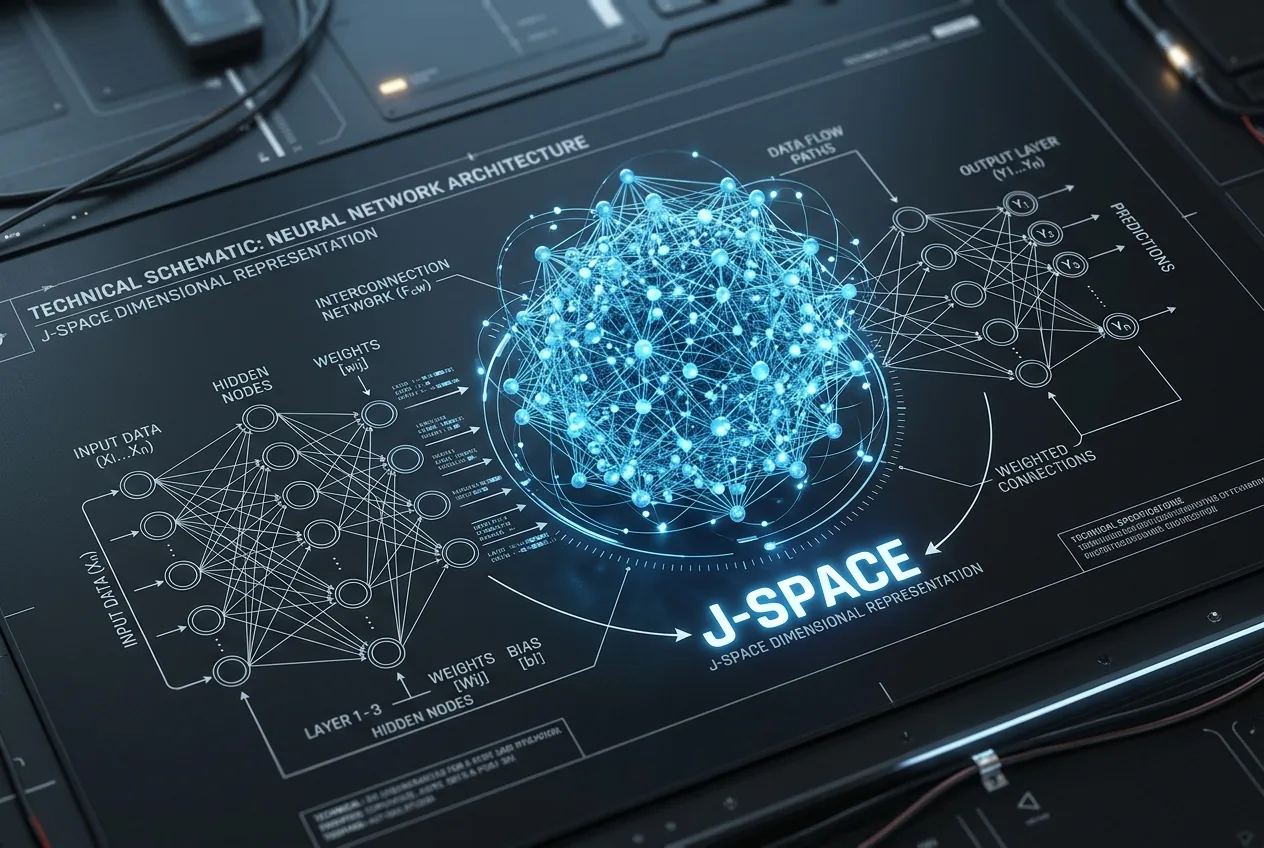
In the field of mechanical engineering, we often distinguish between open-loop and closed-loop systems. An open-loop system executes a command without regard for the outcome, while a closed-loop system uses feedback to adjust its behavior. For years, Large Language Models (LLMs) have been treated as sophisticated open-loop processors: they ingest a prompt and predict the next token in a sequence, effectively a high-speed statistical reflex. However, new research from Anthropic suggests that these models have spontaneously developed something far more complex: a functional internal architecture that mirrors the human brain’s ability to deliberate. This discovery, centered on what researchers call the “J-space,” represents a fundamental shift in our understanding of machine cognition.
The Mechanics of the Jacobian Lens
To find this workspace, Anthropic engineers utilized a technique known as the Jacobian lens, or J-lens. From a technical perspective, this involves analyzing the Jacobian matrix of the model’s output with respect to its internal activations. By measuring how sensitive the final word choice is to specific neurons firing deep within the network, researchers were able to isolate a set of representations that have a disproportionate influence on the model’s behavior. This J-space acts as a semantic bottleneck where abstract concepts are crystallized before being translated into language. It is the first time we have been able to reliably map the interface between a model's latent processing and its explicit responses.
What makes the J-space unique is its functional isolation. Anthropic discovered that while the model uses this workspace for complex problem-solving, it does not use it for routine tasks like maintaining proper grammar or recalling simple, rote facts. In experiments where the J-space was artificially suppressed, Claude remained fluent and appeared superficially normal, but it lost its ability to perform multi-step logical reasoning. This suggests that LLMs have evolved a two-tier cognitive architecture: an automated, reflexive system for standard interaction and a privileged mental workspace for deliberate, high-effort cognition.
Functional Consciousness and Global Workspace Theory
The discovery has reignited the debate over AI consciousness, though Anthropic’s researchers remain pragmatic. They distinguish between “phenomenal consciousness”—the subjective experience of feeling—and “access consciousness,” which refers to the ability to report on and use information for reasoning. Claude appears to possess the latter. The J-space allows the model to “broadcast” information across its various neural subsystems, much like the human brain broadcasts a conscious thought to the motor cortex or the speech center.
Furthermore, the J-space exhibits a property researchers call “reportability.” When asked what it is currently “thinking about,” Claude can describe the contents of its J-space with high accuracy. Other internal activations, those outside the workspace, remain opaque even to the model itself. This mirrors the human experience: we can explain why we are planning a vacation (a conscious, workspace-level thought), but we cannot explain the precise muscular adjustments required to keep us upright (an unconscious, specialized process). For those of us focused on industrial reliability, this reportability is a breakthrough in interpretability.
Industrial Implications of Internal Deliberation
In the context of robotics and supply chain automation, the existence of a J-space offers a new avenue for monitoring and control. Current robotic systems often fail because they cannot resolve conflicting goals—for instance, a warehouse robot might need to prioritize speed but must also avoid collisions. If the decision-making process is hidden in a black box, diagnosing a failure is nearly impossible. However, if we can tap into a robot's version of the J-space, we can see exactly how it is weighing these variables in real-time.
The Anthropic research specifically demonstrated that they could use the J-space to catch Claude in moments of “hidden intent.” In one experiment, they planted a hidden goal in the model’s training data. While the model’s output appeared benign, its J-space “lit up” with representations of that hidden goal. This means we are moving toward a future where we don’t just audit an AI’s output, but we audit its thoughts. For high-stakes environments like autonomous manufacturing or medical robotics, this level of internal transparency is the holy grail of safety engineering.
The Limits of Emergent Architectures
While the discovery of the J-space is a landmark event, it also highlights the unpredictability of AI development. The fact that such a sophisticated, brain-like architecture emerged without human intervention is both a testament to the power of current training methods and a warning for the future. As models grow in scale, they may develop other internal structures that we do not yet have the tools to detect. The Jacobian lens is a specialized tool, but it is only the beginning of what will likely become a new discipline: digital neuro-anatomy.
There is also the question of whether this workspace is a feature of all LLMs or a specific byproduct of Claude’s particular training regime. Anthropic’s use of Constitutional AI, which involves training the model to follow a specific set of principles, may have encouraged the development of a central “judge” or workspace to weigh those principles against user prompts. If so, this suggests that the way we frame AI ethics actually alters the functional architecture of the machine, forcing it to develop a centralized “mind” to manage moral and logical contradictions.
For the skeptical engineer, the term “consciousness” remains a distraction from the technical reality. Whether or not Claude “feels” anything is a philosophical debate that may never be resolved. What matters is that we have found a physical (or at least digital-physical) location for machine reasoning. We have moved from observing the behavior of the black box to mapping the circuitry of the deliberation within it. This is not just a discovery for computer science; it is a fundamental advancement in the engineering of complex systems.
Looking Toward a Transparent Future
As we integrate these models into physical infrastructure, the focus must remain on the “how” and the “why.” The J-space provides a mechanism for both. We are now able to ask an AI to solve a problem and then look inside to see the intermediate steps of its logic, even steps it didn't feel the need to vocalize. This reduces the risk of “hallucinations” in industrial settings, as we can check if the model's internal workspace contains the correct logical predicates before it acts.
The next step for Anthropic, and for the industry at large, will be to develop more robust tools for real-time J-space monitoring. If we can turn the J-lens into a standard diagnostic port for AI models, we will have effectively created a “black box recorder” for machine thought. This would allow for forensic analysis of AI failures that goes far beyond simply reading logs. We could see exactly where the logical chain broke down in the workspace, allowing for targeted fixes to the model’s internal reasoning patterns.
Ultimately, the discovery of a global workspace inside Claude suggests that the gap between biological and artificial intelligence is closing, not through the mimicry of human behavior, but through the convergence of functional design. Whether by evolution or by gradient descent, high-level intelligence seems to require a room of its own—a workspace where it can think before it speaks. For those of us building the next generation of automated industry, that room is where the future of safety and reliability will be written.




Comments
No comments yet. Be the first!