The landscape of artificial intelligence has undergone a seismic realignment. In a funding round that defies traditional venture capital metrics, Anthropic PBC has raised $65 billion, catapulting its valuation to a staggering $965 billion. This move does not merely provide a capital cushion for the San Francisco-based firm; it officially unseats OpenAI as the most valuable private artificial intelligence company in the world. For those of us tracking the intersection of high-end compute and industrial automation, this represents more than a rivalry—it is a clear market signal that the industry is pivoting from consumer-facing experimentation to the rigorous, safety-first architectures required for global industrial integration.
The Mechanics of a $65 Billion Capital Infusion
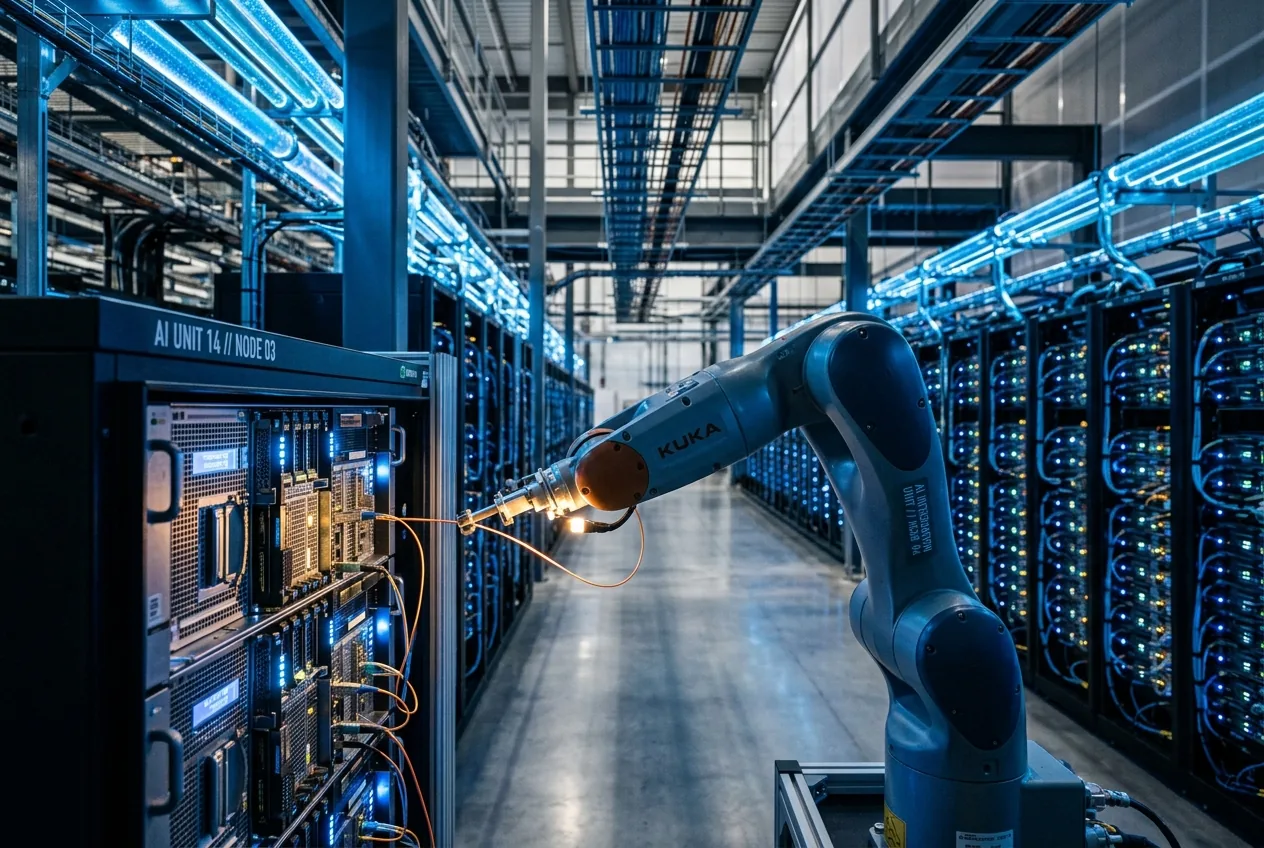
To understand the scale of this round, one must look at the capital requirements of frontier model development. Training a next-generation Large Language Model (LLM) is no longer a task measured in millions, but in billions of dollars of hardware and electricity. Anthropic’s $65 billion raise allows the company to secure the massive GPU clusters—likely centered on NVIDIA’s Blackwell architecture—necessary to keep pace with the scaling laws that define current AI progress. From a mechanical engineering perspective, the bottleneck for AI is increasingly becoming the physical facility: power density, liquid cooling requirements, and the sheer throughput of data centers.
This funding round also highlights a significant divergence in how these companies generate wealth. The round has reportedly vaulted all seven of Anthropic’s founders into the ranks of the world’s 500 richest people, with each co-founder’s stake now valued at approximately $8 billion. Unlike the early days of Silicon Valley where valuations were often decoupled from revenue, Anthropic is showing significant industrial traction. The company is on pace to post $10.9 billion in revenue for the second quarter alone, more than doubling its performance from the previous three-month period. For an industrial analyst, this 100% quarter-over-quarter growth is the most compelling piece of data in the entire announcement. It indicates that enterprise clients are moving past the “pilot” phase and are now integrating Anthropic’s Claude models into their core operational workflows.
Why Does the Market Prefer Constitutional AI for Industry?
The primary technical differentiator for Anthropic remains its commitment to Constitutional AI (CAI). In an industrial context, a model that “hallucinates” or ignores safety parameters is not just a nuisance; it is a liability. Whether an AI is managing a complex supply chain or controlling a robotic sorting arm in a distribution center, the logic must be bounded by a set of rigid, non-negotiable principles. Anthropic’s approach involves training models to follow a specific “constitution” during the reinforcement learning phase, reducing the need for human oversight and creating a more stable foundation for autonomous agents.
This stability is likely what attracted such a massive concentration of capital. While OpenAI’s GPT models are widely used for creative and general-purpose tasks, Anthropic’s Claude has carved out a reputation for being more steerable and less prone to the erratic behavior that can plague large-scale generative systems. In the world of industrial robotics and automation, steerability is synonymous with reliability. If a company is to trust an AI to oversee $100 million worth of automated machinery, they require the architectural guarantees that CAI attempts to provide. The market’s decision to value Anthropic at $965 billion—nearly $113 billion more than OpenAI—is a direct reflection of this “safety premium.”
The Hardware Tax and the Race for Compute
A significant portion of this $65 billion will inevitably flow directly into the hands of hardware manufacturers and energy providers. The AI race is, at its core, a contest of thermodynamic efficiency and transistor density. As Anthropic scales toward its next generation of models, the physical constraints of the data center become the primary limiting factor. We are seeing a move away from general-purpose cloud computing toward highly specialized, purpose-built AI factories. These facilities require specialized cooling systems and power delivery architectures that can handle the extreme heat generated by dense GPU racks.
Furthermore, the competitive landscape is not just limited to the AI labs themselves. The recent news that Databricks has reached a $100 billion valuation underscores the massive demand for the underlying data infrastructure that feeds these models. AI is only as effective as the data it processes, and for industrial applications, that data is often messy, unstructured, and massive in volume. Anthropic’s partnership with cloud giants like Amazon and Google provides them with a distribution network, but this new round of funding gives them the independence to build their own bespoke infrastructure should they choose to do so.
Does the $1 Trillion Valuation Hold Up to Scrutiny?
Critics often point to these astronomical valuations as evidence of a bubble. However, if one applies a traditional price-to-sales ratio to Anthropic’s projected annualized revenue of over $40 billion (based on their Q2 trajectory), the $965 billion valuation begins to look less like speculation and more like a high-growth technology multiple. In the industrial sector, the potential for AI to automate labor-intensive processes represents a multitrillion-dollar opportunity. If Anthropic can successfully deploy agentic AI that replaces or significantly augments human decision-making in logistics and manufacturing, their current valuation may actually be conservative.
The real-world utility of these models is currently being tested in the field of “Agentic AI”—systems that don’t just answer questions but take actions. For example, an agentic system built on Anthropic’s architecture could theoretically manage an entire warehouse’s inventory levels, negotiate with suppliers based on real-time demand, and re-route shipments in response to weather patterns, all without human intervention. The mechanical and systemic complexity of such a task requires a level of logic and safety that previous generations of AI could not provide. With $65 billion in the bank, Anthropic now has the longest runway in the industry to solve these remaining technical hurdles.
The Economic Implications for the Robotics Sector
For those in the robotics and mechanical engineering fields, Anthropic’s ascent is particularly noteworthy because of how it might accelerate the development of the “brain” for humanoid and industrial robots. Until now, the physical hardware of robotics has often outpaced the cognitive capabilities of the software. We have highly capable actuators and sensors, but the logic required to operate them in unstructured environments has remained elusive. A well-funded Anthropic is now in a position to partner with or acquire robotics firms to create a vertically integrated AI-hardware stack.
The Future of the AI Power Balance
The rivalry between Anthropic and OpenAI has often been characterized as a clash of philosophies—safety versus speed. For a long time, speed seemed to be winning. OpenAI’s rapid releases of new models captured the public imagination and drove the initial hype cycle. However, this $65 billion round indicates that the “smart money” is now betting on the safety-first approach. As AI moves from a novelty to a critical piece of global infrastructure, the risks of failure become too high to ignore. Anthropic’s rise to the top of the valuation ladder is a testament to the fact that in the world of heavy industry and global finance, reliability is the ultimate feature.
Looking ahead, the question is no longer whether AI will be integrated into our industrial systems, but which architectural philosophy will dominate that integration. With nearly a trillion dollars in valuation and a revenue stream that is doubling every quarter, Anthropic has moved from being a cautious underdog to the primary architect of the AI-driven industrial revolution. The era of the general-purpose chatbot is ending; the era of the high-reliability industrial agent has begun.




Comments
No comments yet. Be the first!