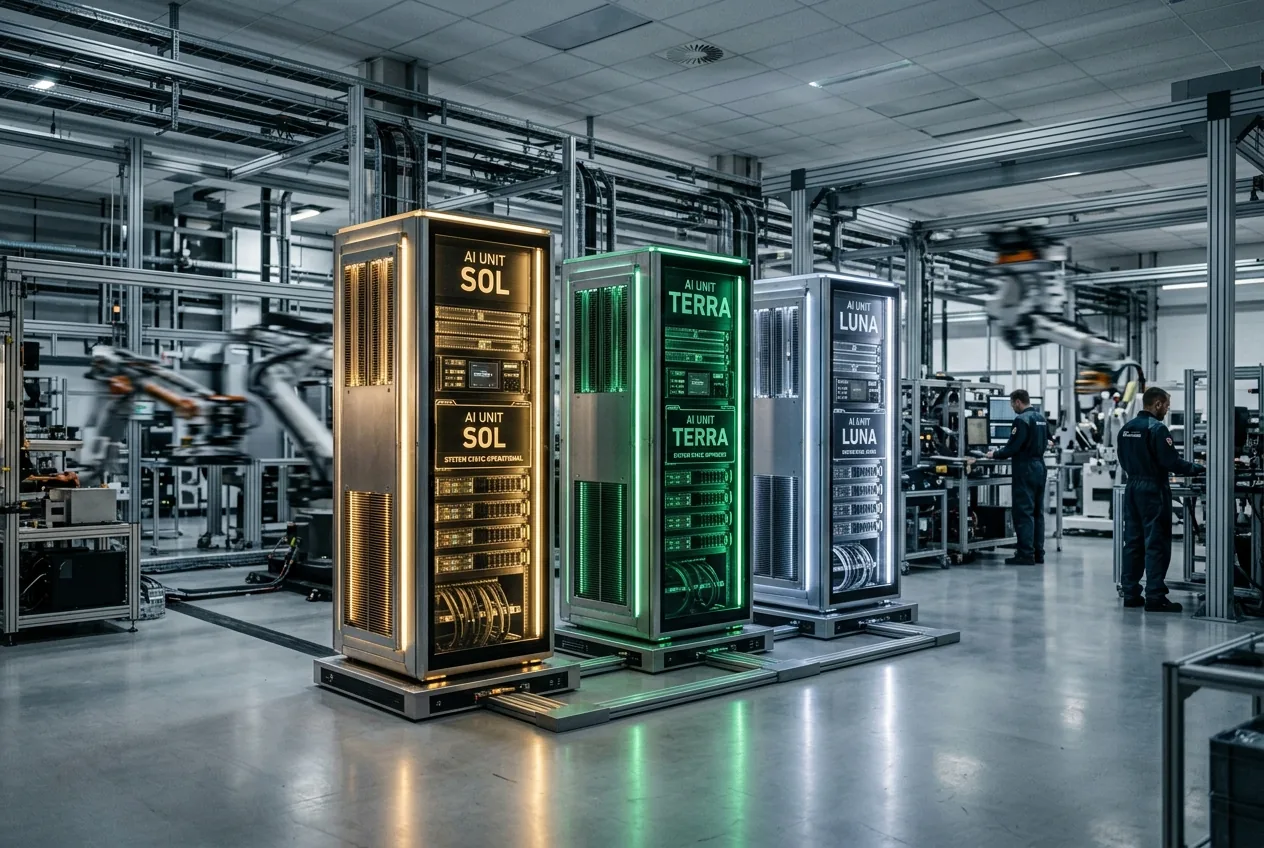
In the rapidly tightening race for dominant artificial intelligence, OpenAI has shifted its strategy from general-purpose assistants toward highly specialized, high-reasoning agents. The recent launch of the GPT-5.6 family marks a pivot in the company’s development cycle, introducing three distinct tiers—Sol, Terra, and Luna—specifically architected to handle the rigors of software engineering, cybersecurity, and scientific research. While previous iterations focused on conversational fluidity, GPT-5.6 is built for execution, particularly in environments requiring multi-step logical sequences and tool coordination.
For those of us observing the intersection of hardware and intelligence, this release is significant not just for its benchmarks, but for how it handles the 'bottlenecks of reasoning.' Sol, the flagship of the family, introduces a computational paradigm OpenAI refers to as 'reasoning configurations.' By allowing the model more 'think time' through its 'max' and 'ultra' settings, OpenAI is effectively trading instantaneous response for deeper verification. It is a systems engineering approach to language modeling: prioritizing the integrity of the output over the speed of the interaction.
The Architecture of Reason: Sol, Terra, and Luna
The GPT-5.6 release follows a tiered deployment strategy designed to address the varying economic and computational needs of industrial users. Sol sits at the top of this hierarchy, intended for the most taxing reasoning tasks. Below it, Terra serves as a general-purpose workload engine, while Luna acts as a low-cost entry point for high-volume, lower-complexity tasks. This stratification is a direct response to the market's demand for specialized AI; enterprise users no longer want one model to do everything, but rather specific models that maximize token efficiency for specific costs.
OpenAI’s technical documentation highlights that the GPT-5.6 family was trained to complete tasks with significantly fewer tokens than its predecessor. In mechanical terms, this is an efficiency gain. For example, the Sol model utilized approximately 61% less time than its nearest competitor, Anthropic’s Claude Fable 5, while achieving comparable results on agentic work indices. By reducing token overhead, OpenAI is addressing the primary barrier to large-scale AI deployment: the operational cost of inference.
How GPT-5.6 Redefines the Coding Workflow
Beyond simple code generation, GPT-5.6 excels at 'long-running engineering tasks.' In benchmarks like Terminal-Bench 2.1 and DeepSWE, which simulate real-world command-line workflows and complex troubleshooting within large codebases, Sol has set new performance ceilings. The model can write and execute its own lightweight programs to coordinate tools, process intermediate data, and monitor its own progress. This is the definition of an agentic system; it is no longer just predicting the next word, but managing a state machine to achieve a defined technical goal.
The introduction of Programmatic Tool Calling in the Responses API further enhances this capability. It allows developers to build workflows where the AI can filter intermediate data before returning only the relevant information to the core model. This minimizes the 'noise' that often leads to hallucinations in large-scale data processing, making the model a more reliable component in an automated pipeline.
Cybersecurity and the IBM Partnership
The launch of GPT-5.6 coincided with a significant announcement regarding OpenAI’s cyber program, which now includes IBM as a key partner. The focus here is vulnerability detection and validation—a critical need as software complexity outpaces human auditing capacity. On the ExploitBench2 metric, which measures the path from identifying vulnerable code to executing a successful exploit, GPT-5.6 scored 73.5%. This is a massive leap from the 47.9% recorded by GPT-5.5 under similar constraints.
However, this level of power necessitates a robust safety framework. OpenAI has integrated stronger safety testing specifically for these high-reasoning modes. The challenge is ensuring that the same reasoning that can find a bug to fix it cannot be easily repurposed to find a bug to break a system. The dual-use nature of this technology remains its most contentious aspect, particularly as its 'exploit generation' capabilities become more refined.
Scientific Reasoning and Professional Workflows
In the realm of science and professional work, GPT-5.6 has demonstrated an ability to synthesize information across 55 different fields. On the Agents’ Last Exam—an evaluation of professional-level workflows—Sol scored 53.6, which is 13.1 points higher than its predecessors using adaptive reasoning. This suggests the model is becoming increasingly capable of handling the 'messy' data associated with scientific research, where information is often siloed across different document types and databases.
A key upgrade is the model's ability to interface with external workplace data. GPT-5.6 can now natively work with files and data from Slack, Notion, Microsoft 365, and Google Drive. In a practical engineering context, this means an agent could theoretically pull a specification from a Google Doc, check recent developer discussions in Slack, and then write a technical summary or draft a CAD-compatible script based on those combined inputs. The OSWorld 2.0 benchmark, where OpenAI reported an 85% reduction in output tokens while maintaining high performance, confirms that the model is getting better at navigating operating system environments to find and use these tools.
For those involved in documentation and design, the model can now inspect rendered interfaces and revise them. It can turn natural-language instructions into interactive visualizations, creating editable presentation decks that respect recurring elements like typography, spacing, and color palettes. This isn't just about making things look good; it's about the model understanding the underlying 'rules' of a design system and adhering to them with mathematical precision.
Can GPT-5.6 Maintain Its Lead in the Global Market?
Despite the impressive launch, OpenAI is not operating in a vacuum. Anthropic continues to push the limits of safety and nuance with the Claude series, and Google’s deep integration into the Android and Workspace ecosystems provides a formidable data moat. Furthermore, regional players are emerging with hardware-optimized solutions. For instance, DeepSeek has launched its V4 model specifically adapted for Huawei AI chips, a move that could dominate the massive Chinese industrial market by leveraging localized hardware acceleration.
The economic viability of these models will ultimately decide the winner. OpenAI’s focus on reducing token counts and offering tiered models like Terra and Luna shows they are aware that the 'brute force' era of AI is ending. The next phase is about surgical precision—deploying the right amount of intelligence for the specific task at hand. For the engineer or the security professional, GPT-5.6 Sol represents a new type of 'power tool': one that doesn't just assist with the work, but understands the technical logic required to complete it.
As we look toward the integration of these models into physical robotics and industrial automation, the reasoning capabilities found in GPT-5.6 Sol provide a glimpse of the future. The ability to coordinate multiple 'agents' or 'sub-routines' in parallel to solve a physical problem—such as a robot arm troubleshooting a jam in a fulfillment center—is the logical next step. OpenAI has built the brain; the industry must now build the nervous system to support it.




Comments
No comments yet. Be the first!