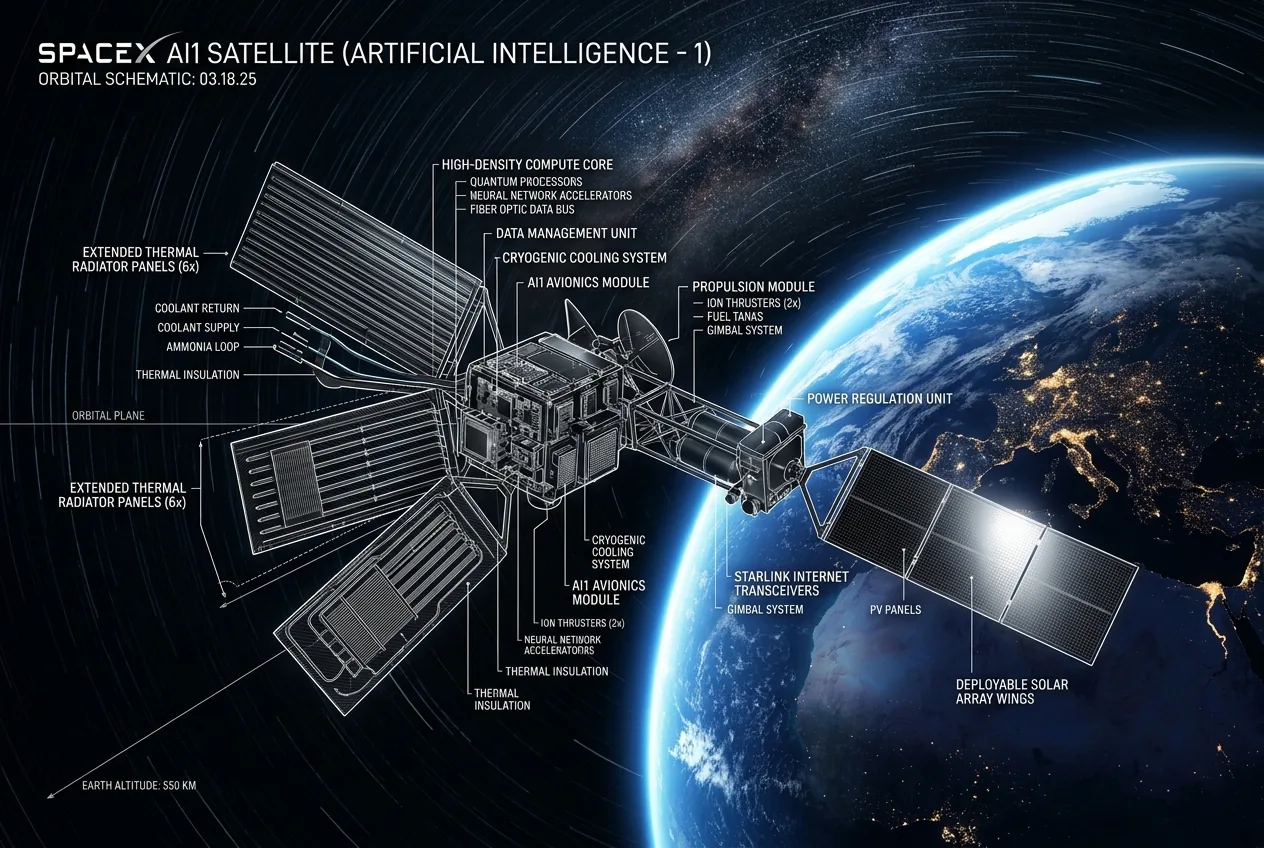
The rivalry between Elon Musk and Sam Altman has transcended the typical boundaries of Silicon Valley competition, evolving into a high-stakes conflict involving allegations of corporate espionage, the weaponization of legal frameworks, and a race to deploy the world’s first orbital artificial intelligence infrastructure. This week, the friction reached a new boiling point as Musk leveraged a massive lawsuit filed by Apple against OpenAI to launch a series of scathing public attacks. Musk not only accused Altman of effectively “stealing” the non-profit foundation of OpenAI but also alleged the theft of Apple’s proprietary hardware technology. In a characteristic display of bravado, Musk tied these accusations to the technical timeline of SpaceX, vowing that his company’s dedicated AI1 satellites will begin deployment next year, while suggesting Altman might be incarcerated before the first payload reaches orbit.
The Architecture of an Orbital Data Center
While the verbal jousting dominates the headlines, the technical implications of Musk’s SpaceX announcement deserve rigorous analysis. The AI1 satellite is not merely a variation of the existing Starlink communication hardware; it represents a fundamental shift toward off-planet edge computing. According to technical specifications circulating within the aerospace community, each AI1 satellite is designed to support up to 150kW of peak compute payload. From a mechanical engineering perspective, the thermal management of such a density in a vacuum is a Herculean task. SpaceX is reportedly utilizing advanced liquid radiators and a centralized compute module to dissipate the massive heat generated by high-performance inference processing.
These satellites, manufactured at the Gigasat facility in Texas, are equipped with reinforced meteoroid shielding and high-efficiency deployable solar arrays. The economic viability of orbital data centers rests on the reduction of latency for global AI agents and the bypassing of terrestrial power grid constraints. By placing AI compute in orbit, SpaceX could potentially offer a sovereign, low-latency intelligence layer that operates independently of traditional internet backbones. Musk’s claim that these will “start flying next year” sets an aggressive schedule for 2027, challenging the terrestrial-first approach currently favored by competitors like OpenAI and Microsoft.
The Apple Lawsuit and Allegations of Hardware Theft
Musk seized on these details to frame Altman as a serial offender in the theft of intellectual and organizational property. On his social media platform, Musk stated that after “stealing” the non-profit mission of OpenAI to convert it into a for-profit powerhouse, Altman has now pivoted to the physical theft of Apple’s phone technology. The “charity” Musk refers to is the original 2015 charter of OpenAI, which Musk heavily funded under the premise that the organization would remain a non-profit, open-source check against the unchecked power of corporations like Google. The subsequent pivot to a multi-billion dollar for-profit entity remains a primary source of legal and personal animosity for Musk.
A Congested Roadmap for Consumer AI Hardware
The conflict over intellectual property arrives as the industry prepares for a massive transition from software-based AI to dedicated consumer hardware. OpenAI is reportedly finalizing several devices, including AI-powered earbuds internally codenamed “Sweetpea” (rumored to retail as “Dime”) and a pen-like device codenamed “Gumdrop.” These devices are expected to rely on real-time AI agent inference, replacing the traditional app-based ecosystem with a seamless, voice-and-vision-driven interface. OpenAI projects sales of up to 50 million units within the first year of the Sweetpea launch, slated for late 2026 or early 2027.
Apple, meanwhile, is not standing still. The Cupertino giant is developing a hardware suite that includes camera-equipped AirPods Pro and a wearable AI pin or pendant. Unlike OpenAI’s proposed standalone devices, Apple’s wearable strategy appears to leverage the existing iPhone ecosystem, using the wearable as a sensor-rich conduit for a more powerful Siri, driven by on-device chips similar to those found in the Apple Watch. This philosophical divide between standalone AI devices and smartphone-tethered peripherals is at the heart of the current IP war. If OpenAI truly utilized Apple’s design architecture for its “Sweetpea” or “Gumdrop” prototypes, it would constitute one of the most significant cases of corporate espionage in modern tech history.
Can the StepX Neo Disrupt the American Duopoly?
While Musk and Altman trade barbs and Apple files motions, a third player from China has quietly achieved a milestone both American companies are still chasing. StepX recently unveiled the Neo, an “agentic” phone built from the ground up around a large language model. Unlike current smartphones that layer AI on top of a legacy operating system, the Neo utilizes the native Step AOS, designed to allow the Amoo AI agent to perform system-wide tasks across applications without user intervention.
The technical specifications of the StepX Neo are formidable, featuring Snapdragon 8 Elite Gen 5 SoCs and up to 16GB of RAM. From a pragmatic standpoint, StepX has achieved the first-mover advantage that OpenAI and Apple are still litigating over. The existence of a working agentic phone in China highlights the risk of the American tech sector becoming bogged down in protracted legal battles. While Musk focuses on orbital compute and Altman focuses on consumer devices, the integration of hardware and software into a cohesive “agent-first” experience is already a reality in the Eastern market. This development puts immense pressure on both Apple and OpenAI to resolve their disputes and bring viable products to market before the global standard for AI hardware is set elsewhere.
The Economic Viability of Orbital Computing
The most forward-looking aspect of this saga remains Musk’s SpaceX AI1 initiative. Skeptics often dismiss Musk’s timelines, yet the mechanical and economic logic of orbital AI is compelling. Terrestrial data centers face increasing pushback due to their massive water consumption and strain on local energy grids. A satellite-based compute network, while expensive to launch, benefits from passive cooling in the shadow of the Earth and uninterrupted solar energy in orbit. If SpaceX can successfully manage the 150kW thermal load, they will have created a new utility: “Space-as-a-Service” for AI inference.
The prison jab Musk directed at Altman, while inflammatory, reflects the gravity of the Apple lawsuit. In the world of mechanical and systems engineering, the theft of physical circuit designs and component architecture is far easier to prove than the ephemeral theft of training data or algorithms. If Apple can produce evidence of hardware samples being used in OpenAI’s development labs, the legal consequences could indeed be severe. For now, the industry is witnessing a two-front war: one for the devices in our pockets and another for the processors in our orbit. The outcome will define whether the next era of computing is defined by collaboration, competition, or court-mandated settlements.




Comments
No comments yet. Be the first!