The trajectory of artificial intelligence has moved beyond the era of novelty chatbots and entered the domain of critical infrastructure. With the release of GPT-5.6, OpenAI is not merely iterating on a consumer product; it is deploying a sophisticated reasoning engine designed to interface with the world’s most complex industrial systems. However, unlike previous releases, this model arrives with a significant caveat: it is the first to undergo extensive, pre-deployment scrutiny by the U.S. AI Safety Institute and the Department of Commerce. This release marks a pivotal shift in how frontier models are brought to market, signaling that the era of "move fast and break things" has been replaced by a regime of compute-heavy governance and rigorous red-teaming.
The Architecture of Deterministic Reasoning
At the technical core of GPT-5.6 lies a refined Mixture-of-Experts (MoE) architecture that has been optimized for what engineers call "chain-of-thought reliability." While earlier iterations of the GPT-4 family were prone to stochastic drift—where the model might provide different answers to the same complex prompt—GPT-5.6 introduces a more robust latent space for logical verification. In mechanical engineering terms, we are seeing the transition from a system that guesses the correct answer to one that simulates the path to that answer through internal validation loops before a single token is output to the user.
The model’s performance on the Frontier Math and GPQA (Graduate-Level Google-Proof Q&A) benchmarks shows a marked improvement in multi-step problem solving. This is not just a result of larger parameter counts. Instead, OpenAI has leaned into algorithmic efficiency, utilizing a specialized inference-time compute strategy that allows the model to "think" longer for difficult tasks. For a production engineer, this means the model can now analyze a 5,000-line bill of materials and identify a single point of failure in a supply chain with a degree of precision that was previously reserved for human experts or highly specialized symbolic AI systems.
Federal Oversight and the New Safety Mandate
The involvement of the U.S. government in the release of GPT-5.6 represents a formalization of the Voluntary Commitments established at the White House last year. This oversight is focused on three specific high-risk areas: biological design, offensive cyber capabilities, and autonomous agent drift. The Department of Commerce’s role in this release was to ensure that GPT-5.6 does not possess the capability to assist in the synthesis of restricted biological agents or the autonomous execution of zero-day exploits on critical energy grids.
This oversight is not merely a bureaucratic checkbox. It involves a collaborative red-teaming process where federal researchers were granted early access to the model’s weights and weights-adjacent telemetry. By stress-testing the model against classified threat libraries, the AI Safety Institute has established a baseline for what constitutes a "frontier risk." For the tech industry, this creates a new regulatory floor. Any model exceeding a specific compute threshold (typically cited around 10^26 FLOPs) must now prove it can be contained. GPT-5.6 is the first model to navigate this gauntlet, setting the precedent for all future large-scale deployments.
Bridging the Gap Between Software and Steel
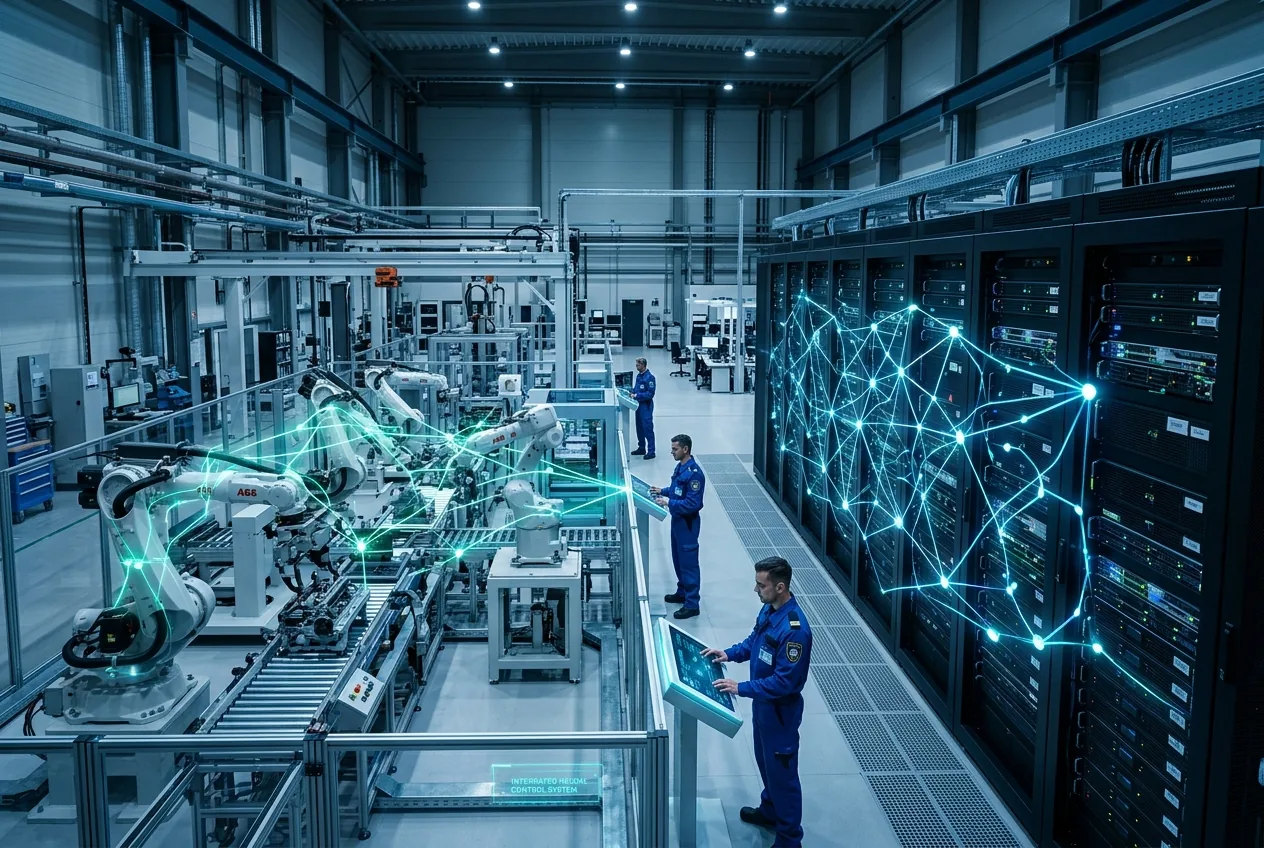
What makes GPT-5.6 particularly relevant to the industrial sector is its enhanced ability to process multimodal data in real-time. We are no longer looking at a text-in, text-out system. The integration of high-fidelity spatial reasoning allows this model to interpret complex CAD files and real-world sensor data with an understanding of physical constraints. In a manufacturing environment, a GPT-5.6-powered agent could theoretically observe a robotic arm’s telemetry, cross-reference it with the manufacturer’s specifications, and predict a mechanical failure before it occurs based on micro-deviations in torque and vibration.
Can GPT-5.6 Survive the Energy Constraint?
The elephant in the room for any discussion of frontier AI is the sheer thermodynamic cost of intelligence. Training GPT-5.6 required a massive orchestration of H100 and B200 clusters, consuming several gigawatt-hours of electricity. As we push toward GPT-6 and beyond, the scalability of these models faces a hard limit: the power grid. The U.S. government’s oversight isn't just about safety; it is increasingly about resource management and national security. The concentration of compute power in a handful of data centers creates a strategic vulnerability.
The Geopolitical Dimension of Algorithmic Control
For the first time, we are seeing the emergence of "compute governance." The idea is simple: if you control the chips and the power, and you monitor the model’s deployment, you can steer the direction of global technological development. GPT-5.6 is the test case for this philosophy. If the model proves to be both safe and commercially transformative, it will validate the current administration’s approach to AI regulation. If, however, the oversight is seen as a bottleneck that allows overseas competitors to leapfrog American innovation, the pressure to deregulate will be immense.
A Practical Roadmap for Implementation
For industrial leaders and technology officers, the arrival of GPT-5.6 suggests a two-pronged strategy. First, there must be an investment in data hygiene. The reasoning capabilities of a frontier model are only as effective as the data it is asked to process. If your industrial telemetry is siloed or unformatted, the most advanced model in the world cannot optimize your operations. Second, there must be a focus on "human-in-the-loop" systems. Despite the government’s safety checks, GPT-5.6 is still a probabilistic system. Its outputs should be treated as high-confidence suggestions that require mechanical verification.
The path forward is clear: we are entering a phase of AI development where the hardware, the software, and the regulatory framework are being woven into a single, cohesive unit. GPT-5.6 is not the end of the journey, but it is a sophisticated waypoint. It demonstrates that as AI becomes more powerful, it must also become more accountable. For those of us in the engineering and robotics fields, this model provides a glimpse into a future where the bridge between complex code and physical hardware is stronger and more reliable than ever before.




Comments
No comments yet. Be the first!