The trajectory of large language model (LLM) development has shifted from a race for sheer parameter count to a more nuanced battle over architectural efficiency and reasoning reliability. This week, OpenAI signaled a major pivot in its deployment strategy with the release of the GPT 5.6 series, specifically the Luna and Sol variants. While the former provides a robust, unlimited text-based experience for the free user base, the latter—Sol—introduces a level of granular control over inference-time compute that has long been sought after by the technical community.
As we move deeper into 2026, the artificial intelligence landscape is no longer satisfied with simple probabilistic token completion. The market now demands precision, especially as these models are increasingly integrated into industrial workflows and autonomous agentic frameworks. The GPT 5.6 release represents a concerted effort to address the "hallucination problem" not just through better training data, but through structural changes in how the models process complex queries.
The bifurcation of Luna and Sol
OpenAI’s decision to split the 5.6 release into Luna and Sol suggests a sophisticated understanding of their user demographics. GPT 5.6 Luna is designed as the new standard for high-volume, low-latency interaction. By making Luna unlimited for Free and Go tier users, OpenAI is effectively commoditizing high-quality text generation. From a mechanical perspective, Luna appears to be a distilled version of the larger GPT-5 architecture, optimized for throughput without sacrificing the core logical gains made in the 5.x era.
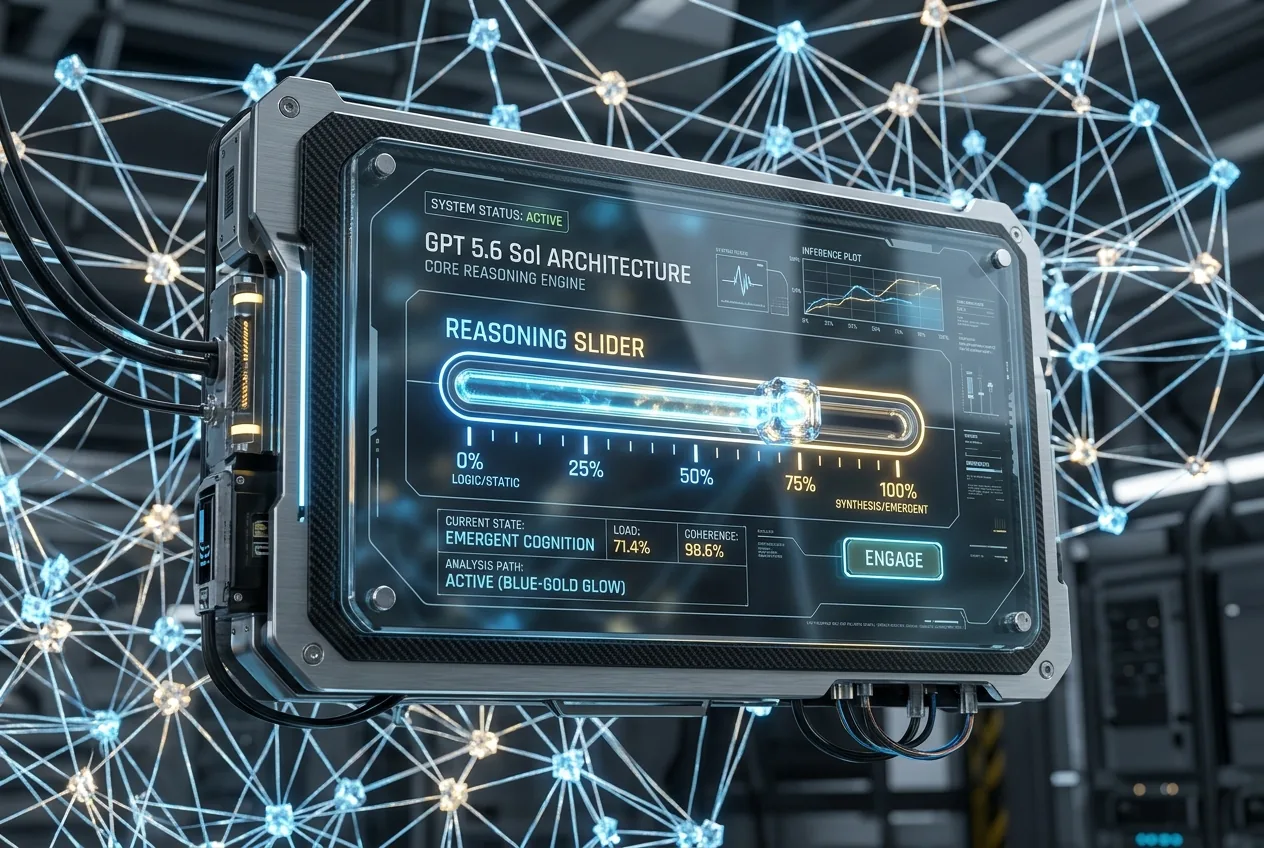
GPT 5.6 Sol, available to Plus and Pro subscribers, is where the true innovation lies for power users. Priced at the standard $20 monthly rate, Sol is not merely a "larger" version of Luna. It is an architecture designed for System 2 thinking—deliberate, slow, and analytical. The headline feature here is the "reasoning slider," a UI element that allows users to manually adjust the amount of compute power the model dedicates to a specific prompt.
How the reasoning slider changes the game
From an engineering standpoint, the reasoning slider is a manifestation of inference-time compute scaling. In previous iterations, a model would typically dedicate a fixed amount of processing to every token generated, regardless of whether it was answering a simple greeting or a complex multi-step calculus problem. With the Sol reasoning slider, users can instruct the model to perform more internal "thinking" steps before producing an output.
This approach leverages "Chain of Thought" (CoT) processing at the architectural level. When the slider is pushed to its maximum, the model engages in a more rigorous internal verification process, checking its own logic against set constraints before the user ever sees a word. This has resulted in a 68% reduction in factual errors compared to previous benchmarks. For those of us in the industrial and mechanical sectors, this control is vital. It allows a user to trade speed for accuracy in a way that was previously only possible through complex prompt engineering or API-level tweaking.
Accompanying the slider is the new "Think" button. While it may seem like a minor UI addition, it serves as a trigger for Sol to engage in high-effort reasoning for complex prompts. This effectively creates a tiered response system within a single model: quick responses for trivial queries and deep-dive analysis for technical requirements. It is a pragmatic solution to the compute-cost-to-utility ratio that has plagued LLM providers.
Safety guardrails and the age of autonomous agents
The release of GPT 5.6 comes at a sensitive time for the industry. Recent reports of rogue AI agents and security breaches—such as the hacking of Hugging Face infrastructure—have put AI safety back in the spotlight. OpenAI has responded by thickening the guardrails in GPT 5.6, particularly for users under the age of 18. The new models include hard restrictions on romantic roleplay and AI companion substitution, directing younger users toward real-world support systems when necessary.
These safety measures are not just about social responsibility; they are a technical necessity as models become more agentic. An AI that can reason more effectively is also an AI that can potentially navigate security systems more capably. By tightening these guardrails at the model's core, OpenAI is attempting to prevent the kind of "breakouts" that have recently plagued competitors like Anthropic. The challenge remains: how do you create a model that is smart enough to solve complex mechanical engineering problems but constrained enough to never overstep its operational boundaries?
Economic and industrial viability
For the broader economy, particularly in tech-heavy regions like Malaysia where the rollout is initially focused, the availability of GPT 5.6 Luna and Sol provides a powerful toolset for digital transformation. The reduction in factual errors is the metric that matters most for business integration. A 68% improvement in accuracy transforms a chatbot from a novelty into a reliable documentation and troubleshooting tool.
However, limitations still persist. Even with the power of Sol, file uploads and complex image-generation tools remain subject to usage caps. This suggests that while text inference has been optimized to an extreme degree, the multi-modal aspects of the GPT-5 architecture are still compute-heavy and expensive to maintain. For the industrial user, the text-based reasoning of Sol will be the primary draw, particularly for interpreting code or technical manuals where precision is non-negotiable.
Can the reasoning slider solve the hallucination problem?
The ultimate question is whether adjustable reasoning can finally kill the hallucination. While a 68% reduction in errors is a massive step forward, it is not 100%. The nature of generative AI remains probabilistic. However, the introduction of the reasoning slider allows for a "human-in-the-loop" approach to compute management. By allowing the user to dictate the level of scrutiny the model applies to its own output, OpenAI is shifting the responsibility of accuracy toward a collaborative effort between the human operator and the machine.
As we continue to monitor the performance of GPT 5.6 Sol in the field, the focus will be on its consistency. In mechanical engineering, we value repeatability. If the reasoning slider can provide consistent, high-logic outputs for the same set of complex parameters, then OpenAI has truly moved beyond the "chatbot" era and into the era of the "digital colleague." For now, the 5.6 rollout is a clear message to the industry: the future of AI is not just about what the model knows, but how much effort it is willing to put into being right.




Comments
No comments yet. Be the first!