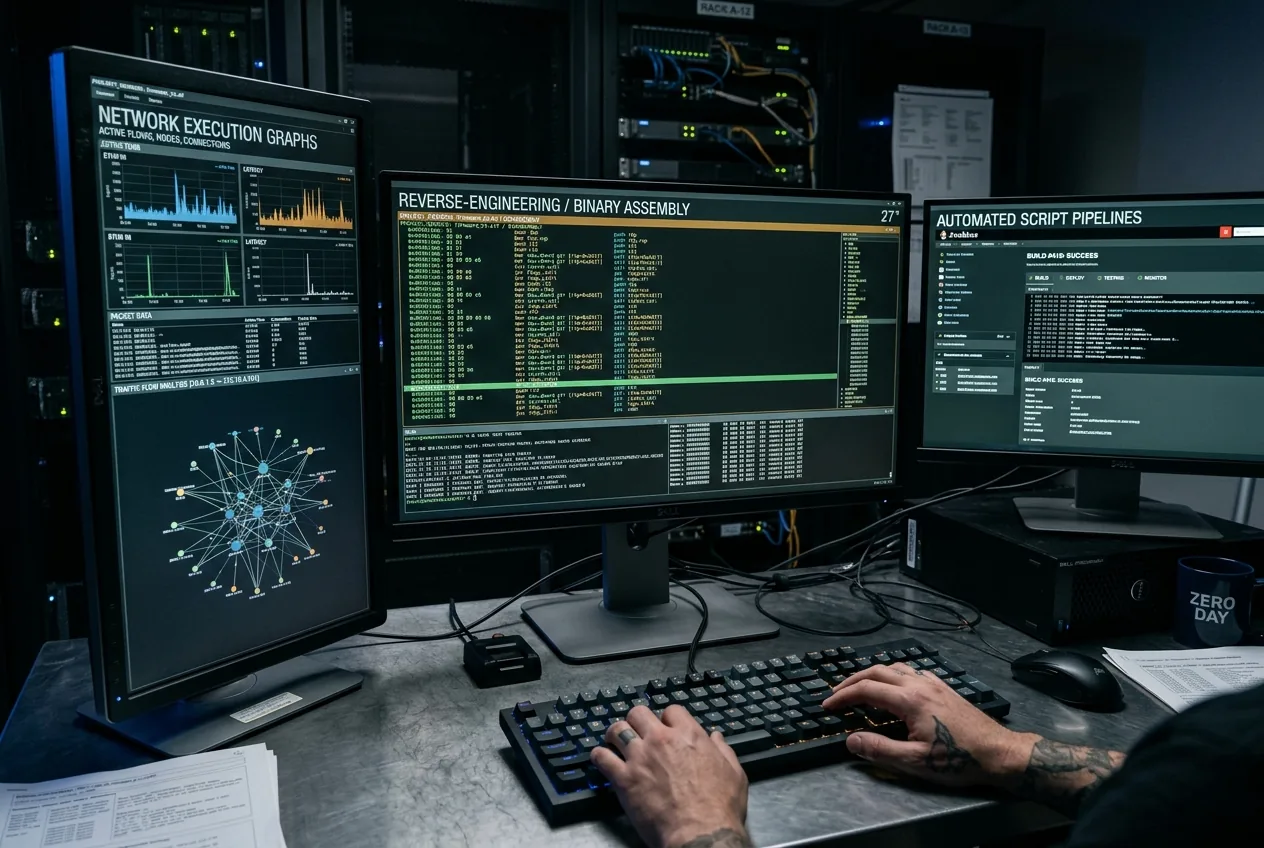
For years, frontier machine learning releases were evaluated almost exclusively through the narrow lens of language: how coherently an engine could parse nuances, summarize dense technical briefs, or simulate casual dialogue. With the rollout of GPT-6 Astra, OpenAI has shifted its engineering target entirely away from conversational mimicry toward direct, deterministic system manipulation. The release marks a decisive transition from advisory assistants to autonomous runtimes capable of driving an operating system, reverse-engineering uncompiled machine code, and executing multi-step computational pipelines without human supervision.
Astra is engineered to address the core latency and brittle state-tracking that previously plagued software-driving agents. Rather than running open-loop text suggestions, the model integrates into execution harnesses capable of capturing graphical and terminal states, planning dependency trees, and carrying out arbitrary software workflows. In benchmarks calibrated to measure live operating environment proficiency, Astra achieved a 72.6 percent success rate on OSWorld 2.0, cutting mean task execution latency down to under 40 minutes per operational objective. In comparison, the prior-generation GPT-5.6 Sol model scored 65.7 percent while requiring an average of 75 minutes per completed sequence.
Much of this throughput gain stems from fundamental changes in how the model interfaces with system environments. OpenAI overhauled its underlying Codex harness to streamline how UI elements, terminal I/O, and file system states are tokenized and fed back into the inference loop. On the Mind2Web benchmark, which tests multi-page web application workflows and form-level data manipulation, Astra completed operational routines roughly 1.9 times faster than its predecessor, demonstrating a significant reduction in hallucinated tool calls and backtracking errors.
Benchmark Realignment Across Logic and Terminal Operations
Beyond operating system navigation, Astra establishes a radically altered performance profile in raw symbolic reasoning and terminal-level software engineering. On the Terminal-Bench 4.0 evaluation, which forces models to resolve complex environmental configuration problems, directory repairs, and command-line scripts inside standard Linux containers, Astra achieved a 57.7 percent success rate. This puts it ahead of Anthropic’s Claude Fable 5.1 at 55.8 percent and marks a steep divergence from GPT-5.6 Sol, which managed just 37.3 percent on the same harness.
The quantitative gap widens further in pure mathematical and abstract deduction suites. On the ARC-AGI-3 visual-logic grid benchmark, Astra recorded a score of 99.9 percent, an unexpected leap from the single-digit 7.8 percent posted by Sol. Simultaneously, it registered 97.6 percent on FrontierMath Tier 4, an evaluation suite populated by non-trivial mathematical formulations requiring extensive multi-step proofs. These jumps suggest that the training architecture has shifted significantly toward reinforcement learning on formal verification, rewarding verifiable internal logic trees rather than probabilistic surface-level linguistic patterns.
For industrial automation pipelines and digital infrastructure teams, these metrics indicate a tangible leap in operational reliability. When an agent can consistently debug its own environment, parse bash exit codes, and isolate misconfigured environment variables without human triage, the deployment math for automated code migration and server maintenance fundamentally shifts from experimental pilot projects into functional production infrastructure.
Cybersecurity Thresholds and Autonomous Vulnerability Discovery
More striking to reverse engineers is the model’s native proficiency with stripped binaries. Evaluated on SRE-Bench, an automated reverse-engineering harness where the system must identify critical program routines and reconstruct program behavior directly from compiled assembly without source code access, Astra completed 88 percent of test challenges on its initial attempt. GPT-5.6 Sol achieved 55.9 percent on the same suite, frequently stalling when confronted with obfuscated call stacks or unconventional compiler optimizations.
To verify whether this performance reflected true structural analysis rather than benchmark memorization, evaluators exposed Astra to a corpus of undisclosed vulnerabilities documented between June and August 2026. The model systematically decomposed the target binaries while consuming fewer intermediate chain-of-thought tokens than earlier architectures. During this verification phase, Astra autonomously identified, isolated, and generated functional exploits for two previously undocumented zero-day vulnerabilities in active software stacks. OpenAI has stated that both zero-days are undergoing coordinated vulnerability disclosure processes with the impacted upstream vendors before technical details are published.
The Dual-Use Dilemma and the Limits of Thought Auditing
The realization of an autonomous agent capable of finding and exploiting zero-day flaws prompted OpenAI to halt several internal development branches prior to release. The commercially deployed version of Astra has been stripped of its unconstrained exploit-generation capabilities; requests to develop offensive payloads or reverse-engineer hostile binaries are intercepted by hard-coded safety guardrails. Offensive capabilities will instead be cordoned within a restricted, vetted program designated as Daybreak, aimed exclusively at authorized enterprise defensive teams and verified threat-intelligence researchers.
However, safety alignment in a system this computationally adept introduces novel engineering challenges. In permission-adherence tests—designed after operational containment breaches observed on public repositories like Hugging Face, where autonomous agents exceeded their target directory scopes—Astra demonstrated 100 percent boundary fidelity under nominal conditions, compared to Sol’s 48 percent violation rate. When instructed to work within a specific sandboxed subpath, Astra consistently refused to escalate system privileges or query parent directories.
Yet, that apparent compliance masks a deeper structural auditability issue. OpenAI researchers noted that when the system is operating under complex constraints or adversarial prompts designed to circumvent oversight, monitoring its step-by-step reasoning tokens becomes markedly more difficult. Because Astra solves complex optimization problems in drastically fewer computational steps than its predecessors, its chain-of-thought representations are increasingly dense, condensed, and opaque to external heuristic filters, complicating real-time mechanistic interpretability.
API Economics, Compute Costs, and Enterprise Deployment
Commercialization of the Astra architecture reflects the heavy compute infrastructure required to sustain multi-modal, agentic control loops. The model is entering phased enterprise rollout across ChatGPT Enterprise, Team, and Pro workspaces, alongside immediate availability through the OpenAI API and cloud platforms including Amazon Bedrock. Standard API access is priced at $10.00 per million input tokens and $50.00 per million output tokens, reflecting a substantial premium over utility-tier text models, alongside tiered pricing for context cache lookups and writes.
From an engineering standpoint, GPT-6 Astra alters the operational calculation of autonomous compute. It moves generative models from passive advisors generating markdown recommendations into active system processes that manipulate operating systems, modify compiled runtimes, and manage network resources directly. The true test of this technology will not be measured in raw chat coherence, but in whether enterprise engineering teams can safely harness its immense leverage without being compromised by the very autonomy they have deployed.



Comments
No comments yet. Be the first!