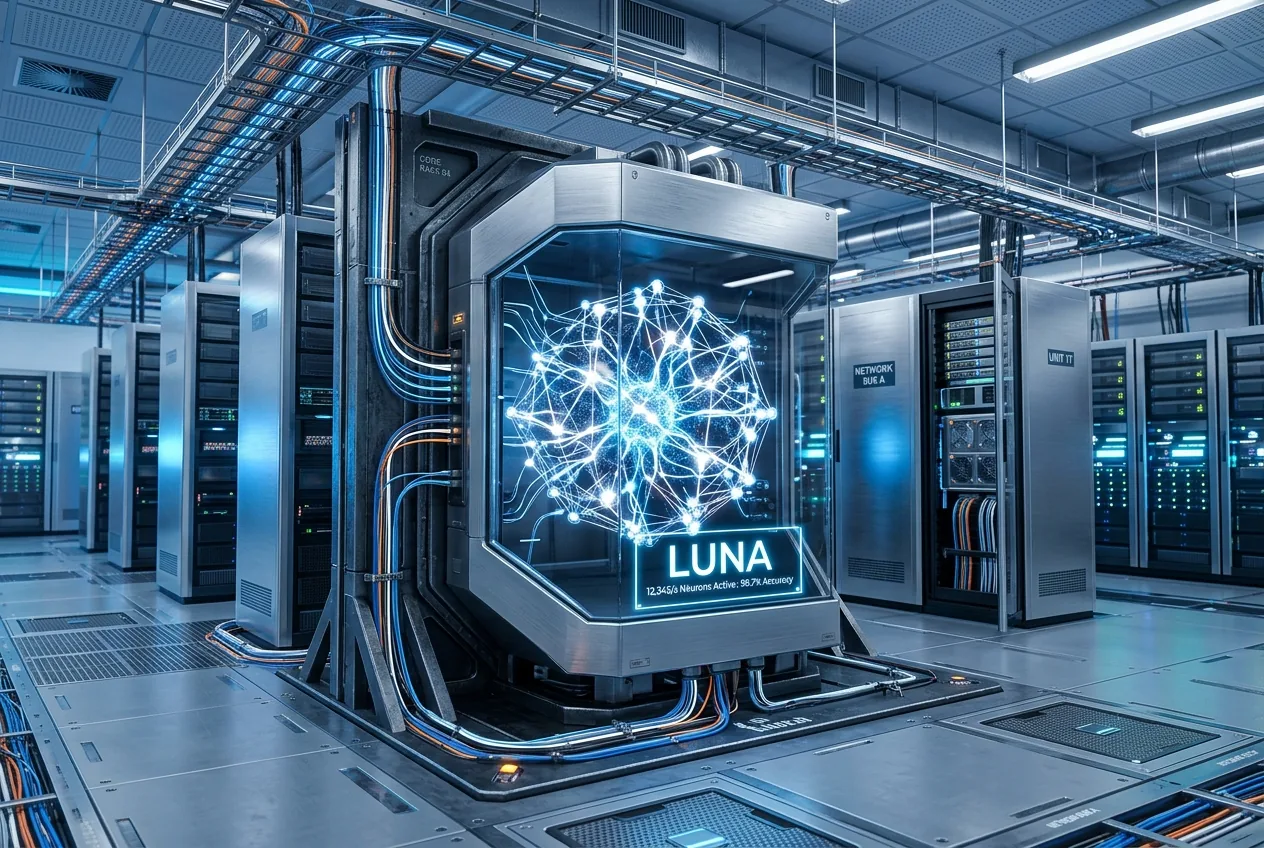
In a strategic maneuver that signals a significant maturation of generative AI infrastructure, OpenAI has announced that its new GPT-5.6 Luna model will become the default engine for all ChatGPT Free and Go users. More importantly, the company is lifting the traditional usage caps on text-based interactions, granting over a billion weekly users unlimited access to the Luna architecture. This shift is not merely a feature update; it represents a fundamental change in the unit economics of high-reasoning artificial intelligence and a direct challenge to the burgeoning AI sector in China.
For those monitoring the industrial application of large language models (LLMs), the rollout of the GPT-5.6 family—comprising the Sol, Terra, and Luna models—marks a pivot from raw scaling to specialized efficiency. As an engineer, I view this through the lens of compute optimization. By segmenting the GPT-5.6 architecture into three distinct tiers, OpenAI is effectively managing the 'compute-per-query' ratio, allowing them to offer the lightweight Luna model at a scale previously thought to be cost-prohibitive for a free service.
The Architecture of the GPT-5.6 Family
The GPT-5.6 series represents a tiered approach to intelligence, structured to handle varying levels of cognitive load. At the top of the stack sits GPT-5.6 Sol, a heavy-compute model designed for deep reasoning and complex problem-solving. Below it, GPT-5.6 Terra acts as the mid-range workhorse, balancing speed with analytical depth. Luna, the model now being democratized, is the most agile of the trio, optimized for high-throughput text generation and rapid interaction.
The transition from the previous GPT-5.5 Instant model to the 5.6 series is significant. While GPT-5.5 focused on conciseness and speed, the 5.6 models incorporate improved factual accuracy and reasoning controls. In internal testing focused on high-stakes domains—specifically financial, medical, and legal prompts—OpenAI reported that GPT-5.6 Sol exhibited a 68% reduction in factual errors compared to GPT-5.5. While Luna is a smaller distillation of this technology, it inherits the structural improvements that allow for more reliable outputs without the massive token-cost associated with the larger Sol model.
How Unlimited Access Becomes Economically Viable
The question for any industrial observer is how OpenAI can afford to provide 'unlimited' access to a frontier-level model. The answer lies in recent pricing adjustments and architectural breakthroughs. OpenAI recently reduced the price for GPT-5.6 Luna by a staggering 80%, while Terra saw a 20% reduction. This suggests that the cost of inference—the process by which the model generates a response—has plummeted due to better hardware utilization and more efficient model quantization.
Can Users Control the 'Depth' of Machine Thought?
One of the more technically intriguing features introduced alongside GPT-5.6 is the 'reasoning slider,' currently available for Plus and Pro users. This interface allows users to manually adjust how much compute (and time) the model dedicates to a specific query. While Free users on Luna will utilize the model’s default reasoning path, the existence of this slider highlights a shift toward 'System 2' thinking in AI—a move from instant pattern matching to deliberative processing.
The inclusion of a 'Think' button for Free users—slated for rollout next week—brings a version of this deliberative capability to the masses. When activated, the model engages in more complex internal chains of thought before delivering an answer. In industrial applications, this is the difference between a robotic arm executing a pre-programmed path and a vision-guided system calculating an optimal grip in real-time. OpenAI is essentially giving users the ability to throttle the 'engine' of the AI depending on the complexity of the task at hand.
The Geopolitics of Inference Pricing
The 80% price cut for Luna is not happening in a vacuum. The global AI landscape is increasingly competitive, with Chinese firms like Alibaba, Baidu, and DeepSeek aggressively cutting prices to dominate the Asia-Pacific market and provide alternatives to Western infrastructure. By making GPT-5.6 Luna unlimited for free users and drastically cheaper for API developers, OpenAI is engaging in a defensive pricing strategy designed to maintain its lead in the global developer ecosystem.
Integrating Professional Workflows
Beyond the model updates, the utility of ChatGPT is being expanded through deep integration with professional toolsets. Adobe has recently brought 70 tools from its creative and productivity suites directly into the ChatGPT interface. This allows users to leverage Luna or Sol to trigger complex digital workflows—such as image manipulation or document formatting—directly from a text prompt. This is a critical development for the 'industrialization' of AI; the model is no longer just a chatbot but a control interface for sophisticated software suites.
For a Free user, the combination of unlimited GPT-5.6 Luna access and integrated professional tools means that the barrier to entry for high-level digital production has never been lower. However, OpenAI is careful to maintain its premium tier value. While text chats are unlimited, current restrictions on image generation (DALL-E 3) and large file uploads remain in place for the free tier, ensuring that the heavy data-ingress and high-bandwidth tasks remain tethered to the subscription model.
The Reliability Gap in High-Stakes Domains
Despite the 68% improvement in factual accuracy, the industry must remain cautious. In mechanical engineering and medical fields, a 32% error rate (compared to the previous baseline) is still significant. The 'unlimited' nature of Luna might encourage over-reliance on the model for factual retrieval. OpenAI’s internal benchmarks show that errors are less common when responses depend on dates, rules, or assumptions, but the 'hallucination' problem is not entirely solved; it is merely being managed through more rigorous model tuning.
The move to GPT-5.6 Sol for Pro users, with its superior reasoning and factual grounding, creates a clear hierarchy of reliability. For a casual query, Luna is more than sufficient. For calculating structural loads or drafting a legal brief, the Sol model—and the human oversight that should accompany it—remains the standard. This tiering allows OpenAI to serve the widest possible audience while maintaining a high-performance lane for enterprise-grade tasks.
What Is the Future of Free AI Access?
The decision to make Luna unlimited marks the end of the 'scarcity era' for basic AI interaction. As we move into 2026, the industry is likely to see further commoditization. If the cost of inference continues to drop at its current rate, we may soon see even more powerful models, like Terra, move into the free tier. The competition is no longer just about who has the smartest model, but who can deliver that intelligence at the greatest scale with the lowest latency.




Comments
No comments yet. Be the first!