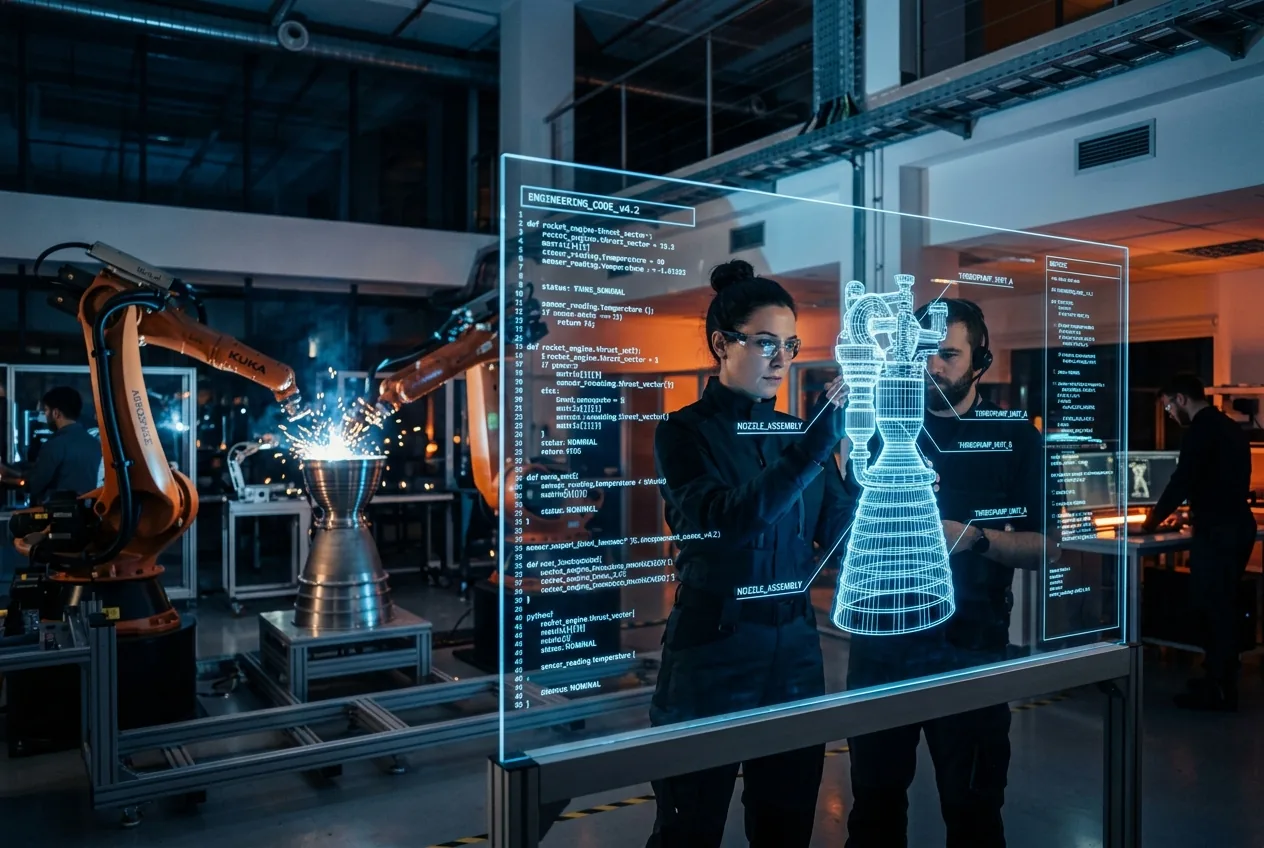
When an aerospace manufacturer deeply entrenched in launch cadence, orbital mechanics, and precision metallurgy acquires a software development environment, the broader engineering industry takes notice. The reported $60 billion transaction uniting SpaceX with Anysphere, the startup behind the breakout AI code editor Cursor, represents far more than an opportunistic diversification into enterprise developer tooling. It marks a decisive structural pivot: the aggressive integration of generative coding architectures directly into the mission-critical hardware supply chain.
For years, SpaceX has operated under an engineering philosophy that aggressively collapses the delta between software simulation and physical hardware iteration. At Starbase in Boca Chica, Texas, changes to Raptor engine turbopump valve sequencing or cold-gas thruster firing logic are not treated as detached algorithmic updates; they are physical interventions tested directly on structural test stands within hours of compilation. By absorbing Cursor’s proprietary contextual indexing engines and workspace-level inference models, SpaceX is positioning automated code generation not as a desktop assistant for front-end developers, but as an indispensable industrial component for rapid flight-hardware prototyping.
The Mechanics of Cursor’s Architectural Edge
To understand why an aerospace giant would invest astronomical capital into a software tool, one must look closely at how Cursor decoupled itself from standard developer tools. Most market alternatives, including early iterations of GitHub Copilot, functioned primarily as inline auto-complete engines reliant on straightforward retrieval-augmented generation (RAG) coupled with public code repositories. Cursor broke away by treating the local repository not as a passive text database, but as an active, multi-dimensional semantic graph.
This architectural shift from passive code generation to cross-file refactoring is precisely what modern industrial engineering demands. In complex mechatronic systems, code is rarely written in isolation. A single sensor revision on an engine manifold can mandate synchronized modifications across embedded C++ firmware, hardware abstraction layers, flight dynamics simulations, and ground control monitoring interfaces. Automating these multi-file transformations without introducing semantic drift is the core competency that Anysphere engineered—and it is the exact bottleneck SpaceX spends millions of engineering hours resolving.
Integrating Synthesized Code into Flight Avionics
The central technical challenge confronting this integration is the uncompromising requirement for determinism in aerospace systems. Commercial web development tolerates occasional race conditions, memory leaks, and non-deterministic logic during rapid feature deployments. Aerospace software, governed by strict real-time operational constraints, allows zero margin for non-deterministic model behavior. A single unhandled buffer overflow in an attitude determination and control system (ADCS) can mean the catastrophic loss of a launch vehicle.
SpaceX’s flight computers on the Falcon 9 and Starship utilize dual- or triple-redundant architectures running stripped-down, deterministic versions of Linux alongside custom real-time C and C++ binaries. The engineering imperative is to leverage Cursor’s neural code generation while strictly maintaining automated formal verification. Rather than allowing an AI model to write unrestrained operational code, SpaceX is integrating Cursor with custom static analysis pipelines, formal proof assistants, and automated hardware-in-the-loop (HIL) simulators.
Under this operational model, Cursor operates inside a sandboxed verification loop. When an engineer prompts the system to generate a digital signal processing routine for phase-matching phased-array Starlink antennas, the generated output is immediately pushed through formal verifiers that prove bounds safety, dynamic memory allocation absence, and worst-case execution time (WCET) predictability. If the code fails strict deterministic criteria, Cursor’s workspace model digests the compiler and verification errors, automatically refactoring the code until it conforms to flight-grade constraints. By combining generative inference with mathematical proof engines, the software iteration loop on complex flight hardware can be compressed by orders of magnitude.
The Compute Backbone and the Challenge to OpenAI
This massive acquisition directly counters OpenAI’s ambition to dominate enterprise software development, transforming coding from a cloud-hosted API service into a core component of vertically integrated industrial operations. While OpenAI has focused on generalized reasoning models and enterprise integrations through Microsoft, SpaceX brings a fundamentally different asset to the table: an internal ecosystem of extreme compute infrastructure, proprietary operational data, and direct physical execution environments.
The engineering synergy between SpaceX and Elon Musk’s AI venture, xAI, plays an inescapable role in this dynamic. With the continuous expansion of the massive Colossus supercomputing cluster in Memphis, Tennessee, the combined entities control an unprecedented density of Nvidia graphics processing units. Fine-tuning code generation models on generic open-source repositories yielded diminishing returns; the real competitive advantage lies in fine-tuning on highly specialized, proprietary engineering corpora. By routing Cursor’s workspace telemetry through dedicated high-bandwidth clusters, the platform can train specialized models on millions of lines of telemetry logs, finite element analysis (FEA) scripts, robotic manufacturing instructions, and proprietary embedded systems.
This closed loop between supercomputing scale, custom foundation models, and real-world manufacturing data presents a formidable challenge to OpenAI’s general-purpose developer platforms. OpenAI must design its models to accommodate generic web frameworks, consumer applications, and cloud-native microservices for thousands of disparate enterprise clients. SpaceX, by contrast, can ruthlessly optimize Cursor’s underlying weights for raw computational efficiency, lower latency inference, and domain-specific engineering languages—spanning Rust, high-performance C++, Verilog for FPGA synthesis, and specialized automation scripts.
Can Algorithmic Speed Translate to Manufacturing Reality?
The critical question remains whether software acceleration can materially overcome the brutal physical constraints of heavy manufacturing. Developing an automated system that refactors flight software in seconds is a monumental technical achievement, but physical rockets must still be welded, cryogenically pressure-tested, static-fired, and cleared by regulatory authorities before they clear the launch pad.
Yet within modern automated factories, the dividing line between software and hardware has largely dissolved. On the Starship production floor, automated robotic gantries perform sub-millimeter friction stir welding, autonomous automated guided vehicles (AGVs) shuttle rocket sections across staging bays, and computerized test stands dynamically simulate propellant loads. Every one of these physical systems operates via programmable logic controllers, industrial vision algorithms, and embedded microcontrollers. When mechanical engineers need to reconfigure an entire assembly cell to accommodate an expanded propellant tank diameter, software rewrites for industrial robots are frequently the most time-consuming bottleneck.
If Cursor can successfully bridge the gap between human design intent and robotic execution code, the throughput of the physical factory itself accelerates. An engineer could conceptually specify a revised weld path or a modified sensor layout in natural language, leaving the underlying AI system to generate, test, and validate the corresponding industrial robot trajectories and safety interlocks within the digital twin before striking an actual physical arc.
The New Industrial Paradigm
SpaceX’s acquisition of Cursor sets a new benchmark for how vertically integrated industrial enterprises view generative computing. The era of treating artificial intelligence as a speculative office-productivity enhancement or an isolated chatbot interface is ending. By embedding high-performance code synthesis directly into the development pipeline of humanity’s most advanced launch vehicles, the boundaries between physical machine and cognitive software are being permanently rewritten.
If the integration succeeds, it will validate a radical engineering thesis: that the fastest path to advancing hardware iteration is to fully automate the software substrate that commands it. As the competitive battleground shifts from general-purpose foundation models to highly specialized, physically grounded automation, the companies that thrive will not be those that merely generate code, but those that harness code to move steel, ignite engines, and leave the atmosphere.




Comments
No comments yet. Be the first!