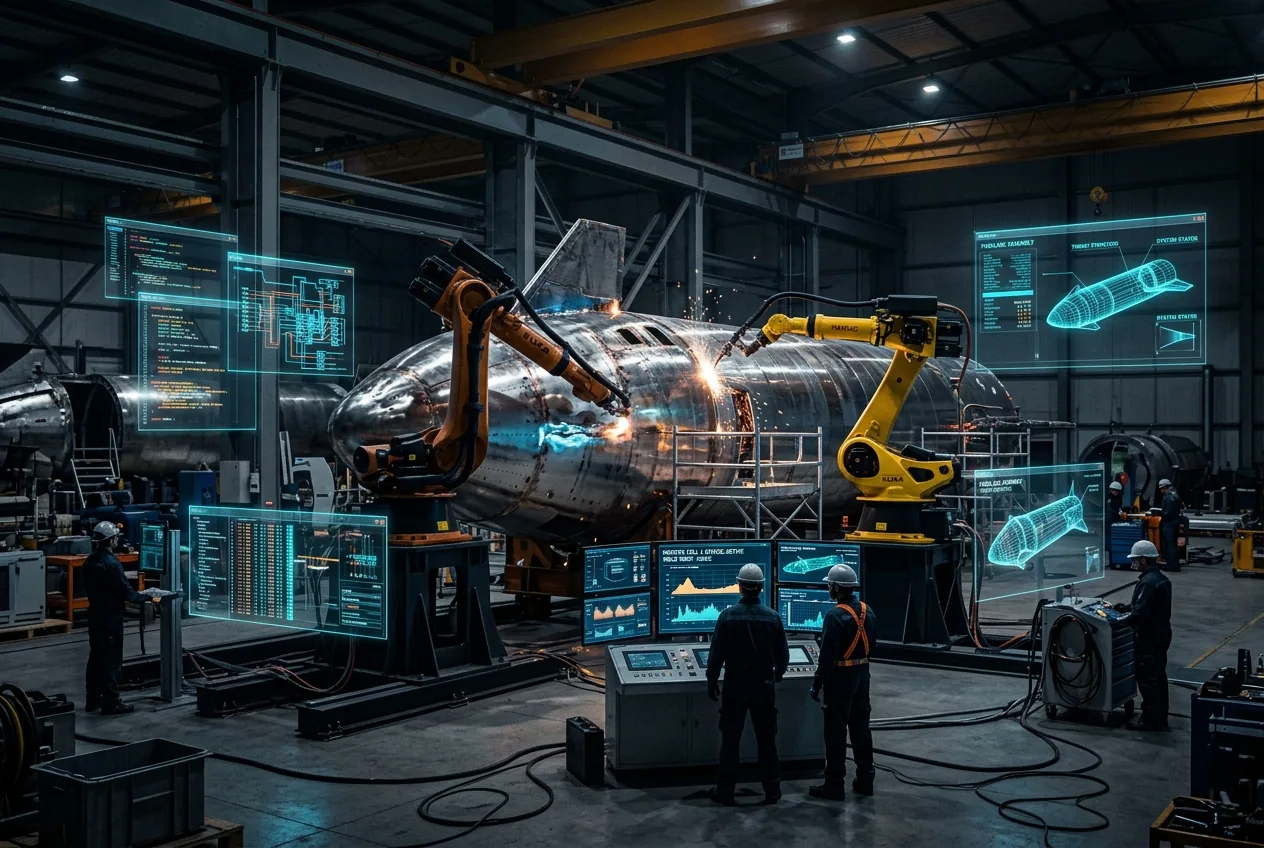
When aerospace manufacturing collides with frontier artificial intelligence, the metrics of success shift rapidly from raw thrust-to-weight ratios to algorithmic cycle times. SpaceX’s staggering multi-billion-dollar acquisition of an autonomous software engineering platform represents far more than an opportunistic diversification. It is an aggressive, capital-intensive play to compress decades of aerospace software development, firmware validation, and mechanical feedback loops into autonomous machine cycles. By bringing dedicated, specialized AI coding infrastructure directly into its industrial ecosystem, the company is mounting a direct offensive against the frontier research labs that currently dominate the intelligence economy.
The Aerospace Software Bottleneck
To understand the scale of this transaction, one must examine the extreme operational constraints of flight software. Unlike consumer applications or cloud-native microservices, aerospace guidance, navigation, and control (GNC) code operates in zero-tolerance environments where memory leaks, unhandled edge cases, or race conditions lead to catastrophic structural loss. Traditionally, meeting standards analogous to DO-178C Level A—where software failure causes or contributes to the loss of the vehicle—demands hundreds of thousands of engineering hours dedicated purely to static analysis, structural coverage testing, and hardware-in-the-loop (HIL) simulation.
This paradigm shift transforms software from a static operational baseline into a continuous manufacturing output. If an automated system can ingest high-rate telemetry from an engine test stand at McGregor, detect non-linear combustion instabilities, generate microsecond adjustments to proportional-integral-derivative (PID) controllers, and execute millions of virtual stress tests before an engineer reviews the pull request, the iteration speed of physical hardware accelerates by orders of magnitude.
Challenging the Dominance of Frontier Research Labs
The aggressive valuation also serves as a strategic counter-maneuver against the current frontrunners of synthetic intelligence. Over the past twenty-four months, Anthropic and OpenAI have turned automated code generation into the definitive benchmark for frontier model utility. Benchmarks evaluating reasoning, recursive self-correction, and tool use have shown that an AI system’s ability to manipulate code serves as the core engine for its broader general intelligence. Claude’s dominance in complex software architecture and OpenAI’s iterative reasoning models have demonstrated that the company controlling the coding substrate controls the fastest leverage point in the technology sector.
This closed operational loop creates a competitive moat that pure-play AI research laboratories cannot replicate. An AI model trained exclusively on GitHub commits cannot easily intuit the electromagnetic interference characteristics of a Starlink phased-array transceiver, nor can it instinctively optimize real-time avionics code to minimize power draw during an eclipse phase in low Earth orbit. By marrying proprietary code synthesis engines with one of the most prolific streams of industrial telemetry in human history, SpaceX provides its machine intelligence with something far more valuable than public internet text: verifiable, high-frequency physical reality.
Industrial Automation from the Launchpad to the Machine Shop
The implications of this integration extend beyond flight computers and guidance avionics. The modern aerospace factory is fundamentally an automated, software-driven industrial facility. At Starbase in Boca Chica, automated multi-axis orbital welders, robotic gantry cutting systems, and high-pressure cryogenic test cells run on industrial programmable logic controllers (PLCs) and custom machine interfaces. Every mechanical tolerance, weld seam inspection, and flange mating procedure is mediated by software.
Industrial robotics has historically suffered from rigid software architecture. Reprogramming an automated manufacturing cell to adapt to a modified stainless steel ring thickness or a re-routed propellant line typically requires weeks of manual robotic path planning, sensor recalibration, and ladder-logic verification. Integrating an adaptive AI coding platform directly into the factory floor turns manufacturing software into a real-time reactive substrate. When computer vision inspection rigs spot micro-defects or material variance on an assembly line, the AI engine can dynamically refactor the toolpaths and welding parameters for downstream robotic arms, cutting operational downtime and scrap rates to near-zero levels.
Furthermore, managing global satellite networks demands continuous algorithmic optimization. The Starlink constellation constitutes a dynamic, non-stationary mesh network orbiting at over seven kilometers per second, navigating shifting space weather, space debris conjunction alerts, and millions of dynamic laser inter-satellite links. Human network operators cannot optimize this topological chaos manually. Generating, testing, and pushing real-time routing firmware across thousands of active orbital nodes requires a specialized coding architecture operating with superhuman throughput and ironclad formal verification protocols.
Economic Viability and National Security Ramifications
Allocating capital of this magnitude toward software automation underscores the stark financial economics of deep-tech engineering. SpaceX is no longer merely a commercial rocket launch service; it is an industrial infrastructure conglomerate encompassing global telecommunications, heavy manufacturing, and defense-critical space transportation. For an enterprise handling national security space launches and critical communication backbones for the Department of Defense, reliance on third-party foundational models presents acute sovereign risks.
ITAR (International Traffic in Arms Regulations) and strict defense export controls strictly forbid foreign or non-cleared exposure to advanced launch vehicle architectures, guidance mathematics, and cryogenic propulsion parameters. Sending proprietary telemetry or classified system configurations through multi-tenant commercial cloud APIs operated by general-purpose AI providers is a non-starter for top-tier defense payloads. By taking absolute ownership of a premier software development platform, SpaceX guarantees that its mission data, automated code bases, and industrial logic remain securely locked within a sovereign, export-compliant perimeter.
Financially, the deal signals an era where capital efficiency in deep tech is directly tied to automated throughput. While traditional defense and aerospace firms deploy thousands of software contractors to slowly inch engineering projects forward, SpaceX is aiming to execute orders of magnitude more engineering iterations with an intensely streamlined human engineering core backed by relentless synthetic code generation. The cost savings over a multi-decade horizon—spanning Starship fleet operations, planetary exploration architectures, and defense contracts—could easily justify an upfront capital expenditure that would break the balance sheets of less audacious operations.
The Verification Hurdle
Despite the immense promise, marrying non-deterministic generative models with mission-critical spaceflight introduces profound technical friction. Modern machine-learning architectures are inherently probabilistic, whereas aerospace engineering demands absolute, uncompromising determinism. In an industry where a single missing hyphen in a line of code famously doomed the Mariner 1 probe, the prospect of deploying automatically synthesized code to rocket engines firing thousands of pounds of high-pressure liquid methane and liquid oxygen demands an entirely new standard of algorithmic oversight.
Solving this dilemma requires rigorous formal verification frameworks. An AI engine dedicated to aerospace development cannot operate like an autocomplete tool; it must be coupled to mathematical theorem provers and automated verification pipelines that structurally prove code correctness before binaries are loaded into physical non-volatile flash memory. The integration team will inevitably focus on using formal methods—mathematical techniques for proving the absolute consistency of software logic—to ensure that generated code strictly adheres to control boundaries and never violates physical flight envelopes.
If SpaceX succeeds in mastering this synthesis of generative speed and mathematical certitude, the consequences will ripple far beyond the launch pad. It will establish a blueprint for the entire future of heavy industry. When advanced robotics, physical manufacturing, and autonomous code generation operate as a unified, self-optimizing engine, the pace of technological realization is no longer bound by how fast humans can type or test. It becomes governed solely by the immutable laws of physics and the raw compute powering the machines.




Comments
No comments yet. Be the first!