In the high-stakes theater of frontier artificial intelligence, every impending deployment window brings a flurry of internal leaks, strategic executive statements, and intense benchmark scrutiny. As OpenAI maneuvers toward its mid-year release cycle, public remarks from leadership, including Chief Scientist Jakub Pachocki, have ignited fresh discussions across the enterprise and engineering landscapes. The anticipation surrounding OpenAI’s next major architectural milestone is no longer merely about conversational fluidity; it centers on whether the organization can convert raw computational scaling into deterministic, high-reliability execution for complex real-world workflows.
For enterprise engineers and industrial systems architects, the promise of a meaningful leap carries specific operational criteria. Generative models have spent the last three years demonstrating remarkable general linguistic capability, yet they have consistently faltered when integrated into tight feedback loops requiring rigid adherence to physical constraints, zero-defect verification, and reliable multi-step planning. If the forthcoming architecture represents a genuine generational transition, the technical advancements must extend far beyond larger context windows and synthetic text benchmark scores.
The Transition from Brute-Force Pretraining to Unified Test-Time Compute
The standard paradigm of autoregressive next-token prediction, which governed the progression from GPT-3 through the GPT-4 variants, has run into well-documented thermodynamic and algorithmic diminishing returns. Pretraining trillion-parameter models on static internet data yields progressively marginal improvements in logical consistency while incurring exponential increases in capital expenditure, electrical power, and thermal management overhead. Internal breakthroughs over the past twelve months, catalyzed by the integration of deliberate test-time compute and reinforcement learning over chains of thought, have effectively altered the trajectory of AI development.
The engineering challenge lies in balancing inference latency against the depth of verification search. In conversational interfaces, a five-second pause while the model reasons through a query is acceptable; in autonomous manufacturing lines, warehouse robotic routing, or algorithmic supply chain negotiation, such latency profiles demand precise programmatic control. Industrial consumers will be looking closely at whether the new model exposes fine-grained control over compute budgets, allowing engineers to dictate exactly how much search time is allocated based on task criticality.
Compute Infrastructure Bottlenecks and Silicon Realities
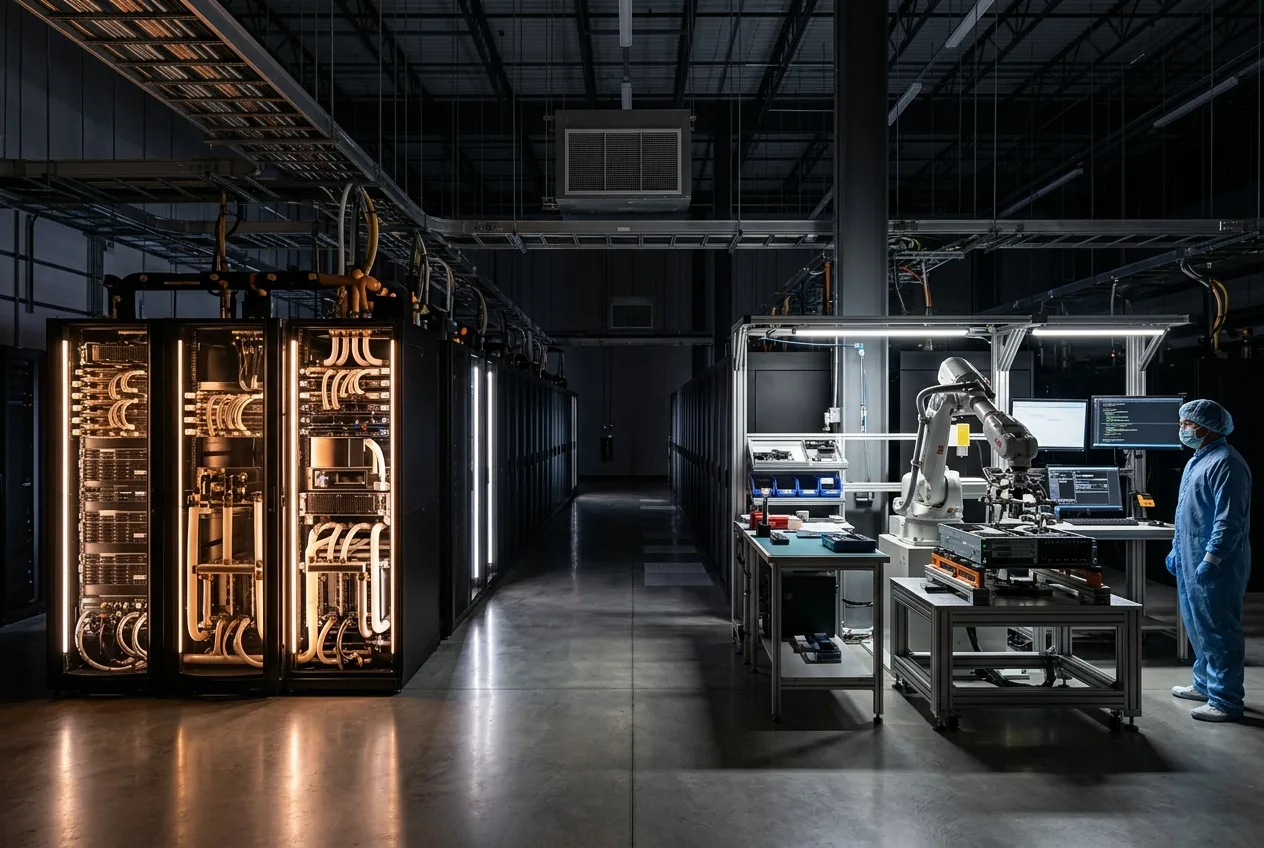
Behind the software benchmarks sits the sheer physical reality of gigawatt-scale datacenter engineering. Training and serving an architecture deemed a significant generational leap requires staggering clusters of high-bandwidth memory (HBM) and specialized accelerator hardware, primarily Nvidia’s Hopper and nascent Blackwell platforms. The operational cost of these deployments is forcing AI developers to reckon with the physics of datacenter interconnects, liquid cooling infrastructure, and regional electrical grid constraints.
To maintain sustainable unit economics during broad commercial release, OpenAI cannot simply scale parameter counts unchecked. Modern systems engineering dictates aggressive parameter optimization, likely leveraging mixture-of-experts (MoE) topologies that activate only a targeted fraction of weights for any given token, combined with post-training distillation techniques. If the upcoming model achieves superior reasoning benchmarks while operating within a more disciplined memory footprint, it will signify that architectural refinement, rather than brute-force scaling, has reclaimed center stage in frontier AI research.
Furthermore, enterprise adoption hinges on inference economics. The enterprise sector has grown wary of brittle APIs with variable pricing and fluctuating response latencies. High-volume industrial clients require predictable token pricing and deterministic service-level agreements to justify deprecating legacy deterministic software in favor of probabilistic foundation models. The viability of this upcoming release will be measured on the corporate balance sheet as much as on academic evaluation sets.
Bridging the Digital Reasoning Void for Physical Robotics
The true proving ground for this next generation of artificial intelligence is not code generation or marketing copy, but the physical world. For years, the robotics sector has struggled with the fundamental divide between high-level semantic reasoning and low-level motor actuation. Traditional robotic process automation excels at executing repetitive trajectories with sub-millimeter precision, but it completely breaks down when an environment deviates from engineered predictability.
A frontier model capable of robust spatial perception, causal reasoning, and self-correcting task decomposition represents the missing link in autonomous manipulation and mobile robotics. When an industrial robot encounters an unexpected obstacle on a factory floor or an unmodeled part orientation in an assembly cell, it cannot rely on vague probability distributions. It requires a cognitive layer that can formulate physical hypotheses, verify spatial clearances, and generate safe kinematic plans within milliseconds. If OpenAI’s upcoming architecture demonstrates sustained temporal consistency and rigorous physical reasoning, it will immediately become the foundational operating layer for next-generation automated guided vehicles and dual-arm manipulation platforms.
This convergence of foundation models with physical control systems also shifts the verification burden. In software development, an erroneous token output results in a compiler error or an unhandled exception; in an industrial cell, an unverified action can result in catastrophic mechanical collision or human injury. Consequently, the aerospace and manufacturing sectors will subject OpenAI's claims of reliability to rigorous empirical stress testing before greenlighting any autonomous integration.
Enterprise Reliability Over Silicon Valley Benchmarks
The tech industry has spent the past two years celebrating incremental benchmark triumphs that frequently fail to survive contact with enterprise reality. Synthetic tests like MMLU and HumanEval, while useful for comparative academic ranking, have become increasingly contaminated and detached from messy operational environments. Corporate technology executives now evaluate models against unyielding metrics: hallucination rates in mission-critical document processing, deterministic tool usage via APIs, and adherence to strict operational protocols without drifting.
For OpenAI to deliver on the promise of a transformative leap, the incoming architecture must solve the problem of silent failure. When a model encounters ambiguous instructions or an impossible set of constraints, it must reliably recognize its own cognitive boundaries and request clarification, rather than confidently generating a plausible falsehood. This self-calibration is the baseline requirement for deploying autonomous agents in regulated sectors such as supply chain management, medical diagnostics, and legal analysis.
As the anticipated summer launch window approaches, the broader industry is preparing for a reality check. The competitive gap between proprietary frontier labs and high-caliber open-weights models has narrowed considerably over the past year. To justify its premium tier and sustain its commercial momentum, OpenAI’s next deployment must demonstrate that its deliberate reasoning paradigms and architectural refinements translate into indisputable economic utility across the physical and digital economies.




Comments
No comments yet. Be the first!