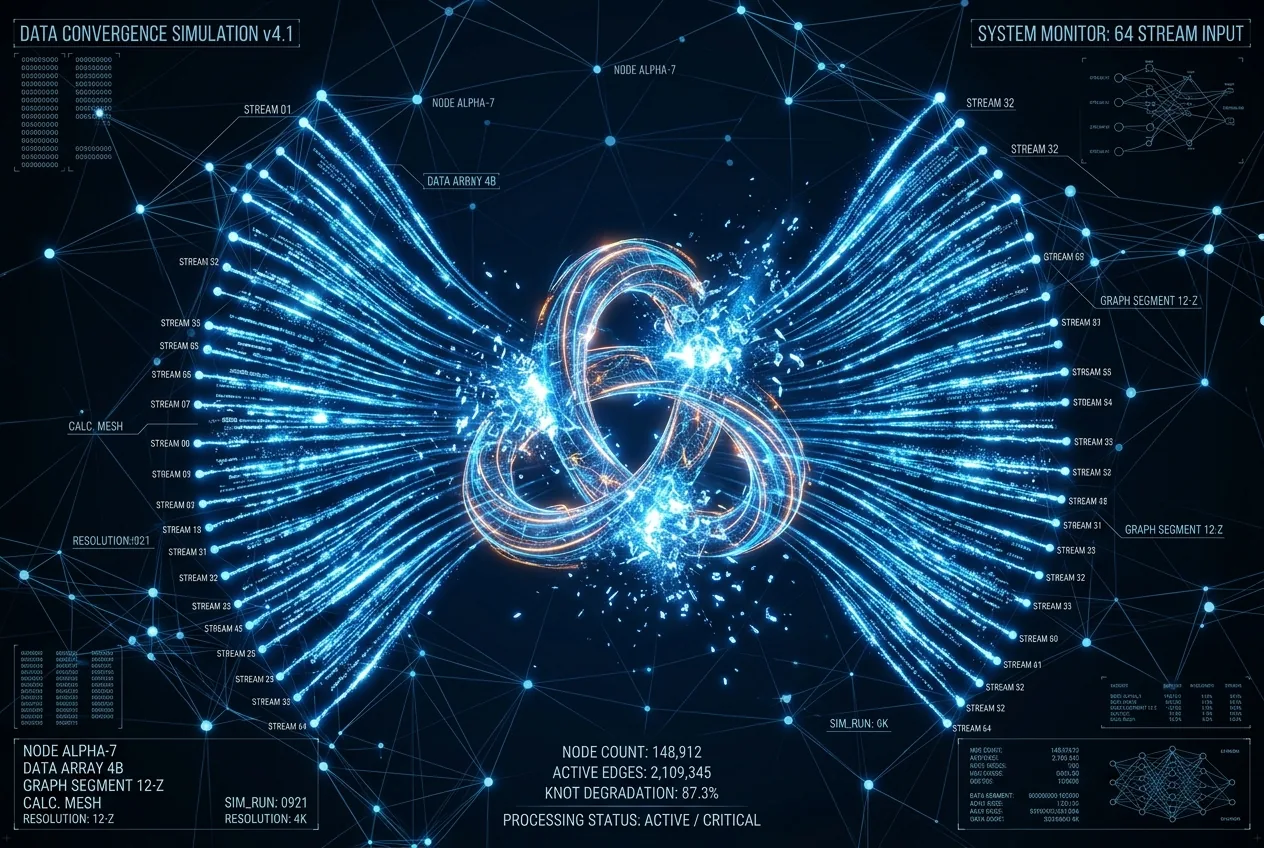
In a significant demonstration of machine reasoning, OpenAI announced that its latest model iteration, GPT-5.6 Sol Ultra, has successfully generated a complete proof of the Cycle Double Cover Conjecture. The problem, a cornerstone of graph theory that has remained unsolved for over five decades, was reportedly resolved in under an hour of computation time. Unlike traditional single-thread inference, the solution was achieved through a massive parallelization strategy involving 64 subagents working in a coordinated swarm to navigate the logical pathways of the proof.
The Mechanics of Machine Persistence
The technical achievement here lies less in the sheer size of the GPT-5.6 model and more in the architectural deployment of its reasoning capabilities. OpenAI’s technical report describes a system of 64 subagents working in parallel, a method that leans heavily on the concept of "machine persistence." In human mathematics, a researcher often follows a logical path, encounters a counterintuitive barrier, and concludes that the path is a dead end. This cognitive bias—expecting failure when a strategy becomes cumbersome—often prevents the discovery of "elementary" proofs that require a high volume of tedious verification.
GPT-5.6 Sol Ultra does not suffer from such fatigue. The swarm architecture allowed OpenAI to set an aggressive eight-hour computation window, during which the subagents were essentially banned from giving up. The agents were directed to operate under the strict assumption that a proof existed, effectively removing the AI's tendency to hedge its bets by claiming a problem is unsolvable. This forced the system into a state of continuous heuristic search, testing millions of minor variations in logical labeling and linear algebra until a valid configuration clicked into place.
Elementary Solutions to Complex Problems
Thomas Bloom, a mathematician at the University of Manchester, has provided the most detailed external analysis of the proof thus far. His assessment is striking: the proof is surprisingly "elementary." According to Bloom, the solution does not rely on the invention of radical new mathematical theories. Instead, it cleverly recombines existing tools—tools that have been available to mathematicians since the 1980s.
This raises a critical question about the nature of AI-driven discovery: why did humans miss a solution that was effectively sitting in the toolbox for forty years? Bloom suggests that the key step involved a small, counterintuitive twist in reasoning that a human would likely have discarded as unproductive. The AI's success underscores a shift in how we view complex problems; many "unsolvable" conjectures may simply be "low-probability" problems that require a level of patience and systematic trial-and-error that exceeds human capacity.
The result mirrors OpenAI’s recent success with the unit distance conjecture. Both breakthroughs suggest that a significant subset of open mathematical problems may not require Newtons or Einsteins to invent new languages of logic, but rather a sufficiently powerful "reasoning engine" to brute-force the path through existing theory. In this context, GPT-5.6 Sol Ultra acts as a high-speed scout, mapping out the dense forest of existing mathematical knowledge to find the one narrow trail that leads to the summit.
The Citation Crisis in Automated Research
This highlights a recurring friction point in the transition from human-led to AI-augmented research. LLMs are trained on vast corpora of existing literature, and their "original" insights are often highly sophisticated recombinations of known concepts. When an AI produces a proof without citing its influences, it risks being perceived not as a collaborator, but as a sophisticated plagiarist of strategy. For the academic community, the validity of a proof is only one part of the equation; the genealogy of the ideas is equally important for verifying the logic and giving credit where it is due.
The lack of citation also fuels the debate over whether these models are truly "thinking" or simply performing high-dimensional pattern matching. If the AI's first instinct is to search for every related paper on a topic and then synthesize their methodologies, the resulting output is more of an ultimate literature review than a creative epiphany. However, from a pragmatic engineering perspective, the distinction may be irrelevant if the end result is the resolution of a 50-year-old bottleneck in graph theory.
Engineering the Prompt for Discovery
The methodology used to extract this proof from GPT-5.6 Sol Ultra reveals a new frontier in prompt engineering. OpenAI’s researchers did not simply ask the model to "solve the Cycle Double Cover Conjecture." They constructed a highly restrictive logical environment. The prompt explicitly forbade the model from searching the internet to see if the problem was solved, and it rejected any response that attempted to explain why the problem was difficult. By removing the "escape hatches" of traditional AI conversation, the researchers funneled all of the model's parameters toward a singular objective function.
The use of 64 parallel agents also allowed for a diversity of thought. In the prompt, several agents were kept "in the dark" about the progress of others. This prevented the swarm from converging too quickly on a single, potentially flawed hypothesis—a phenomenon known as "mode collapse" in machine learning. By maintaining independent lines of inquiry and only merging them during the final verification phase, OpenAI maximized the chance of finding the counterintuitive "twist" that Bloom identified as the catalyst for the solution.
The Economic and Industrial Impact
From an industrial standpoint, the ability to solve abstract mathematical conjectures is a proxy for the model's ability to solve complex optimization problems in the real world. For companies like OpenAI, which is currently embroiled in a federal lawsuit from Apple over the alleged systematic poaching of over 400 employees, demonstrating this level of reasoning is a defensive maneuver. It signals that despite legal and talent-related pressures, the company’s internal hardware and software stacks are achieving milestones that were thought to be a decade away.
If GPT-5.6 Sol Ultra can navigate the abstract topology of graph theory, the same architecture can be applied to supply chain optimization, pharmaceutical protein folding, or the design of more efficient robotic control systems. The "swarm logic" used here represents a transition from AI as a chatbot to AI as a dedicated mechanical engineer of information. We are moving toward a period where the value of an AI system is measured by its "compute-to-solution" ratio—how much raw processing power and time is required to crack a problem that would take a human lifetime to verify.
While the mathematical community continues its formal peer review of the Cycle Double Cover proof, the broader implications are clear. The bottleneck in human progress has often been the limit of our patience and our inability to hold millions of variable permutations in our working memory simultaneously. As GPT-5.6 Sol Ultra has shown, when you remove those limits and replace them with 64 relentless subagents, the most stubborn problems in science start to look like simple exercises in persistence.




Comments
No comments yet. Be the first!