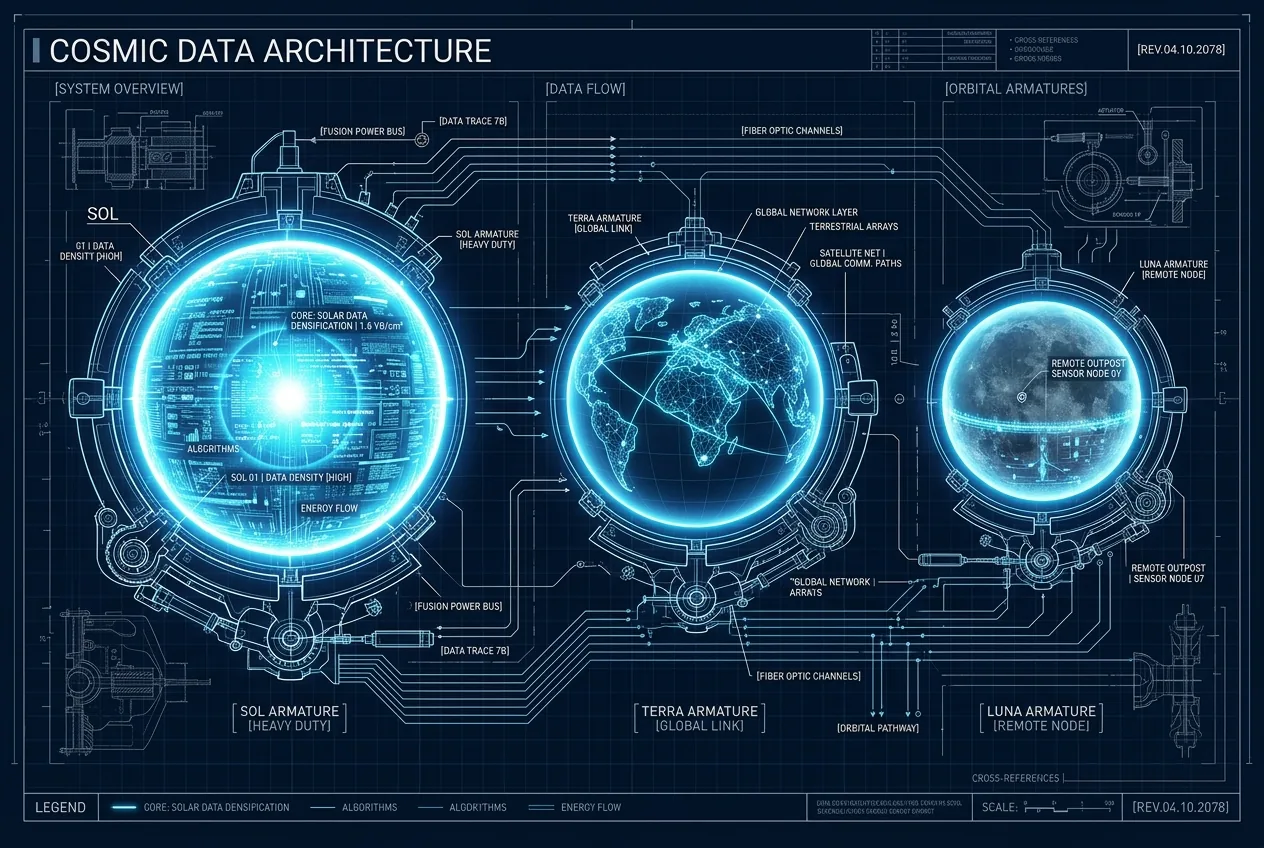
The landscape of large-scale linguistic and multimodal modeling is shifting from general-purpose assistants toward highly specialized, compute-optimized architectures. This Thursday, OpenAI is slated to release GPT-5.6, a versioning leap that signals more than just an incremental update to the GPT-4 family. The release introduces a trifecta of models—codenamed Sol, Terra, and Luna—each engineered for specific operational envelopes. For the industrial sector and the robotics community, this move represents a pivot toward the 'compute dividend,' where inference-time scaling and architectural efficiency take center stage over raw parameter counts.
From a mechanical and systems engineering perspective, the release of GPT-5.6 is less about the novelty of AI conversation and more about the integration of complex reasoning into the physical and digital supply chains. As we move closer to autonomous systems that require real-time decision-making, the distinction between these three models becomes critical. The technical community is looking past the marketing nomenclature to understand how these models handle high-token-count environments, latency-sensitive robotics controls, and the massive VRAM overhead that has historically plagued the deployment of frontier models.
The Architecture of Tiered Intelligence
Sol: The High-Reasoning Flagship
Sol is the pinnacle of the 5.6 release, designed to push the boundaries of what OpenAI calls 'System 2' thinking. In cognitive psychology, System 2 refers to slow, deliberate, and logical reasoning. In the context of GPT-5.6 Sol, this translates to enhanced inference scaling—giving the model more 'think time' to process complex chains of thought before delivering an output. For engineers working in mechanical design or supply chain optimization, Sol is the model that can ingest tens of thousands of lines of documentation or CAD specifications and identify structural weaknesses or logistical bottlenecks that simpler models would miss.
The technical differentiation for Sol lies in its increased context window and its ability to maintain high coherence over long-range dependencies. While previous iterations struggled with 'lost in the middle' phenomena—where the model forgets information buried in the center of a large prompt—Sol utilizes a redesigned attention mechanism that provides uniform focus across the entire input. This makes it an ideal candidate for heavy-duty simulation and R&D tasks where data integrity and logical rigor are paramount.
Terra: The Backbone of Industrial Integration
If Sol is the laboratory tool, Terra is the factory floor engine. Terra is positioned as the successor to GPT-4o, balancing the multimodal capabilities of its predecessor with the architectural refinements of the 5.6 generation. For the robotics industry, Terra represents the sweet spot for vision-language-action (VLA) models. It is fast enough to process visual feeds from a robotic arm in near-real-time while possessing the reasoning capacity to adapt to environmental anomalies.
The economic viability of Terra is its most compelling feature. Through more efficient KV (Key-Value) caching and speculative decoding techniques, OpenAI has likely reduced the per-token cost for Terra compared to GPT-4. This is a critical metric for companies looking to scale AI across thousands of nodes in a warehouse or logistics network. Terra’s ability to handle structured data output with high reliability means it can be integrated into existing ERP (Enterprise Resource Planning) systems with minimal friction, acting as the intelligent middleware that translates high-level human directives into executable machine code.
Luna: Low Latency and Edge Efficiency
The smallest of the trio, Luna, is perhaps the most significant for the future of ubiquitous robotics. Luna is designed for high-speed, low-power environments. In many industrial applications, sending data to a centralized cloud server and waiting for a response is a non-starter due to latency and security concerns. Luna is optimized for distillation, meaning it can potentially be deployed on local servers or even high-end edge devices (like NVIDIA’s Jetson Orin platform) with minimal loss in functional utility for specific tasks.
Luna’s primary function is 'System 1' thinking: fast, instinctive, and reactive. In a robotics context, Luna could handle basic obstacle avoidance or gesture recognition, only escalating more complex problems to Terra or Sol when necessary. This hierarchical AI deployment strategy—where Luna serves as the first line of intelligence—mirrors the way human biology handles sensory input, filtering the mundane at the periphery and reserving metabolic energy for complex problem-solving at the core.
Can Multimodality Solve the Robotics Bottleneck?
The launch of GPT-5.6 brings the question of native multimodality to the forefront. Unlike earlier models that relied on separate vision and audio encoders 'bolted on' to a text-based LLM, the Sol, Terra, and Luna models are rumored to be natively multimodal from the ground up. This means the models do not translate an image into text descriptions before processing it; they 'see' the pixels and 'hear' the waveforms as primary data types.
The Economic and Compute Dividend
The timing of this release, coming amidst a global scramble for H100 and B200 GPUs, highlights OpenAI’s need to demonstrate compute efficiency. The shift from 'bigger is better' to 'smarter is better' is a pragmatic response to the physical limits of data center expansion. By offering the Luna and Terra models, OpenAI is providing a pathway for enterprises to derive value from AI without requiring a massive increase in their compute footprint.
As we look toward the official rollout this Thursday, the focus will remain on the 'how'—how these models handle real-world data, how they manage the trade-offs between speed and accuracy, and how they integrate into the existing fabric of global industry. GPT-5.6 is not just a software update; it is a recalibration of the relationship between artificial intelligence and the physical world.




Comments
No comments yet. Be the first!