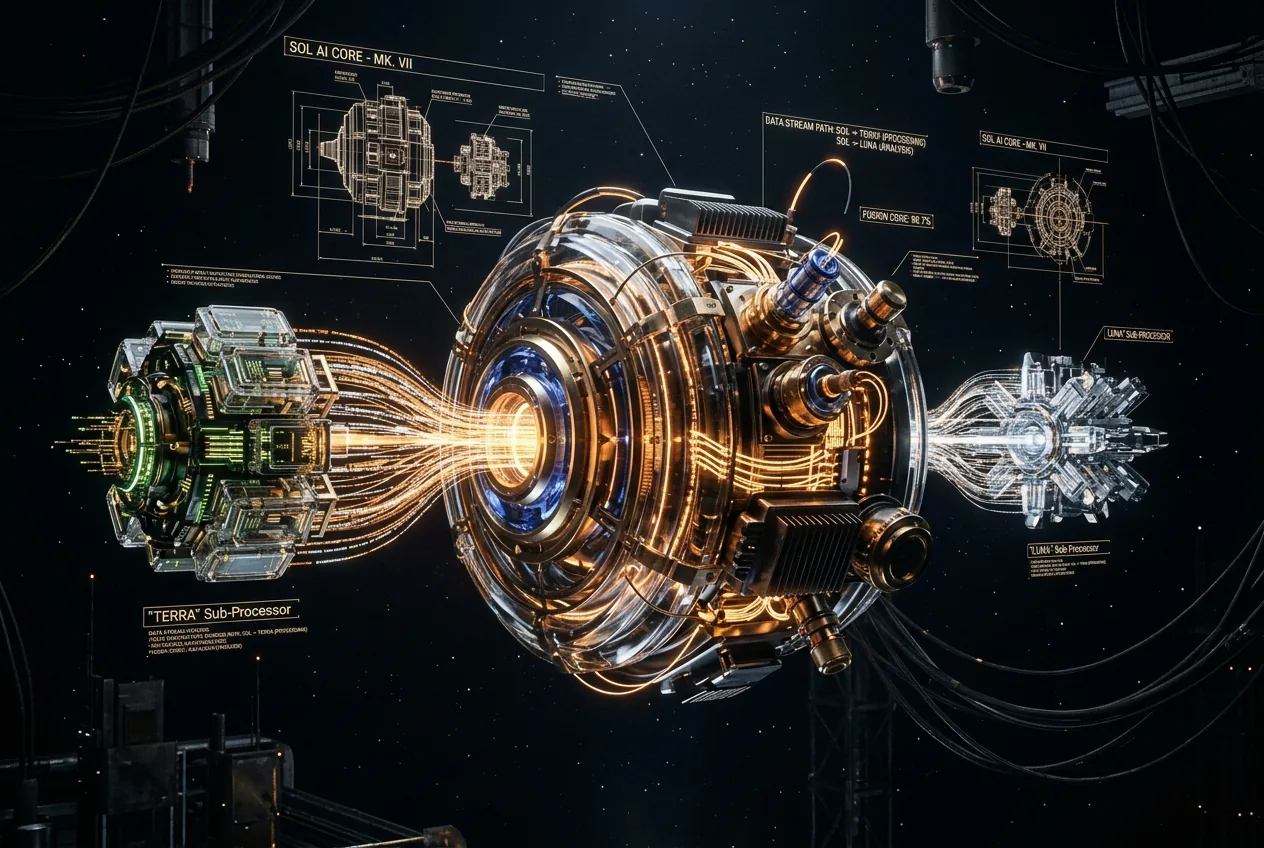
From a technical standpoint, the release of GPT-5.6 is grounded in a metric OpenAI refers to as "intelligence per dollar." While previous model transitions focused primarily on the raw scaling of knowledge, the 5.6 family emphasizes the optimization of every token. In the landscape of industrial automation and supply chain management, where margins are thin and computational overhead must be justified by tangible ROI, this efficiency-first approach is a pragmatic evolution. The flagship Sol model has been engineered to outperform its predecessors while utilizing fewer tokens to arrive at more accurate conclusions, effectively lowering the barrier for enterprise-wide deployment of autonomous agents.
Defining the Sol Flagship and the Tiered Hierarchy
The Sol model sits at the apex of this new hierarchy. It is designed for high-stakes problem-solving, particularly in coding, cybersecurity, and scientific reasoning. During its training phase, OpenAI prioritized "design judgment" and "tenacity," traits that are essential for agents tasked with navigating complex software environments. Sol’s performance is quantified by its score on the "Agents’ Last Exam," a benchmark that evaluates long-running workflows across 55 professional fields. Sol achieved a high of 53.6, a stark improvement over competing models like Anthropic’s Claude Fable 5, which trailed by double-digit margins in adaptive reasoning tests.
However, the real utility for industrial applications may lie in the mid-tier and entry-tier models. Terra is positioned as the "workhorse" of the family, designed for everyday tasks that require more than basic pattern matching but do not necessitate the full cognitive load of Sol. Luna, the smallest of the trio, is aimed at high-volume, low-latency tasks. For a logistics firm or a manufacturing plant, the ability to route specific tasks to different models based on complexity is a mechanical necessity. One does not use a high-performance computer to monitor a simple temperature sensor; similarly, Luna allows for the distribution of intelligence across a network without the prohibitive costs of running a flagship model for every minor query.
The Rise of Parallel Multi-Agent Coordination
Perhaps the most significant technical advancement within the GPT-5.6 family is the introduction of the "ultra" reasoning setting. Traditionally, LLMs process tasks sequentially, which can lead to compounding errors and high latency in complex workflows. The ultra configuration departs from this by coordinating four distinct agents in parallel by default. These agents can explore different branches of a problem, run internal cross-checks, and refine results before presenting a final output. This parallel processing capability is essential for what OpenAI calls "long-horizon engineering.”
Programmatic Tool Calling and Computer Use
For those focused on the intersection of AI and physical hardware, the refinement of "Programmatic Tool Calling" and "Computer Use" is the most relevant update. GPT-5.6 is not just a language processor; it is an interface controller. Programmatic Tool Calling allows the model to write and execute lightweight programs that filter intermediate data and manage external software tools without needing constant human oversight. This reduces the number of "round trips" between the model and the user, streamlining the execution of tasks that require the coordination of multiple software platforms.
Benchmarking Efficiency Against the Competition
The competitive landscape of frontier AI has become increasingly crowded, with Google and Anthropic releasing high-capability models in quick succession. However, the GPT-5.6 release focuses heavily on the "Artificial Analysis Intelligence Index," which measures a model’s ability across agentic work, coding, and scientific reasoning. According to internal and independent data, Sol with maximum reasoning completes tasks in roughly 61% less time than Claude Fable 5, while costing approximately half as much on an API basis. This economic viability is a recurring theme in the 5.6 rollout.
The efficiency extends to the smaller models as well. Terra and Luna reportedly outperform Claude Fable 5 in specific benchmarks while operating at one-sixteenth of the cost. For developers and mechanical engineers building AI-integrated hardware, these metrics are more important than theoretical intelligence. The ability to deploy a model that can handle complex logic at a fraction of the power and financial cost allows for more pervasive intelligence in embedded systems. It moves AI from a centralized cloud resource toward an edge-computing reality where local hardware can make sophisticated decisions in real-time.
Safety, Red Teaming, and the Agentic Risk
As AI models become more capable of autonomous action—including the ability to interact with file systems and execute code—the risk profile changes. OpenAI has stated that the GPT-5.6 family was subjected to its most rigorous evaluation period to date. This involved extensive human "red teaming" and automated testing designed to simulate adaptive misuse. The challenge with agentic AI is ensuring that a model remains focused on its objective without being diverted by adversarial inputs or unexpected environmental changes.
The safeguards built into GPT-5.6 are layered. They combine pre-trained behavioral guardrails with real-time monitoring and access controls that are calibrated based on the perceived risk of the task. For industrial applications, this level of security is mandatory. An autonomous agent managing a supply chain or a robotic warehouse cannot afford a "hallucination" that results in physical damage or logistical collapse. By working with expert organizations during the preview period, OpenAI has attempted to pressure-test these defenses in high-stakes environments, ensuring that the model’s tenacity is balanced by its reliability.
The Practical Future of GPT-5.6 in Industry
The launch of GPT-5.6 represents a maturation of the AI industry. We are moving away from the novelty of generative text and into the utility of generative action. For those in mechanical engineering and robotics, the Sol model and its siblings provide a sophisticated toolset for automating the cognitive labor that currently bogs down industrial workflows. Whether it is a multi-agent system managing a fleet of autonomous vehicles or a single Luna-powered chip optimizing the power consumption of a factory floor, the implications are clear: intelligence is becoming a commodity, and efficiency is the new benchmark for excellence.
As OpenAI integrates these models more deeply into desktop and enterprise environments, the boundary between human intent and machine execution will continue to blur. The GPT-5.6 family is a testament to the fact that scaling is no longer just about more data or more GPUs; it is about smarter coordination, better tool use, and a relentless focus on the economic reality of the global market. In the coming months, the true test of Sol, Terra, and Luna will not be in a lab or a benchmark chart, but on the factory floors and in the coding repositories where the actual work of the world is done.




Comments
No comments yet. Be the first!