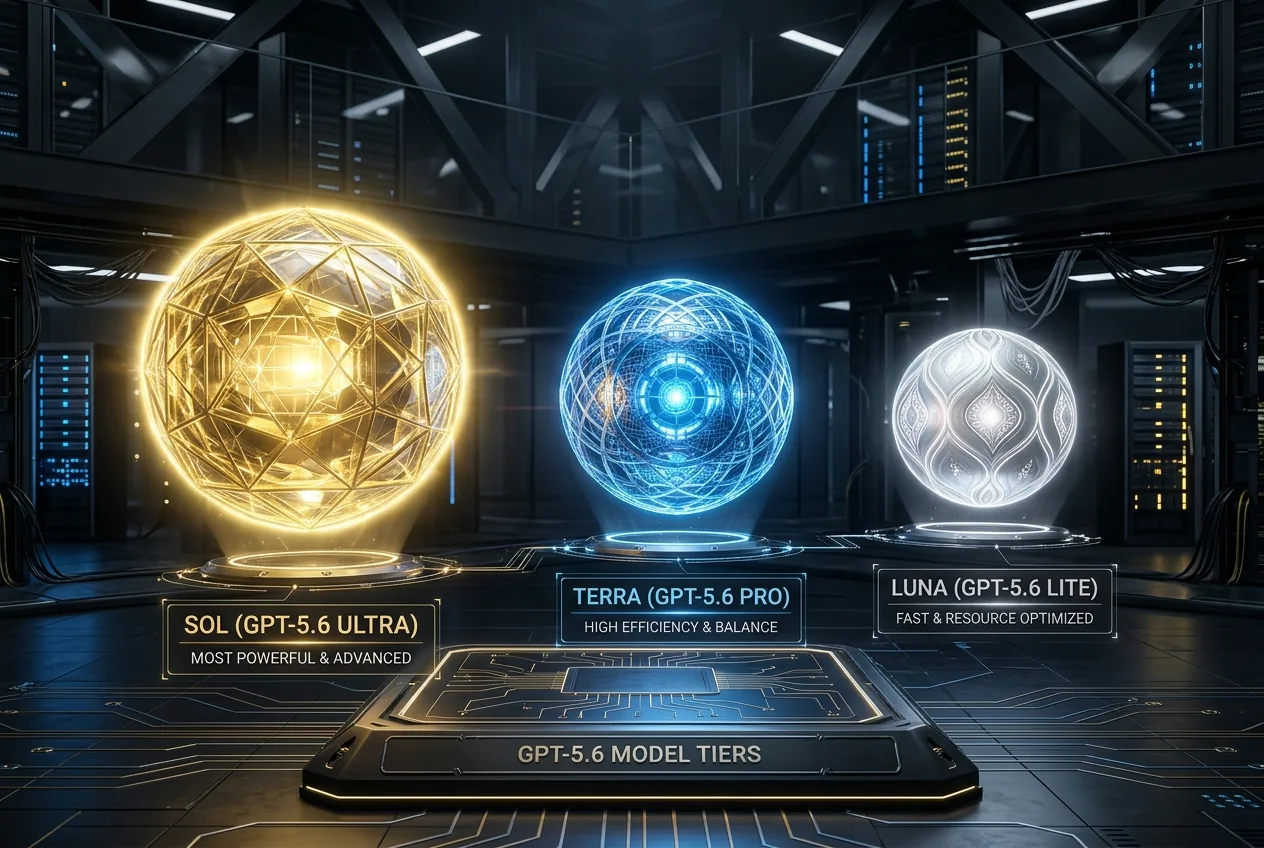
In a move that signals both a technical leap and a new era of regulatory oversight, OpenAI has officially launched its GPT-5.6 model suite and a specialized agentic platform called ChatGPT Work. The release follows a high-stakes delay requested by the U.S. federal government, marking a pivotal moment where frontier artificial intelligence models are now subjected to national security evaluations similar to aerospace or defense technologies. The rollout introduces three distinct iterations of the 5.6 architecture—Sol, Terra, and Luna—alongside a significant shift in OpenAI’s product strategy as it sunsets the Atlas browser in favor of deep agentic integration.
From an engineering perspective, the GPT-5.6 series represents more than a mere incremental update to context windows or token speed. It is a tiered deployment designed to address specific industrial and economic requirements. For the first time, OpenAI is moving away from a monolithic model release, opting instead for a specialized family of models that balance raw compute power against operational costs. This strategy reflects a maturing market where enterprises are no longer satisfied with general-purpose intelligence but require cost-optimized performance for specific production environments.
The Architecture of Choice: Sol, Terra, and Luna
The flagship of the new series, GPT-5.6 Sol, is positioned as the high-water mark for reasoning capabilities. According to OpenAI’s internal benchmarks, Sol is engineered to compete directly with Anthropic’s Mythos model, focusing on complex multi-step reasoning and high-fidelity output. For industrial applications requiring the highest degree of accuracy—such as structural simulation analysis or complex legal synthesis—Sol is the intended engine. However, the true story for most industrial users lies in the mid-tier and entry-tier models: Terra and Luna.
GPT-5.6 Terra is perhaps the most economically significant release in the lineup. It maintains the performance benchmarks of the previous GPT-5.5 generation but at exactly 50% of the operational cost. In the world of industrial automation and supply chain management, where margins are often thin, a 2x reduction in inference costs while maintaining high-tier intelligence is a major catalyst for adoption. Terra is designed for the "workhorse" tasks of the digital economy: processing massive streams of logistical data, managing inventory through predictive modeling, and maintaining high-uptime communication interfaces.
Finally, Luna represents the "edge" of the 5.6 family. It is a low-latency, low-cost model optimized for high-volume, lower-complexity tasks. While it lacks the deep cognitive depth of Sol, it offers a level of responsiveness that makes it suitable for real-time monitoring systems and simple interactive agents. By providing this spectrum of capabilities, OpenAI is effectively creating a "compute budget" framework for its users, allowing them to route tasks to the most cost-effective model based on the complexity of the requirement.
The Rise of ChatGPT Work and the Death of Atlas
Coinciding with the model release is the debut of ChatGPT Work, a new agentic platform that represents the convergence of the company’s LLM research and its Codex-driven automation. ChatGPT Work is not merely a chatbot; it is an autonomous agent designed to operate across multiple digital environments. By combining the reasoning of GPT-5.6 with the execution capabilities previously seen in Codex, ChatGPT Work can independently manage long-term projects, such as building entire web applications, synthesizing cross-platform data into executive slide decks, or managing complex spreadsheets over several hours of autonomous operation.
The launch of ChatGPT Work has come at the cost of the Atlas browser. OpenAI confirmed it is sunsetting Atlas after only nine months, citing that the lessons learned from browser-based browsing agents have been fully integrated into the ChatGPT Work architecture. This move underscores a shift from a "human-in-the-loop" browsing experience to an "agent-led" workflow. Instead of providing a tool for a human to browse the web more efficiently, OpenAI is now providing an agent that handles the browsing, data extraction, and synthesis as a background process, delivering a finished product to the user.
For those in mechanical engineering and logistics, the implications of ChatGPT Work are profound. The agent’s ability to break down complex tasks into smaller, manageable sub-steps and complete them independently suggests a future where the "digital twin" of a factory or a supply chain can be managed by an AI that not only monitors data but takes corrective actions—drafting purchase orders, updating project timelines, and coordinating with third-party vendors without constant human oversight.
National Security and the Regulatory Ceiling
From a pragmatic standpoint, this scrutiny is a double-edged sword. While it ensures a higher baseline of safety and reliability for corporate users—vital when integrating AI into sensitive industrial workflows—it also introduces a layer of geopolitical friction. As AI becomes the central nervous system for global industry, the speed at which these models can be updated and deployed will become a key factor in national economic competitiveness.
Economic Viability in a Post-Release World
For large-scale industrial operations, the cost of running an AI-driven logistics network or a predictive maintenance system can run into millions of dollars monthly. A 50% reduction in those costs significantly lowers the threshold for a positive Return on Investment (ROI). This economic shift will likely accelerate the adoption of GPT-5.6 Terra in sectors that were previously hesitant due to the high overhead of earlier models. The 5.6 series isn't just a win for performance; it is a win for the balance sheet.
Ultimately, the dual launch of the GPT-5.6 suite and ChatGPT Work represents a maturing of the AI industry. We are moving away from the era of "interesting demos" and into the era of "industrial-grade tools." With government oversight now a standard part of the release pipeline and a clear focus on tiered performance and cost efficiency, the trajectory of AI is beginning to mirror the development of other critical industrial technologies. For the engineers and operators on the ground, these tools offer a new level of autonomy and efficiency, provided they can navigate the complexities of this new, highly regulated landscape.




Comments
No comments yet. Be the first!