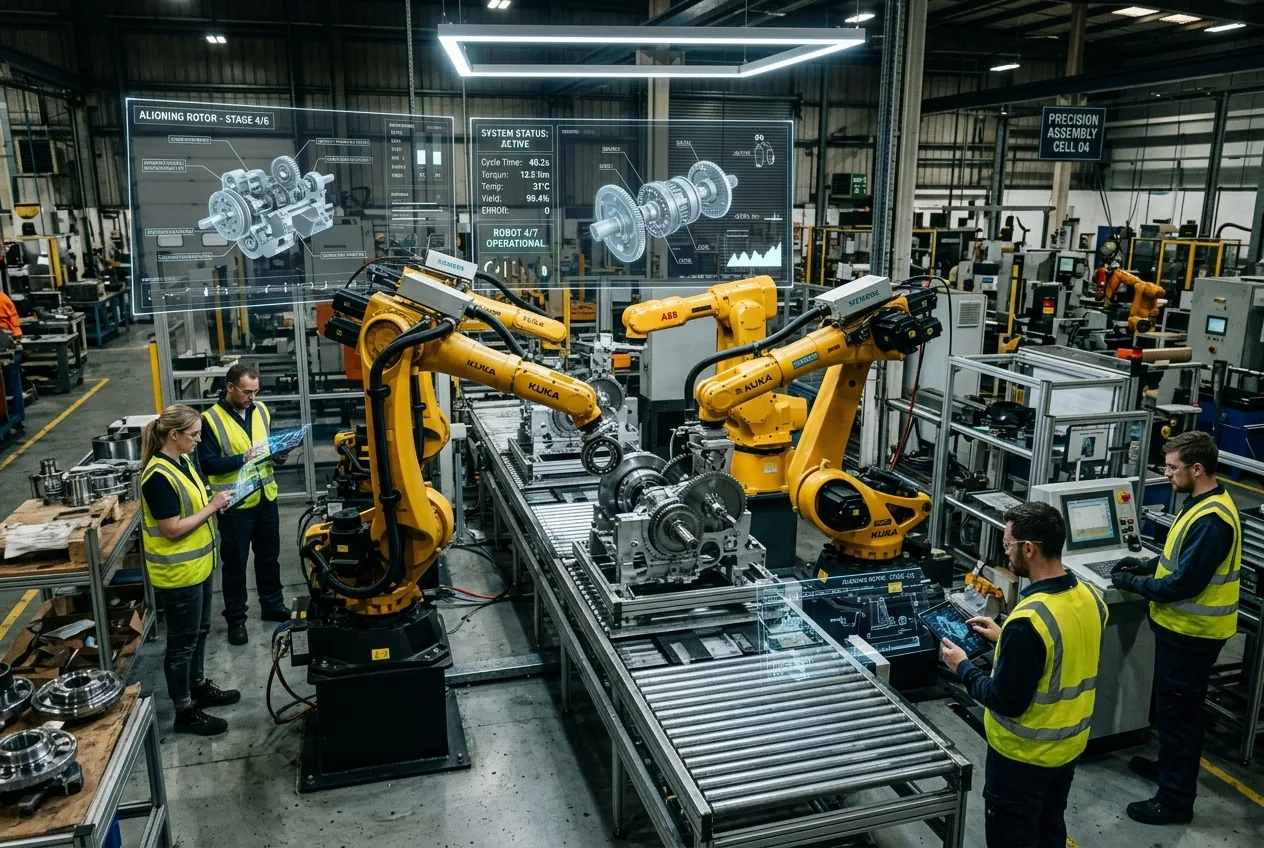
In the high-speed cycle of frontier artificial intelligence, announcements of generational leaps have become an almost weekly spectacle. Teasers and benchmark releases detailing next-iteration powerhouses—from advanced Claude iterations to multimodal models decoding physical sensor data—command immediate attention across enterprise software sectors. Yet for engineers who work outside the clean boundaries of cloud software development, the critical question is never about whether a model can score three percentage points higher on an academic reasoning exam. The real question is whether these cognitive engines can survive contact with the mechanical, high-stakes realities of industrial automation, factory floors, and global supply networks.
Moving Beyond Conversational Novelty to Deterministic Tool Use
For decades, factory automation relied strictly on deterministic code. Programmable Logic Controllers (PLCs), ladder logic, and rigid industrial robotics operated under an ironclad premise: every input had an exactly predictable output, governed by deterministic cycle times measured in milliseconds. The early waves of large language models, characterized by stochastic text generation and unpredictable hallucinations, were completely incompatible with this paradigm. No plant manager running an automotive welding cell or a pharmaceutical packaging line would ever route sensor telemetry into an ungrounded neural network.
That wall between probabilistic software and deterministic hardware began to crumble with the maturation of structured tool use and programmatic computer operation. Anthropic’s focused development on deterministic API calling, programmatic interfaces, and structured reasoning within the Claude ecosystem demonstrated that modern frontier architectures could behave less like creative chatbots and more like deterministic execution kernels. When an enterprise model can parse multimodal spatial inputs, produce rigidly formatted JSON that matches industrial API schemas, and autonomously check its own logical assumptions against physical constraints, it ceases to be a novelty. It becomes an operational runtime layer capable of coordinating complex cyber-physical machinery.
This shift has ignited substantial interest among mechanical engineers and operations executives. Instead of requiring human engineers to hand-craft thousands of lines of ladder logic or specialized robotic scripts for every minor variation in component geometry, frontier models are being evaluated as supervisory reasoning layers. These systems oversee automated diagnostic pipelines, translate high-level logistical objectives into precise robotic assembly sequences, and interface directly with manufacturing execution systems (MES) without requiring human translation at every node.
The Latency Dilemma and the Edge Compute Divide
Frontier cloud models, routed through wide-area networks and requiring substantial compute time for auto-regressive token generation, routinely exhibit a time-to-first-token (TTFT) measured in hundreds of milliseconds, if not full seconds. In mechanical engineering, that latency is an eternity. As a consequence, industrial deployment is bifurcating into a hierarchical architecture. At the edge, ultra-fast, quantized vision-language-action (VLA) models and traditional deterministic control loops handle the millisecond-by-millisecond physical manipulation. Above them sits the frontier cloud model—such as advanced Claude or equivalent enterprise architectures—acting as the asynchronous cognitive orchestrator.
In this supervisory configuration, the cloud-based frontier model ingests batch telemetry, visual inspection streams, and inventory schedules. It performs anomaly detection across millions of historical machine cycles, diagnoses root causes for micro-stoppages on the line, and dynamically reconfigures the parameters sent down to edge PLCs. This decoupled framework insulates the physical plant from the latency spikes and connectivity dropouts inherent to cloud inference, while still capturing the advanced analytical synthesis that frontier models uniquely provide.
Decoding the Physical World with Multimodal Sensorium
Historically, automated visual inspection was brittle. A standard computer vision algorithm trained to identify surface micro-cracks in machined aluminum housings would frequently generate false positives if factory ambient lighting shifted slightly or if an anti-corrosion oil left an atypical sheen on the component. The introduction of deep multimodal models with broad contextual comprehension has fundamentally altered this landscape. Because these networks understand the underlying physics, material properties, and operational context described in their extensive technical pretraining, their ability to discern cosmetic variations from structural defects is dramatically higher than traditional edge vision filters.
Furthermore, this multimodal capacity extends directly into design and maintenance. Engineers can now upload mechanical engineering drawings, electrical schematics, and live thermal telemetry into the model simultaneously. A technician troubleshooting a complex hydraulic manifold failure on an injection molding press no longer needs to manually cross-reference an eight-hundred-page paper manual against scattered PLC error registers. The supervisory AI can correlate the hydraulic pressure drops with the specific valve sequence in the schematics, pinpointing the failing proportional solenoid in seconds. This reduction in mean-time-to-repair (MTTR) represents the true economic driver for adopting high-end models in heavy industry.
The Cold Economics of Industrial Tokenomics
While the technical possibilities are vast, widespread deployment ultimately hinges on economic viability. Running frontier models is expensive, and calculating the return on investment for an enterprise AI deployment requires strict unit economics. If an autonomous diagnostic system burns through millions of tokens per hour processing continuous video feeds and operational telemetry, the inference costs can easily outstrip the operational savings realized from labor reduction or scrap minimization.
Consequently, pragmatic industrial engineering teams are pioneering intelligent data gating. Rather than piping continuous raw sensor feeds directly to cloud inference APIs, industrial architectures are utilizing localized, lightweight statistical models to monitor nominal operations. As long as vibration, temperature, and visual parameters stay within standard standard deviations, no external tokens are generated. Only when an anomaly trigger fires does the system capture a dense multimodal snapshot, compile the surrounding contextual telemetry, and query the high-capacity frontier model for advanced root-cause analysis.
This hybrid approach optimizes the cost-performance envelope. It leverages low-cost, on-premises compute for 99% of normal operational runtime, while reserving costly, highly capable frontier reasoning for the 1% of operational failures that threaten costly production downtime. In an industry where a single hour of unplanned downtime in an automotive plant can cost upward of $2 million, the targeted deployment of high-capacity models becomes not just economically justifiable, but an indispensable competitive advantage.
Engineering the Next Era of Industrial Autonomy
The relentless competition among frontier model developers is undeniably captivating for technophiles and software developers, but its true transformative value will not be measured in automated conversational prose. The real revolution is occurring quietly in the integration layers that bridge silicon cognition with physical steel, carbon fiber, and automated supply networks. As developers like Anthropic and their industry counterparts continue to refine context windows, latency profiles, and deterministic execution tools, the boundary between abstract intelligence and industrial reality will continue to blur.
For manufacturing and robotics engineers, the path forward requires rigorous technical discernment. The goal is to strip away the consumer marketing sheen, ignore broad assertions of general machine intelligence, and treat these advancing models for what they truly are: exceptionally capable, non-deterministic computational blocks that must be integrated with mechanical precision. Those who master the synthesis of frontier cognition with hardened physical engineering will define the next century of global industrial production.




Comments
No comments yet. Be the first!