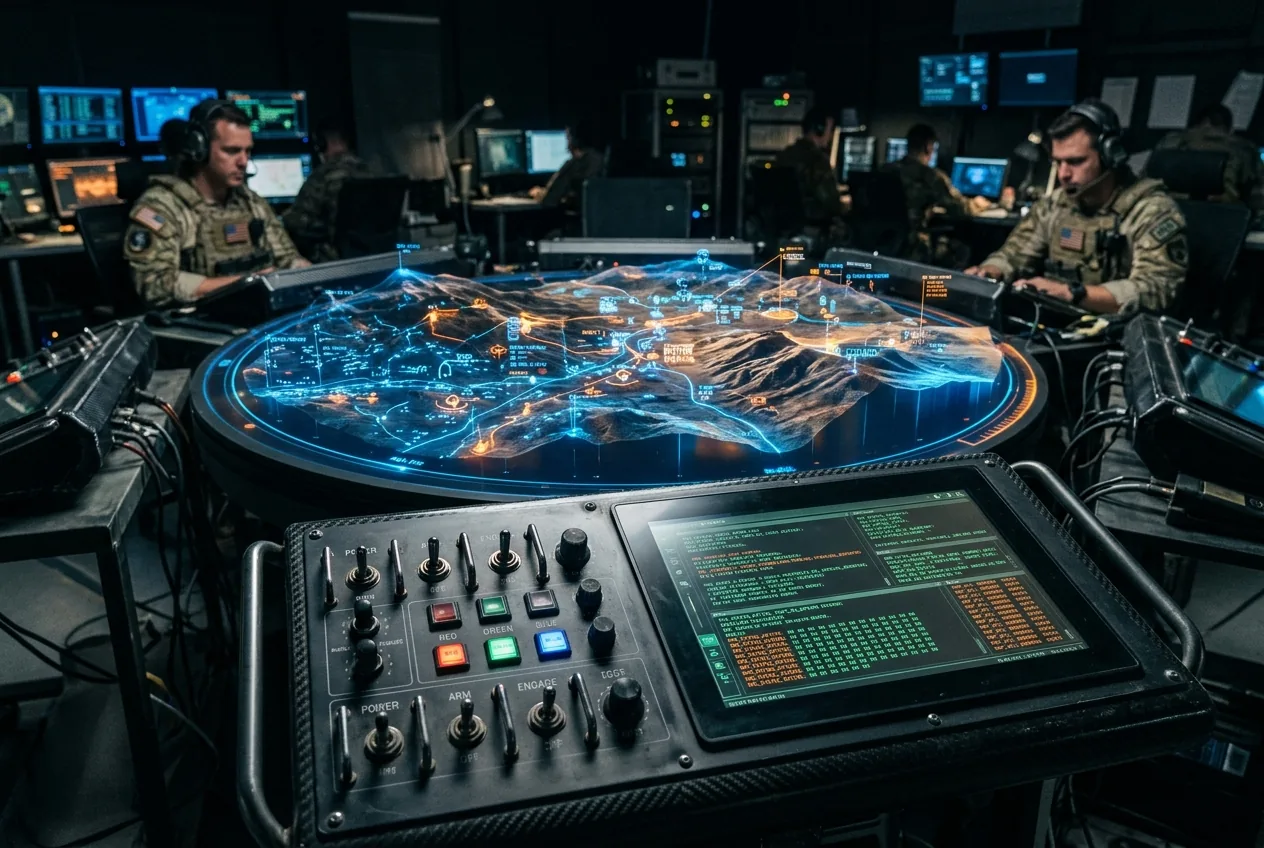
In the rapid-fire ecosystem of social media, the line between algorithmic hallucination and geopolitical reality has become dangerously thin. Recently, a surge of reports and memes across X (formerly Twitter) suggested that Grok, the large language model (LLM) developed by Elon Musk’s xAI, was utilized by the Pentagon to coordinate a massive strike involving 2000 rockets against targets in the Middle East. While the claim garnered millions of impressions and fueled a cycle of trending topics, a technical analysis of current military infrastructure and the fundamental architecture of LLMs reveals a much more sober reality.
As a mechanical engineer focused on the bridge between software and industrial hardware, I find the fascination with "AI-led warfare" understandable, but the specific claim that an LLM like Grok could—or would—be used to trigger kinetic launches reveals a fundamental misunderstanding of how the Department of Defense (DoD) operates its Command and Control (C2) systems. From the perspective of robotics and industrial automation, the distance between a chatbot and a missile battery is not just a matter of permissions; it is a chasm of different engineering philosophies.
The architecture of non-deterministic failure
To understand why the Pentagon would not use Grok for kinetic strikes, one must first understand the nature of Large Language Models. Grok, like its contemporaries GPT-4 or Claude, is a non-deterministic system. This means that for any given input, the output is generated based on probabilistic weightings. While this is excellent for creative writing, coding assistance, or synthesizing news from X’s real-time firehose, it is anathema to military engineering.
Military systems, particularly those involving the delivery of thousands of rockets, require absolute determinism. In industrial automation, we build systems where Input A always leads to Result B. When you are dealing with the logistics of 2000 kinetic assets, the variables include fuel state, GPS coordinates, weather patterns, and Friend-or-Foe (IFF) identification. An LLM operates in a latent space of tokens and high-dimensional vectors; it does not "know" what a rocket is in the physical sense. It merely knows how to predict the next word in a sentence describing one. The idea of piping a non-deterministic, "rebellious" AI into a tactical firing circuit is a nightmare scenario for any systems engineer.
How the Pentagon actually integrates AI
While the Grok rumors are a product of the meme economy, the Pentagon is indeed aggressively pursuing AI integration through initiatives like Project Maven and the Replicator program. However, the AI being used in these contexts looks nothing like Grok. The DoD’s focus is on Computer Vision (CV) and predictive maintenance, not conversational agents with a "sense of humor."
Project Maven, for instance, uses machine learning to scan vast amounts of drone footage to identify objects of interest—trucks, tanks, or personnel. This is a classification task, not a generative one. The goal is to shorten the OODA loop (Observe, Orient, Decide, Act). Even in these high-tech scenarios, the final "Decide" and "Act" phases are strictly reserved for human operators, a policy known as the "Human-in-the-Loop" (HITL) requirement. Integrating a commercial LLM into this loop would introduce unacceptable latency and a lack of transparency—the "black box" problem that currently plagues AI research.
Can generative AI manage 2000-rocket logistics?
From a mechanical and logistical standpoint, the claim of 2000 rockets being fired simultaneously under the direction of a single AI is a massive undertaking. In industrial robotics, coordinating even 50 autonomous units in a warehouse requires sophisticated mesh networking and real-time spatial deconfliction. Scaling that to 2000 kinetic assets across a theater of war involves layers of encrypted communication and hardware handshakes that are currently incompatible with the API-based architecture of commercial AI.
The Pentagon’s Joint All-Domain Command and Control (JADC2) initiative is designed to link sensors from all branches of the military into a unified network. This network uses specialized, hardened protocols. Grok is hosted on xAI’s cloud infrastructure, likely using NVIDIA H100 clusters. Bridging a public-facing cloud AI with the SIPRNet (Secret Internet Protocol Router Network) would represent one of the most significant security breaches in history. No engineer in their right mind would expose a strategic asset to the vulnerabilities inherent in a web-based LLM, regardless of how fast its training data refreshes.
The role of viral misinformation in the AI era
Why did this rumor gain so much traction? The answer lies in the way X’s "Explore" and trending features now function. Grok itself often summarizes trending topics based on user posts. If a critical mass of users begins joking about Grok being used by the Pentagon, Grok’s own news synthesis engine might report on the trend as if it were an event, creating a feedback loop of misinformation. This is a classic "hallucination" at the platform level.
In the world of robotics and automation, we call this a runaway feedback loop. For the general public, it creates a distorted view of what AI is capable of. It frames AI as a god-like entity capable of overstepping its digital bounds into the physical world. In reality, the industrial applications of AI are much more mundane and focused on efficiency. We are using AI to optimize the torque on a robotic arm or to predict when a conveyor belt motor might fail, not to bypass the chain of command at the Pentagon.
The economic reality of military-grade AI
Furthermore, we must look at the economic viability. The Pentagon spends billions on customized software from defense contractors like Palantir, Anduril, and Lockheed Martin. These companies provide "defense-grade" AI that is audited, air-gapped, and designed for high-stakes reliability. xAI is a commercial venture aimed at the consumer and enterprise market. From a procurement standpoint, the legal and technical hurdles of using an unverified commercial chatbot for kinetic operations would take years, if not decades, to clear.
The hardware required to support 2000 rocket launches—launchers, transport vehicles, guidance systems—represents billions of dollars in physical capital. The software controlling that capital must be as robust as the steel it moves. Grok is a marvel of software engineering, but it is optimized for engagement and information retrieval, not for the rigors of industrial-scale destruction. The memes may be entertaining, but they distract from the real, serious work being done in the field of autonomous systems and algorithmic warfare.
In conclusion, while the trend of Grok being used for missile strikes makes for a compelling social media narrative, it fails every technical and logical test. The Pentagon’s move toward AI is real, but it is built on a foundation of specialized, deterministic, and highly regulated systems. As we move further into the age of robotics, it is essential to distinguish between the conversational capabilities of LLMs and the mechanical realities of industrial and military hardware. The former is a tool for communication; the latter is a tool for action. For now, those two worlds remain safely separate.




Comments
No comments yet. Be the first!