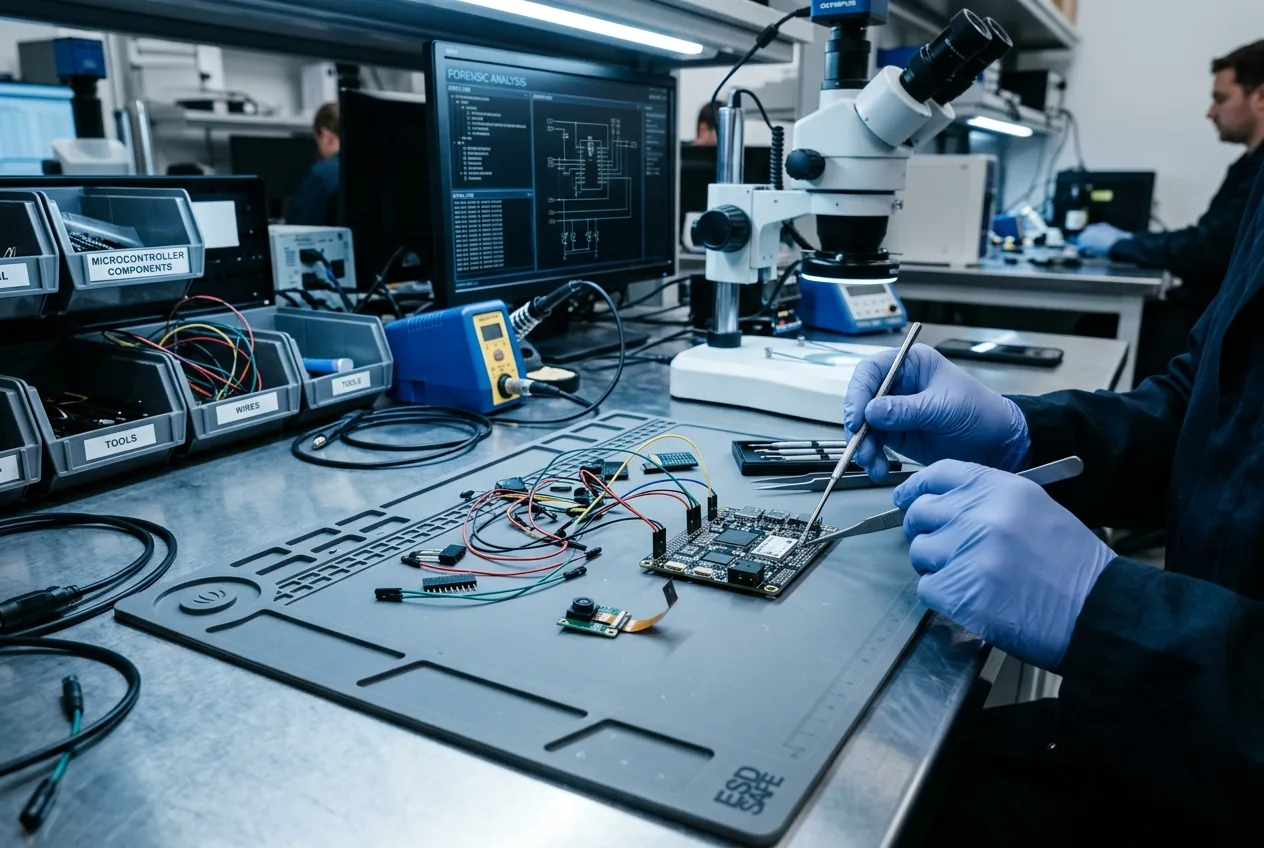
When physical security personnel at OpenAI conducted a routine sweep of an executive conference room in late September, they were not looking for software vulnerabilities or unauthorized API calls. Instead, their sweep uncovered something straight out of twentieth-century espionage: a physical bugging module, wired with a digital microphone, a camera sensor, and localized flash storage, taped directly behind a high-definition monitor.
Federal prosecutors have unsealed court documents detailing the arrest of Abdulrahman Alfozan, a 35-year-old Saudi national and former OpenAI engineer accused of surreptitiously intercepting confidential executive communications. The filings reveal that mere days before the Federal Bureau of Investigation took him into custody, Alfozan had booked a one-way flight out of the United States to Saudi Arabia via Istanbul for himself, his wife, and another family member. The timing of the travel arrangements, paired with the discovery of customized eavesdropping hardware in his personal possessions, has turned an internal corporate security breach into a high-stakes federal case touching on geopolitical competition, trade secret protection, and the physical security perimeter of the artificial intelligence industry.
The Anatomy of the Intercept Hardware
From an embedded engineering standpoint, the device recovered from OpenAI’s San Francisco headquarters highlights the dangerous accessibility of commercial off-the-shelf microcontroller platforms. According to the federal complaint, the module wedged behind the conference room monitor was built around components sourced from Seeed Studio, a well-known open-source hardware manufacturer that produces compact development boards used widely across robotics and Internet of Things prototyping.
The assembly featured a recording microcontroller paired with a detachable camera sensor, a digital microphone, and a microSD interface for non-volatile local storage. In a rudimentary attempt at physical isolation and vibration dampening, the hardware had been bundled into a roll of toilet paper before being fixed out of sight. Crucially, forensic examiners noted that the microcontroller’s firmware had been customized to obfuscate and encrypt data written to the storage medium, preventing immediate read-outs of the intercepted audio and video files without access to the proper decryption keys.
Modern ultra-low-power microcontrollers, such as those built on ARM Cortex-M or ESP32 architectures, present a formidable challenge to corporate counter-surveillance teams. These chips operate on milliamp budgets, allowing them to record acoustic data for days on miniature lithium-polymer battery packs, or indefinitely if spliced parasitically into the 5-volt USB servicing ports standard on commercial televisions. Because these microcontrollers do not necessarily require active Wi-Fi or cellular connections to perform continuous logging, they emit virtually zero RF signature during collection periods, bypassing standard radio frequency spectrum analyzers commonly used during commercial bug sweeps.
Agentic Systems as Operational Tools
Beyond the physical mechanics of the intercept device, the Department of Justice revealed a detail that underscores the uniquely modern nature of the breach: Alfozan allegedly spent more than a month preparing the physical installation by utilizing ChatGPT and an internal agentic AI tool. Charging documents state that the engineer leveraged these models to plan logistics and troubleshoot the operational parameters of his surveillance attempt prior to mounting the hardware on September 28.
For security architects, this disclosure confirms a growing theoretical fear regarding autonomous software agents. Frontier labs have heavily invested in deploying agentic systems internally to accelerate code development, analyze complex systems, and coordinate multi-step workflows. Yet these same multi-turn reasoning engines can be repurposed to optimize adversarial tradecraft, such as identifying blind spots in facilities, suggesting wiring harnesses for commercial electronics, or scripting custom firmware modules designed to mask storage logs.
The complaint does not disclose the precise prompts or internal system outputs Alfozan generated. However, the revelation that an internal frontier model was consulted to facilitate a physical intrusion against its own parent facility will likely force an immediate reckoning over how internal AI tooling monitors employee behavior and intent. Corporate telemetries typically flag data downloads and unauthorized database queries, but behavioral monitoring around physical site security remains a persistent blind spot in enterprise automation.
Counter-Surveillance Traps and the Chain of Custody
That counter-measure yielded direct visual evidence. In the days following the initial sweep, surveillance footage captured an individual identified as Alfozan entering the executive room and deliberately reaching behind the display monitor to check on the physical deployment of the bug. This physical interaction established the initial chain of custody required for law enforcement intervention.
The case solidified shortly thereafter when security personnel searched an unattended bag belonging to Alfozan within the facility. Inside, alongside his personal identification and wallet, investigators discovered a second, functionally identical recording device sourced from the same manufacturer. Like the first unit, this secondary hardware featured a customized microcontroller configured to obfuscate storage files, indicating a deliberate, multi-device effort rather than an isolated hardware experiment. When Alfozan subsequently reclaimed his personal belongings, he questioned security staff about missing items from his bag but explicitly avoided asking about the confiscated microelectronics.
The Geopolitical Horizon of Frontier AI Secrets
The legal team representing Alfozan has pushed back aggressively against the government’s narrative. His attorney has characterized the allegations as entirely out of character for the engineer, emphasizing that the one-way travel to Saudi Arabia was prepaid and arranged prior to his arrest, while cautioning against anti-foreign bias given his client’s nationality. Defense counsel has maintained that Alfozan was genuinely surprised by the FBI search and has highlighted that investigators have yet to present definitive evidence showing proprietary model weights, algorithms, or sensitive audio had actually been transmitted to any foreign entity or third-party server.
Nevertheless, the incident plays out against an escalating international race to acquire frontier artificial intelligence capabilities. Gulf nations, most notably Saudi Arabia and the United Arab Emirates, have committed hundreds of billions of dollars to transition their domestic economies away from fossil fuels toward computing infrastructure, advanced semiconductors, and applied AI. High-ranking regional figures have openly encouraged domestic engineering talent working in Silicon Valley to acquire frontier technical expertise before returning home to build out sovereign tech ecosystems.
The value of executive-level intelligence within OpenAI cannot be overstated. Discussions held in executive suites do not merely revolve around standard corporate administration; they dictate strategic compute allocation, compute cluster topology, breakthrough algorithmic methodologies, multi-modal alignment architectures, and government safety negotiations. For competitor nations or rival commercial entities, real-time awareness of these deliberations represents an asymmetric intelligence windfall that software firewalls alone are powerless to prevent.
Hardening the Physical Perimeter in Silicon Valley
For the broader technology sector, the Alfozan case signals an overdue transition in how advanced engineering companies conceptualize defense. For the past decade, Silicon Valley’s defense spending has concentrated almost exclusively on cybersecurity: multi-factor authentication, zero-trust network architectures, hardware security keys, and data-loss prevention software. Physical access protocols, conversely, often lean on the casual ethos of modern tech workspaces, where engineers are granted broad access across expansive campuses with standard badge credentials.
That informal paradigm is breaking under the geopolitical weight of advanced machine learning. If convicted, Alfozan faces up to five years in federal prison and a $250,000 fine under federal surveillance charges. But the lasting legacy of his prosecution will be felt inside the server rooms and conference spaces of every major frontier lab.
As autonomous intelligence and robotics edge closer to direct industrial and strategic integration, the companies developing them can no longer operate like consumer software startups. The counter-surveillance sweeping protocols, tamper-evident mounting of office hardware, and physical isolation of sensitive discussion spaces will need to match the rigor of defense contractors and classified national laboratories. In an era where a sixty-dollar maker microcontroller can jeopardize the intellectual property of a multi-billion-dollar enterprise, hardware security has abruptly returned to the center stage of technological defense.




Comments
No comments yet. Be the first!