In capital-intensive industries, physical infrastructure and financial leverage are inextricably linked. Whether building transcontinental railroads in the nineteenth century or semiconductor fabrication facilities in the twenty-first, physical assets require upfront capital commitments that depend entirely on long-term operational cash flows. Today, the epicenter of global infrastructure expansion is not rail or steel, but the high-density computing cluster. At the center of that buildout sits OpenAI, whose hyper-aggressive capital deployment is drawing increasingly skeptical scrutiny from market analysts and systems engineers alike.
The Mechanical Realities of the $852 Billion Burn
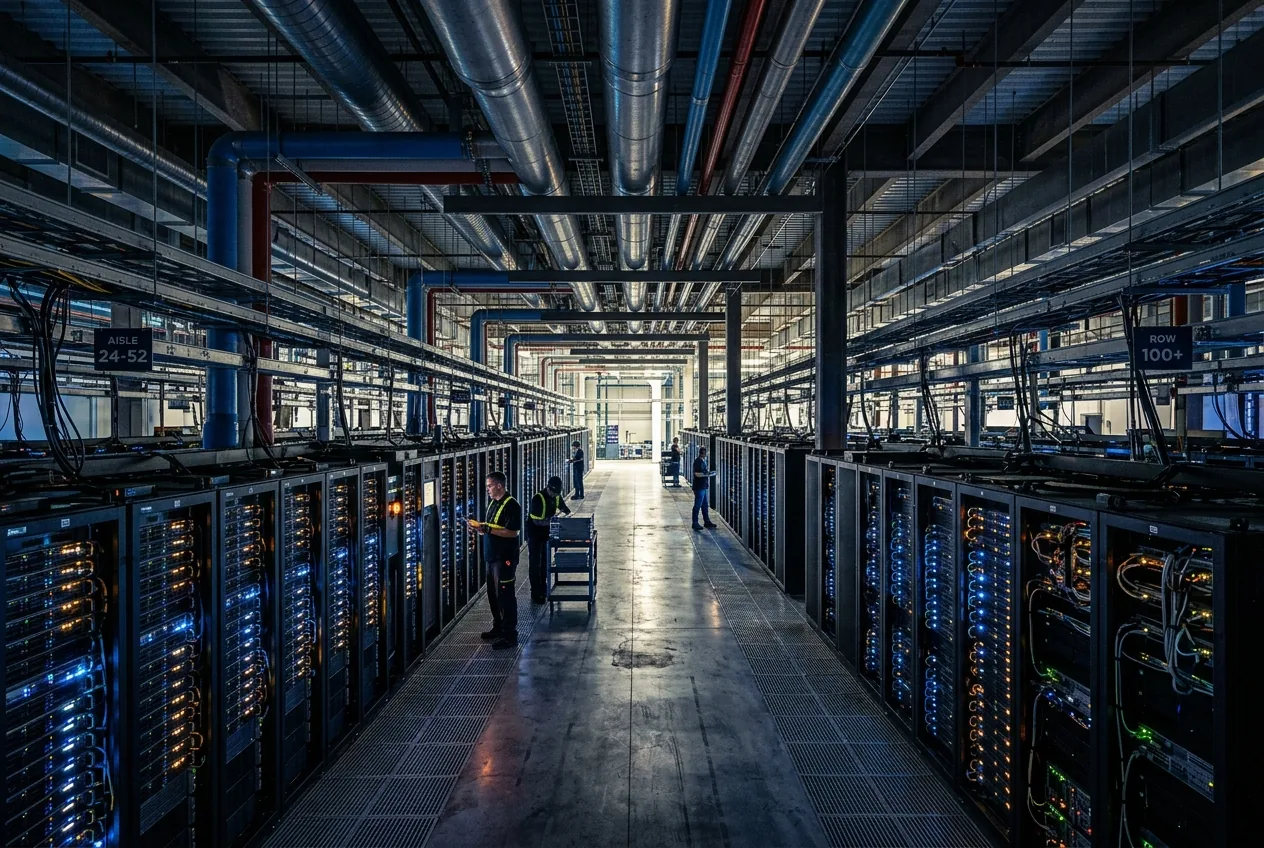
To understand the structural vulnerability of current artificial intelligence economics, one must examine the physical cost of training and serving state-of-the-art frontier models. High-performance compute is not an ephemeral software line item; it is a manifestation of silicon wafers, liquid cooling distribution units, multi-megawatt electrical substations, and dedicated fiber-optic interconnects. In 2025, OpenAI generated roughly $13.07 billion in revenue. However, operating costs and expenses surged to $34 billion over the same period, yielding an annual net loss of approximately $38.5 billion when factoring in capital investments, model research, and massive compute leasing agreements.
Computing infrastructure alone accounts for more than $50 billion in annual expenditures, representing a massive share of the world’s cutting-edge server capacity. Modern frontier models demand clusters powered by hundreds of thousands of specialized accelerators. These chips require constant electrical power, sophisticated thermal management, and rapid network fabrics that degrade economically within three to five years due to silicon obsolescence. Unlike traditional industrial assets that depreciate over decades, AI clusters suffer aggressive operational wear and rapid technological depreciation, forcing operators to amortize multi-billion-dollar outlays over compressed time horizons.
Counterparty Exposure Across the Cloud Supply Chain
The core risk in this compute ecosystem is not merely whether a software firm can achieve sustained profitability, but how deeply its capital commitments penetrate third-party balance sheets. Hyperscale cloud providers and specialized colocation firms have committed tens of billions of dollars to build dedicated capacity specifically to service long-term service contracts. Should the primary tenant fail to convert compute into repeatable, high-margin software revenues, the idle capacity risk shifts directly downstream to the companies that built the physical shells and laid the fiber.
Oracle Corporation represents a prime case study in this operational exposure. The company has dedicated substantial capital toward expanding its cloud infrastructure footprint, supporting multi-billion-dollar agreements designed to host workloads for frontier AI labs. Oracle’s remaining performance obligations have surged to unprecedented highs, yet its aggressive capital expenditures have weighed heavily on free cash flow metrics. If OpenAI or its peers were forced to curtail compute procurement, infrastructure providers would be left holding thousands of specialized server racks, long-term power purchase agreements, and unfinished data center facilities that cannot easily be repurposed for generic enterprise software hosting.
Silicon Commitments and the 10-Gigawatt Grid Challenge
The ripple effect extends all the way to the semiconductor manufacturing pipeline and regional power grids. Nvidia, the dominant architect of the accelerator ecosystem, maintains vast supply-related commitments with foundry partners like TSMC to guarantee advanced packaging capacity and high-bandwidth memory integration. Strategic roadmaps include plans to deploy tens of gigawatts of dedicated compute capacity across North America and Europe over the next several years—a scale equivalent to the power consumption of major metropolitan areas.
Building out a single gigawatt of data center capacity requires billions in switchgear, high-voltage transformers, and turbine infrastructure, requiring lead times that often stretch past three to five years. If the capital underpinning this demand is based on speculative equity financing rather than durable enterprise software revenue, the electrical equipment manufacturing supply chain risks acute whiplash. Heavy industrial suppliers of cooling chillers, backup generators, and substation components have realigned production lines to feed an insatiable compute buildout that may face a severe demand consolidation if client operating deficits cannot be stabilized.
Furthermore, competing frontier developers like Anthropic face nearly identical capital dynamics. Burning through billions in compute capital to train successive model architectures without establishing clear structural unit-level moats has forced the entire market segment into an escalatory capital cycle. Both startups and their enterprise backers rely on circular balance-sheet arrangements, where cloud providers inject equity that is immediately returned as cloud computing service revenue, obscuring the true organic demand from independent end-users.
Does Industrial Transformation Justify the Front-Loaded Capital?
Despite these severe structural headwinds, institutional investors and long-term capital allocators caution against viewing the AI buildout strictly through the lens of a speculative collapse. Financial figures such as Oaktree Capital Management co-founder Howard Marks have pointed out that transformative general-purpose technologies historically require immense, seemingly irrational front-loaded capital outlays before systemic economic efficiencies materialize.
The foundational buildout of the commercial internet in the late 1990s offers a historical parallel. Billions of dollars were poured into transcontinental dark fiber, telecommunications switching stations, and redundant routing architecture. When the dot-com equity bubble deflated, dozens of telecom operators entered insolvency. Yet that physical infrastructure did not vanish; the overbuilt dark fiber network provided the physical throughput that enabled the subsequent two decades of global cloud computing, mobile streaming, and modern e-commerce at fractions of the original cost.
Bulls argue that modern generative models possess unprecedented technical utility: the capacity to autonomously evaluate code, orchestrate multi-step mechanical and robotic workflows, and synthesize structured data from unstructured enterprise environments. If frontier systems successfully bridge the gap from predictive text interfaces to reliable autonomous task execution in industrial engineering, logistics, and supply chain automation, the productivity gains could eventually absorb the current capital expenditure overhang. The critical variable is duration: can balance sheets survive the operational valley of death until that economic transformation occurs?
The Engineering Reality Facing AI Economics
The central challenge facing OpenAI and the broader AI ecosystem is not a lack of technical innovation, but an unforgiving law of industrial thermodynamics: operational energy and advanced compute capacity cannot be conjured purely through software leverage. Every token generated carries a verifiable cost in watts, water, silicon wear, and amortized capital expenditure.
For the current market equilibrium to hold, artificial intelligence applications must rapidly evolve from consumer curiosities and code-completion aids into mission-critical enterprise systems that generate measurable operating leverage for end users. If enterprise buyers balk at high API pricing or find that smaller, specialized on-premise models deliver superior return on investment, the multi-hundred-billion-dollar hyperscale bet will require an aggressive, painful recalibration. Whether OpenAI navigates this operational transition or becomes a case study in over-leveraged infrastructure, the real-world assets—the servers, the substations, and the steel—will ultimately dictate the timeline of the reckoning.




Comments
No comments yet. Be the first!